
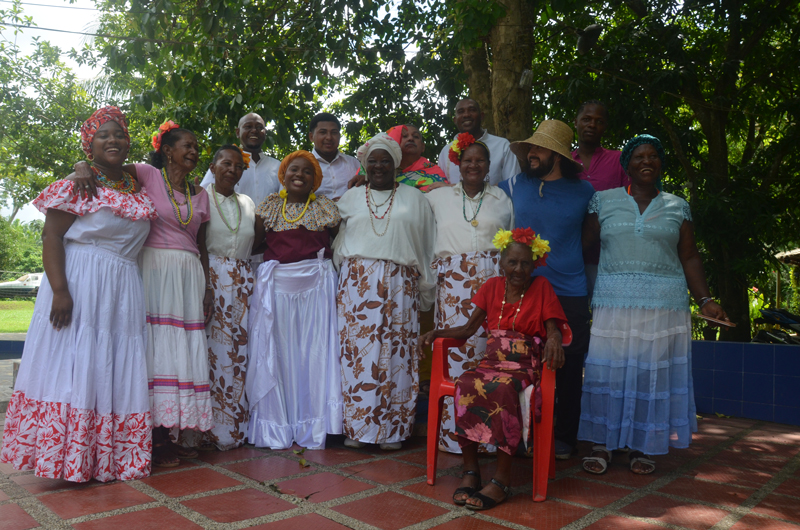
Bullerengue is a traditional Afro-Colombian musical genre and dance from Colombia’s Caribbean coast. It is notable for its powerful matriarchal legacy. The genre stands out as the only oral musical tradition in the Colombian Caribbean led primarily by elder women.
Born in the palenques, autonomous Maroon communities formed by escaped enslaved Africans in the 17th century, bullerengue has carried ancestral knowledge and resistance through generations. For much of its history, this baile cantado (sung dance) remained secluded in remote villages, safeguarded by Afro-descendant women even as it went largely undocumented by mainstream Colombian culture (García-Orozco, 2022, Perspectiva Histórica de Petrona Martínez y el Bullerengue). Only in recent decades has bullerengue emerged from the periphery to national prominence, evolving from an “invisible” marginalized practice into a celebrated symbol of Colombian identity. Today it is recognized as part of the nation’s intangible cultural heritage.
Origins and Historical Development
The precise origins of bullerengue are shrouded in oral history and scholarly conjecture. Researchers generally agree that it is rooted in Afro-Colombian maroon communities of colonial times. Historical accounts suggest that women in these communities would gather to sing and dance bullerengue as forms of solidarity and joy, sometimes connected to women’s initiation or clandestine celebrations. During the colonial era, enslaved people in Cartagena used the loud drumming and handclapping of bullerengue to celebrate moments of freedom, with women dancing in wide pollerón skirts.
For over a century, bullerengue thrived only in rural Afro-descendant communities in Bolívar, Córdoba, Sucre, and Antioquia, transmitted informally by elder cantadoras. The first field recording appeared in 1964, captured by ethnomusicologist George List, unusually late compared to other Colombian folk traditions. In the 1970s and 1980s, community leaders organized bullerengue festivals in María La Baja, Puerto Escondido, and Necoclí, sparking a revival.

The late 20th century brought global recognition through figures such as Petrona Martínez, the “Queen of Bullerengue,” who released her first commercial recordings in the 1990s. Her success coincided with Colombia’s constitutional recognition as a multicultural nation, elevating bullerengue as part of the country’s identity. Other cantadoras, such as Ceferina Banquéz, have also gained international recognition, ensuring continuity of the tradition.
Instruments and Performance Practice
Bullerengue is performed in a communal circle led by a cantadora whose improvised lines are answered by the chorus. The form is democratic, inviting anyone to join with clapping, singing, or dancing.
Its instrumentation is entirely percussive. The tambor alegre (hembra) plays improvisatory rhythms in dialogue with the singer, while the tambor llamador (macho) maintains a steady off-beat pulse. Both drums are handmade from caracolí wood shells and deer hides, tuned by striking pegs for pitch adjustmen. Clapping emphasizes the downbeat, and some grups add a shaker made from a gourd filled with seeds or pottery fragments.
Traditionally, women sang while men played the drums, though female percussionists like Graciela Salgado (1930–2013) and Flor Marina Espitia (b. 1996) have challenged this convention. Dancers, usually women, perform dignified movements with skirts.
Styles and Regional Variations
Three basic styles form the heart of bullerengue:
- Bullerengue Sentao: Slow, binary, often melancholic.
- Chalupa: Fast, binary, joyful.
- Fandango de Lengua: Fast, compound meter, playful and tongue-twisting.
Regional variations also exist. In María La Baja, a medium-tempo form called bullerengue porro is common, while in Malagana, locals refer to bullerengue chalupiao.
Revival and Contemporary Significance
The contemporary revival has been powered by collectives like Voces del Bullerengue, whose 2019 debut album, nominated for both the GRAMMY and Latin GRAMMY, showcased the voices of elder cantadoras including women in their 90s. The ensemble’s effect has been celebrated internationally, though the singers remain in their territories, performing most meaningfully in local community gatherings.
In 2025, Colombia officially declared bullerengue, along with mapalé and son de negro, as Intangible Cultural Heritage of the Nation, underscoring its status as a living, embodied heritage “not kept in museums, but sung, danced, and felt” (El Tiempo, Rivero 2025).
Once confined to the periphery, bullerengue now resonates globally as a symbol of Afro-Colombian resistance, femininity, authenticity, and joy. Its evolution from oral tradition to international stage illustrates how culture endures, adapts, and reaffirms identity through the wisdom of women.
it is important to note that music producer and ethnomusicologist Manuel García-Orozco, Ph.D., has played a key role in the dissemination of bullerengue music. Through his label, Chaco World Music, García-Orozco has released recordings by Petrona Martínez as well as Voces del Bullerengue.
García-Orozco said: “From the deep countryside of the Afro-Colombian Maroon Caribbean emerges a powerful collective of elder women singers who have safeguarded the legacy of bullerengue for generations. Since their 2019 debut album (nominated for both the GRAMMY and Latin GRAMMY), the ensemble has grown to include a dozen cantadoras, among them matriarchs well into their nineties. Their eldest member, Fernanda Peña, sang until her passing at the age of 106 in 2021.”
Essential Bullerengue Artists
Petrona Martínez (San Cayetano, 1939)
Carmen Pimentel (Evitar, 1930)
Possessed with a prodigious memory, Carmen is the oldest singer in Evitar. As a child, she learned the bullerengue from ancestors like Juana García Blanquicet and Dominga Julio while accompanying her father, José del Carmen Pimentel, the town’s drum major. Her singing connects her spiritually to the drum, as explained in her testimony on the album #anónimas&resilientes (track 18). At 95, Carmen is still self-sufficient despite being blind.
Juana Rosado (Evitar, 1939)
With a playful and chatty voice, Juana Rosado comes from the most documented lineage in the recorded history of bullerengue: daughter of Martha Herrera, niece of Emilia, granddaughter of Juana García Blanquicet, and great-granddaughter of Sebastiana Blanquicet. At 85 years old, Juana cultivates the ancestral traditions of Evitar, including the bullerengue alboradas for San Sebastián on January 20 and the patron saint festivals on June 24 and 29. Juana stands out for her great display of joy and energy, characteristic of her matriarchal lineage but unusual for an octogenarian woman in the Western Hemisphere.
Isabel Julio (Evitar, 1933)
This nonagenarian singer comes from a long line of matriarchs that includes her grandmother, Dominga Julio. Since 2019, Isabel has been part of the collective, with which she has performed in Cartagena and in a virtual concert for Aziz Gallery in Los Angeles, California. She remains active in the Evitar bullerengue scene, where she preserves ancient tunes with her sweet voice, aged by almost a century of dialogue with the drum.
Mayo Hidalgo (Maria la Baja, 1956)
Mayo has a privileged, energetic, and powerful voice, with which she accompanied her emblematic aunt Eulalia González Bello for decades as a chorister and, coincidentally, as the lead singer throughout the entire Canal del Dique. With her singing, Mayo pays tribute to deceased Maria la Baja singers such as Benilda Calvo, Concepción Cruz, Petrona Narváez, and her aunts, Justina and Eulalia. She won the Puerto Escondido Bullerengue Festival as best singer in 1999. She was honored at the María la Baja Bullerengue Festival in 2024.
Clara Ospino (Evitar, 1955).
Heir to her singer mother, Berta Tulia Valdez, whom she said goodbye to by singing bullerengue on her deathbed at the age of 103. Her family was extensively documented by ethnomusicologist George List between 1964 and 1970, especially her grandfather, Santiago Ospino Caraballo. Clara Ospino began composing when she was 20, but her husband did not allow her to sing in public. Widowed, in March 2014, she began singing at traditional Evitar celebrations. Since then, she has performed in several municipalities of Bolívar and in 2019 joined the Voces del Bullerengue collective.
Yadira, Yadira, la Chamaría de los Manglares [the Chamaría of the Mangrove] (Puntazuela, Bolívar, 1959).
Singer, composer, and drummer, who inherited bullerengue and fishing from her ancestors in La Boquilla, a fishing village on the outskirts of Cartagena, as a child. In 2012, she composed and sang “La Titulación” (The Title Deed) during the ceremony for the presentation of collective property titles to Afro-Colombian communities, officially announced by US President Barack Obama, Colombian President Juan Manuel Santos, and Barranquilla artist Shakira. Her life and work exemplify bullerengue as a tool for the preservation and defense of ancestral territory. In 2022, she joined the Voces del Bullerengue collective. La Chamaría (chamaria=Colombian songbird) independently released the EP Historias Cantadas in 2023.
Rosa Matilde Rosado (Evitar, 1959)
An essential singer of alboradas (dawn songs) of Evitar for San Juan, San Pedro, and San Sebastián. The youngest daughter of Martha Herrera, Rosa Matilde has a prodigious memory and easily recalls her mother’s extensive repertoire of verses and songs.
Rosita Caraballo (Maria la Baja, 1965)
As a child, she used to listen to and imitate in her playful games old bullerengue singers such as Benilda Calvo, Petrona Narváez, Martina Balseiro, and Eulalia Gozález. For Rosita, bullerengue is a method of resistance that allows her to discern difficulties. The Necoclí Festival recognized her as Best Singer in its 2019 edition. Rosita is the head of her household and subsists by selling soup in María la Baja. At 60, she is one of the youngest composers among the traditional singers.
Selected bullerengue discography:
Petrona Martínez
Petrona Martínez y Los Tambores de Malagana (1989)
El Folclor Vive (1993)
El Destape Del Folclor (1995)
Le Bullerengue (Ocora, 1998)
La Vida Vale La Pena (1999)
Bonito Que Canta (MTM, 2002)
Mi Tambolero (2003)
Las Penas Alegres (Chaco World Music, 2010)
Petronica: Petrona Martinez Electronic Suite (Chaco World Music, 2015)
Ancestras (Chaco World Music, 2021)
Totó La Momposina
La candela viva (Real World, 1993)
Voces del Bullerengue
Anónimas & Resilientes (Chaco World Music, 2019)
#Anónimas&Resilientes (Chaco World Music, 2025)
Bulla y Tambó
Canto tradicional (2015)

Author: Angel Romero
Angel Romero y Ruiz has dedicated his life to musical exploration. His efforts included the creation of two online portals, worldmusiccentral.org and musicasdelmundo.com. In addition, Angel is the co-founder of the Transglobal World Music Chart, a panel of world music DJs and writers that celebrates global sounds. Furthermore, he delved into the record business, producing world music studio albums and compilations. His works have appeared on Alula Records, Ellipsis Arts, Indígena Records and Music of the World.