Loulé cast aside its provincial character and, for three days, became a vibrant musical capital of the world. Around 25,000 people gathered to celebrate another edition of Festival MED, which, in its twenty-first installment, once again proved that music knows no borders.
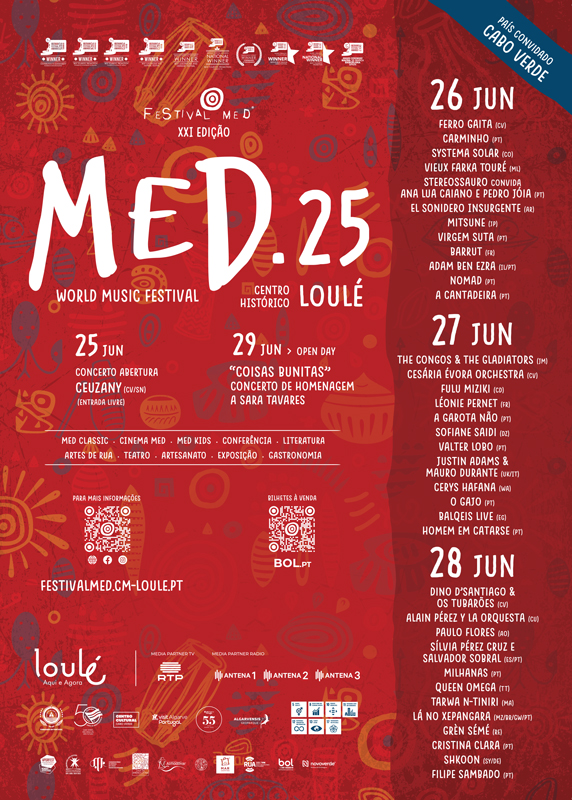
Cape Verdean artist Ceuzany kicked things off with a free performance on Wednesday, June 25, at the Castelo stage. Her boundless energy, dancing, and stage presence, driven by the powerful rhythm of coladeira, were infectious. But she also leaned into funk, morna, reggae, and soul. Supported by a tight quartet of musicians, it was clear from the beginning that something magical was brewing. Cape Verde, celebrating 50 years of independence this year, was the guest country of the festival.

By Thursday the 26th, early in the morning, Loulé’s historic center was being enclosed with metal fencing. Technicians, workers, and organizers bustled around the main stages, putting on the final touches. This small city in the Algarve region of southern Portugal, with a population of 70,000, was undergoing a transformation.
Festival MED is also one of the most affordable cultural events in Europe. With just 30 euros (if purchased in advance), a person gets access to three days of live music, featuring over 40 international artists and bands. Add to that film, western classical and jazz music, painting, literature, and gastronomy—it becomes a true celebration of the arts.
At exactly 8:30 p.m., Virgem Suta took the Chafariz stage. Founded in 2009, this Portuguese band delivered a pop-rock sound in their native tongue, laced with subtle irony and undeniable style. In “Dança de Balcão,” lead singer Jorge Benvinda raised a glass of wine while singing of a body surrendered to laziness. The crowd smiled and swayed with the lyrics. Some sang along; others raised their glasses, toasting with the wine the band had shared with the front rows. “Let’s toast to ourselves, let’s toast to our grandparents,” Benvinda declared. They were a hit.
A quick five-minute walk brought us to the Castelo stage, where Israeli musician (and now Portugal resident) Adam Ben Ezra awaited with his double bass. By his third piece, “Flamenco,” the spirit of cante jondo had overtaken him, and he passed it on to the audience with conviction. Adam is a true one-man band, using live loops and sequences, and with the addition of Cuban drummer Michael Olivera, the sound became more organic and full. “Free Fly” was fast-paced and enchanting, while “Hide and Seek” dove into darker, murkier effects as he scraped the strings with his bow. Just pure magic.
Crowds weren’t too dense on the first night, and it was not that hot yet, making it easy to move between stages. Next was Carminho, the beloved Portuguese fado singer, performing on the bigger Matriz stage. Unsurprisingly, it was packed. A dark background cloaked the musicians in shadow; the spotlight was entirely hers. Carminho sings each song as though she’s pouring out her soul. She has breathed new life into traditional fado with more modern lyrics. Perhaps her performance would’ve been better suited to a more intimate venue, but when it’s Carminho, a bigger location is always needed.

We made our way to the Cerca stage for Malian guitarist Vieux Farka Touré. He opened with two traditional acoustic songs, and the sound of the calabash added some Cuban groove to the mix. Some sound issues arose, and his frustration showed. But once resolved, the magic returned. The musical dialogue between the ngoni and his acoustic guitar delighted the audience. Then he strapped on his electric guitar, and the ngoni faded into the background; now it was all Vieux. He walked the stage with confident swagger and a smile that revealed his joy. Trading solos with his bassist and swaying with every burst of sound, the performance felt more rock than blues. The crowd loved it.
Back at the Matriz stage, we found the legendary Ferro Gaita, masters of the Cape Verdean funaná. The accordion and iron scraper were front and center, but the addition of a trombone brought unique flavor to their infectious sound. With almost 30 years of experience, the band knows how to get people dancing. The atmosphere was electric. We dashed off again, hoping to catch more acts, but sadly, seeing more performances was impossible.
We closed the night with the Colombian group Systema Solar, performing at the Cerca stage. They wasted no time connecting with the audience. Their show was an avalanche of frenzied dancing, blending hip hop, electronic beats, reggaeton, and Afro-Colombian rhythms into one explosive party. With a drummer driving the rhythm and a DJ adding pre-recorded melodies, their message, centered on environmental issues that scar their country and the whole planet, was delivered with unrelenting festivity. Songs like “Ya voy ganao,” “Rumbera,” and “Futuro Primitivo” brought the house down. ¡Sabor y guepajey!
The first day of Festival MED was filled with deep feelings, joy, and wonder. Music brought us together, offering a brief refuge from the brutal realities of war, genocide, and natural catastrophes.
More abut the festival: festivalmed.cm-loule.pt/en/

Author: Rafael Mieses
