Gryphon’s formation in early 1972 was the culmination of years of musical experimentation. Founding members Richard Harvey and Graeme Taylor first met at Tiffin Boys’ School in Kingston, England, in 1965, bonding over their shared appreciation of early European music. While Harvey leaned toward western classical influences like Ottorino Respighi, Taylor was drawn to pop, blues, and rock. Both were captivated by John Renbourn’s fusion of folk and jazz, as well as Shirley and Dolly Collins’ folk arrangements with David Munrow’s Early Music Consort of London.
Harvey, who later attended the Royal College of Music, met Brian Gulland, a former Canterbury Cathedral chorister turned National Youth Orchestra musician. Gulland, inspired by The Doors and The Incredible String Band, was eager to explore beyond the western classical realm. With Harvey’s encouragement, he embraced medieval and renaissance music, leading to collaborations in the early music group Musica Reservata.
In 1971, Harvey and Gulland formed The Spelthorne Ensemble, performing historical pieces in London restaurants. When their guitarist departed, Taylor joined, pushing the group toward a more eclectic sound. The turning point came in 1972 with the addition of drummer and vocalist Dave Oberlé, whose rock background expanded their sound. The newly formed quartet adopted the name Gryphon, laying the foundation for a distinctive mix of progressive rock and early music influences.
Their recorded story began in June 1973, when Transatlantic released Gryphon, the group’s self-titled debut, recorded in engineer Adam Skeaping’s attic. The album broadened their range with electric guitars, keyboards, and winds rarely heard in rock at the time, including bassoon and crumhorn.
That hybrid approach quickly traveled beyond the studio. Gryphon built a reputation on the UK club circuit, moving between folk and rock clubs, while also appearing at Shakespeare celebrations at St. Paul’s Cathedral and Southwark Cathedral. National attention followed in short order, with features across all four BBC Radio stations within a five-day stretch. Later in 1973, the band contributed music connected to the documentary film Glastonbury Fayre and completed a European tour. By 1974, Phillip Nestor had joined as bassist.
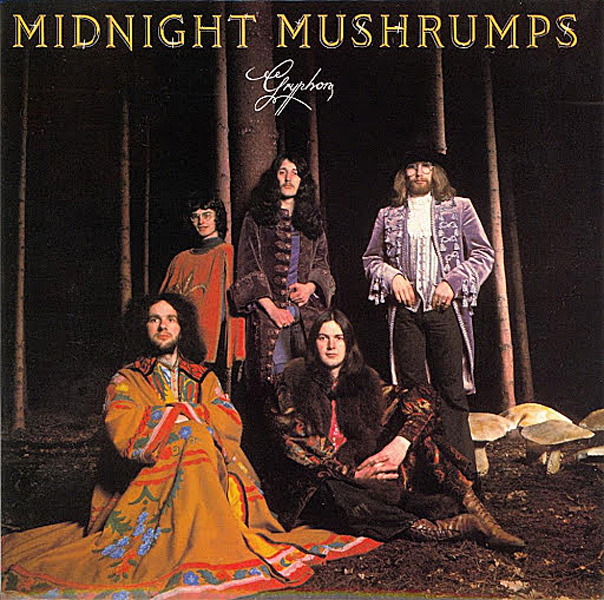
Their second album, Midnight Mushrumps, was recorded in January 1974 at Chipping Norton Recording Studios in Oxfordshire. Its centerpiece, an 18-minute title track conceived by Richard Harvey, signaled a larger, more suite-like direction. Around the same period, the band received a commission to write and record music for a National Theatre production of Shakespeare’s The Tempest, directed by Peter Hall. The production opened at The Old Vic in April 1974, the same month Midnight Mushrumps was released, and the play’s language helped inspire the album’s title. In July 1974, Gryphon returned to The Old Vic for a landmark event: the venue’s first rock-band concert.
One month later, the group recorded their third album, Red Queen To Gryphon Three, a progressive rock effort that reduced the use of non-standard instruments. A management change also took place, with Brian Lane, also manager of Yes, replacing Wright. Former Yes keyboardist Rick Wakeman introduced the band to Lane and encouraged an American label deal. Released in December 1974, Red Queen To Gryphon Three became Gryphon’s first US release via Bell Records, setting the stage for extensive touring across the US, Canada, and the UK. From November 1974 through May 1975, they opened for Yes in larger venues than they had previously played, occasionally joining the headliners onstage for encores. During that run, Malcolm Bennett replaced Phillip Nestor on bass while also contributing flute.
The next phase arrived with 1975’s Raindance, which leaned more heavily on songs and found drummer Dave Oberlé increasingly focusing on lead vocals. Personnel changes followed: Malcolm Bennett and Graeme Taylor departed to form Precious Little. Guitarist Bob Foster and bassist Jonathan Davie stepped in, while Alex Baird joined as kit drummer so Oberlé could concentrate on singing and lighter percussion. That lineup recorded the more rock-oriented Treason, released on Harvest Records in 1977.
Gryphon disbanded later in 1977, shortly after Treason was released. Members cited a loss of energy and the rise of punk, which pushed their style further from the center of attention. Richard Harvey’s expanding work outside the band, such as folk rock projects, sessions, and soundtrack assignments, also demanded increasing attention. In the same year, Harvey and Davie briefly appeared under the names Rik Mansworth and John Thomas as members of the punk/new wave “scam” group The Banned.
Decades later, Gryphon returned. In September 2007, the band announced plans for a new album after 31 years of silence. A one-off reunion performance followed on June 6, 2009, at Queen Elizabeth Hall in London, 32 years after their previous live appearance. Original members Richard Harvey, Brian Gulland, Graeme Taylor, and Dave Oberlé opened with selections from Gryphon, then welcomed Jon Davie (their final bassist, heard on Treason) and new member Graham Preskett, a multi-instrumentalist and film/production music composer.
Plans for more dates took time to materialize, but Gryphon ultimately played six shows in May 2015 and added performances in 2016, including Fairport Convention’s Cropredy Convention and a return to Union Chapel. Harvey departed in early 2016, and Keith Thompson (woodwinds) and Rory McFarlane (bass) soon joined. In September 2018, Gryphon released ReInvention, their first studio album of original material in 41 years, followed in November 2020 by Get Out Of My Father’s Car!.
Discography
Gryphon (1973)
Midnight Mushrumps (1974)
Red Queen to Gryphon Three (1974)
Raindance (1975)
Treason (1977)
ReInvention (2018)
Get Out Of My Father’s Car! (2020)

Author: Angel Romero
Angel Romero y Ruiz has dedicated his life to musical exploration. His efforts included the creation of two online portals, worldmusiccentral.org and musicasdelmundo.com. In addition, Angel is the co-founder of the Transglobal World Music Chart, a panel of world music DJs and writers that celebrates global sounds. Furthermore, he delved into the record business, producing world music studio albums and compilations. His works have appeared on Alula Records, Ellipsis Arts, Indígena Records and Music of the World.