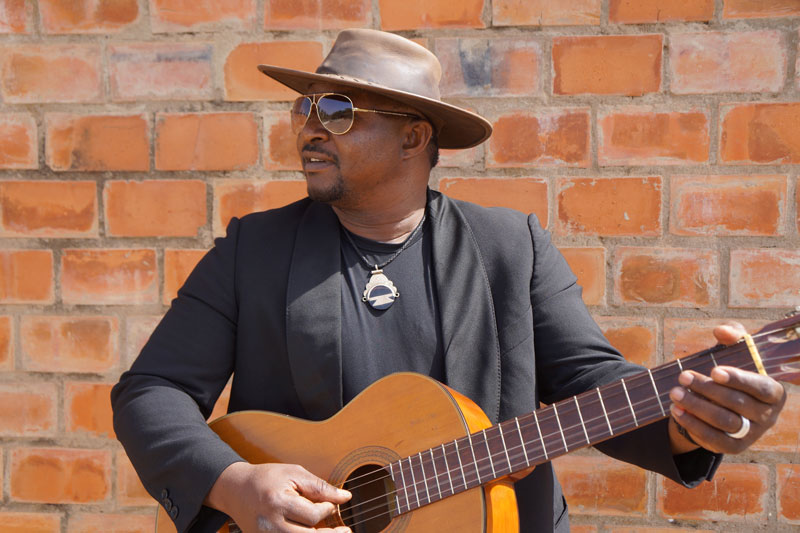
(headline image: Samba Touré – Photo by Karim Diarra)
Malian singer, guitarist, and composer Samba Touré is one of the foremost torchbearers of Songhoy blues. A disciple of the legendary Ali Farka Touré, he first toured with the late master in 1997. That experience was formative, prompting Samba to forge his own musical identity, a hybrid of traditional Malian music and American blues.
Born in 1968 in Dabi, a village in the Timbuktu region, Samba Touré grew up immersed in local music. After moving to Bamako, he began performing Zairean-inspired guitar music before falling under the spell of Ali Farka Touré. The influence was immediate and lasting: he adopted a similar guitar style and eventually joined Farka Touré’s band. In 2000, Samba launched his own group, Fondo (“departure” in Songhoy), marking the beginning of a solo career rooted in heritage yet open to evolution.
His debut album with Fondo, Songhai Blues: Homage to Ali Farka Touré, presents a mix of traditional Songhoy melodies, Niger River blues, and Western influences. The ensemble featured master musicians including Zoumana Tereta (sokou), Hamma Sankaré (calabash), and Djimé Sissoko (ngoni and tamani). Samba’s lyrics carry moral weight and celebrate everyday life in Mali. For instance, “Foda Diakaïna” honors intergenerational family bonds, while “Anbafo” invites Mali’s ethnic groups to celebrate their diversity in unity.

Crocodile Blues, released internationally in 2011, marked a creative leap. Recorded during Ramadan in Bamako, the sessions fostered a relaxed and collaborative environment. Contributors included longtime friend Baba Simaga (bass and production) and Oumar Touré (congas), with Samba’s brother Bouri Séré transitioning from modern drums to calabash for a more organic sound. The album features tributes to friends and family, as well as a duet with Oumou Sangaré on “Moussoya,” a salute to Malian women’s enduring contributions to society. The album won the 2012 Tamani Award for Best International Album.
With Wande (2018), Samba embraced spontaneity. Though intended as a return to acoustic roots, the sessions yielded a warmer, groove-oriented collection. Only two songs were pre-written: the title track, dedicated to his wife, and “Tribute to Zoumana Tereta.” Most songs emerged organically in the studio, such as “Yo Pouhala,” composed and recorded in a single day. The tama, a talking drum central to Malian tradition, takes a prominent role throughout. Samba’s preference for live takes and minimal overdubs resulted in a natural, unvarnished sound.
Binga (2021) was named after the region south of Timbuktu where he was raised. it is Touré’s most direct album. Returning to a core lineup of guitar, ngoni, calabash, and light percussion, the album strips down to essentials. The result is lean, mesmeric, and focused. Touré addresses social realities, youth migration, education failures, political instability, through songs like “Sambamila,” “Fondo,” and “Atahar.” Yet there is joy too: “Sambalama” affirms resilience, while “Kola Cissé” honors a beloved national figure. Two traditional pieces, “Tamala” and “Terey Kongo,” bookend the album.
Touré’s 2023 release, Baarakelaw (“The Workers”), shifts focus to unsung laborers in Malian society—water sellers, tailors, and housekeepers—whose contributions are essential yet often overlooked. The album combines blues-rock, psychedelia, and love ballads, including a tribute to his late wife. Here, Touré acts as an “anti-griot,” singing not for power but for the people.
Despite global acclaim, Samba Touré remains firmly rooted in his Songhoy heritage. He resists labels like “desert blues” or “African rock,” preferring to call his work “contemporary music from Mali.”
Discography:
Fondo (Camara Production, 2003)
Songhai Blues: Homage to Ali Farka Touré (World Music Network, Riverboat Records, 2009)
Crocodile Blues (Riverboat Records, 2011)
Albala (Glitterbeat, 2013)
Gandadiko (Glitterbeat, 2014)
Wande (Glitterbeat, 2018)
Binga (Glitterbeat, 2021)
Baarakelaw (Glitterbeat Records, 2025)

Author: Angel Romero
Angel Romero y Ruiz has dedicated his life to musical exploration. His efforts included the creation of two online portals, worldmusiccentral.org and musicasdelmundo.com. In addition, Angel is the co-founder of the Transglobal World Music Chart, a panel of world music DJs and writers that celebrates global sounds. Furthermore, he delved into the record business, producing world music studio albums and compilations. His works have appeared on Alula Records, Ellipsis Arts, Indígena Records and Music of the World.