
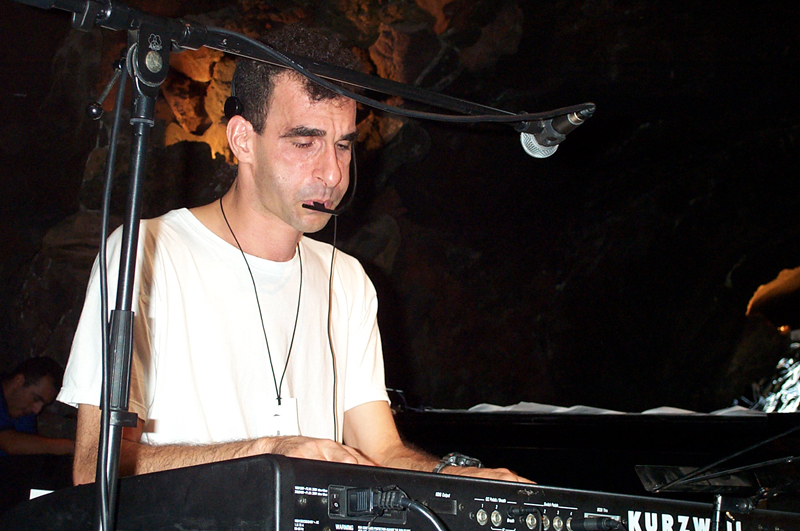
(headline image: Jamshied Sharifi in Lanzarote, Canary Islands (Spain) – Photo by Angel Romero)
Jamshied Sharifi was born October 17, 1960, in Topeka, Kansas, to an Iranian father and an American mother. At an early age, Sharifi was exposed to jazz and Middle Eastern music by his father and to European classical and church music by his mother. He began to study classical piano at age five and quickly developed a thirst for musical instruction and a desire to improvise. At age nine he began studying guitar and drums and at age ten added flute.
After graduating from the Massachusetts Institute of Technology with a degree in humanities, Sharifi went on to further his musical education at Berklee College of Music in Boston. At Berklee, he studied Jazz Piano and Composition as well as Film Scoring, and in 1983 he received of the Outstanding Jazz Pianist award at the Collegiate Jazz Festival held at the University of Notre Dame. He studied with noted trumpeter and Charlie Parker sideman Herb Pomeroy and after graduation from Berklee Pomeroy asked Sharifi to lead the MIT Festival Jazz Ensemble, a post Pomeroy had held for twenty-two years.
From 1985-1992 under Sharifi’s direction and leadership the group recorded two CDs performed twenty of his compositions and won the prestigious Notre Dame Collegiate Jazz Festival in 1991. During this time, Sharifi also taught in the Music Synthesis and Ensemble Departments at Berklee.
In 1992, he left his teaching positions in Boston and moved to New York City in search of new musical endeavors and opportunities.
Sharifi began to focus his attention on film soundtracks. His foray into the world of film and television began as a keyboardist and orchestrator for Michael Gibbs. Together they scored three feature films and fifteen one-hour television shows. Sharifi went on to compose the soundtracks to many major studio and independent films including Muppets From Space, Down To Earth, Harriet the Spy and Clockstoppers and contributed to the scores of The Thomas Crown Affair and The Rugrats Movie.

While Sharifi’s initial focus in music can be credited to American jazz, it is his infusions of elements from the Middle East and Africa that made his music distinctive. He was an accomplished pianist and synthesizer player. Notably, Sharifi held the synthesizer to an ‘acoustic’ standard and aimed to play it with the detail and richness of articulation that comes naturally to an acoustic instrumentalist. To achieve this sound, he used a controller which allowed him to manipulate the synthesizer with his breath. He combined this technique with a ribbon controller that allowed him to bend the pitch smoothly and continuously with his finger. According to Jamshied using both these techniques made the instrument a “wind-driven fretless synthesizer.”

His Alula Records debut in 1998, A Prayer for the Soul of Layla (named in honor of his daughter) was voted Best Contemporary World Music Album in the first annual New Age Voice Music Awards. The widespread critical acclaim “Layla” received sent him and his group to São Paulo, Brazil to perform at the Musica Mundial festival with artists such as Baaba Maal and Baka Beyond. “The album is a distillation of all these directions,” said Sharifi. “Because I’ve always had a lot of contact with acoustic instruments and players I have tried to hold the synthesizer up to an ‘acoustic’ standard, in other words to try and play it with the depth, detail, and richness of articulation that come naturally to an acoustic instrumentalist.”
Sharifi’s second solo album One was released April 8th 2008. Drenched in world rhythms and instrumentation, accented by contemporary Western influences. One invited the listener to journey to places off the map through its blending of cultures performers and sounds.
Sharifi invited internationally influential names to lend their voices to this momentous album. “I wanted to put together singers and musicians who wouldn’t normally perform together and see where that led” said Sharifi. “I was intentionally disrespectful of world music ‘boundaries’ hoping that the spirit of cooperation and mutual respect would prevail.”
On the opening track, “One,” Sharifi orchestrated a stage of layered instrumentation for Tibetan vocalist Yungchen Lhamo to weave intricate vocal melodies. “My thought was that this track would set the tone of the whole project” explains Sharifi. “By combining performances of Yungchen Lhamo and a West African singer, it would define the space in which my project would live.”
Yungchen who was encouraged directly by the Dalai Lama to share her inimitable voice to the world was joined by Malian vocalist Abdoulaye Diabate. On the passionate “Darfur Is Burning,” a response to our and the world’s inaction in the face of what can only be called genocide, Diabate’s soulful vocals pleaded over the delicate kora playing of Mamadou Diabate.
Grammy Award winner Paula Cole lent her well-known voice to “My Grandfather The Tree” and “A Charlotte Sky,” which Sharifi wrote for Cole’s daughter with Hassan Hakmoun who joined Cole on the track.
Hakmoun performed on two other songs, including the album’s closing track “Requiem” which was written at the request of John Diliberto at Echoes soon after 9/11. Sharifi invited Irish whistle player Seamus Egan of the band Solas to play the melody and Hakmoun to sing the brief lament in the middle of the song. “It’s worth remembering that 9/11 has been for most Muslims a tragedy as well.”
Also appearing on the album were critically acclaimed vocalist Sussan Deyhim of Tehran and North Indian vocalist Vishal Vaid. Remarkably Vaid infuses his performances with the ancient technique of Ghazal singing, creating the perfect counterpart to Sharifi’s compositions.
In addition to creating his own albums and scoring films, Sharifi produced and arranged albums for many artists, including Tibetan vocalist Yungchen Lhamo and Persian vocalist Mamak Khadem. He also recorded four albums with world fusion band Mo Boma.
Jamshied Sharifi won a Tony Award in 2018 for orchestrating the stage adaptation of The Band’s Visit.
Sharifi passed away died on August 15, 2025, at the age of 64, after a long battle with cancer.
Discography:
A Prayer for the Soul of Layla (Alula Records, 1998)
One (Ceres, 2000)

Author: Angel Romero
Angel Romero y Ruiz has dedicated his life to musical exploration. His efforts included the creation of two online portals, worldmusiccentral.org and musicasdelmundo.com. In addition, Angel is the co-founder of the Transglobal World Music Chart, a panel of world music DJs and writers that celebrates global sounds. Furthermore, he delved into the record business, producing world music studio albums and compilations. His works have appeared on Alula Records, Ellipsis Arts, Indígena Records and Music of the World.