(headline image: Making The Accordion Great Again: Liberty Bellows exhibition – Photo by Angel Romero)
Few instruments move as fluidly through working-class dance halls, classical and jazz stages, and religious processions as the accordion. Ethnomusicology treats it as a family of free-reed aerophones bound by bellows and reeds, adapted by regional aesthetics, repertories, and maker traditions. The modern accordion emerged in early nineteenth-century Vienna. From there, it disseminated throughout Europe and the Americas, where local builders and players refashioned it for polkas, tango, forró, zydeco, conjunto, and beyond.
Cyrill Demian and his sons presented a compact “accordion” in Vienna on May 6, 1829. Soon after, the patent was granted May 23 of that year. Demian’s device produced ready-made chords with a handful of buttons, an approach that accelerated adoption among amateurs and itinerant musicians. The novelty of the small, diatonic, bisonoric format contributed to its rapid spread due to price and portability. Debates persist over precursors, especially the Asian mouth-organ lineage and contemporaneous European free-reed experiments. However, the 1829 patent signified the first official use of the term “accordion.”

Instrument builders converged on a fundamental set of materials whose combinations strongly affect response and timbre: hardwood cases and frames; steel reeds riveted to reed plates of zinc or aluminum; leather or synthetic valves; and composite coverings. German and Italian factories popularized celluloid cladding for durability and visual sheen, while specialty makers continued natural-wood finishes. Russian bayan makers diverged in reed engineering by mounting rectangular reeds on large plates without wax, a practice documented in technical surveys and performer testimony.
Across the Atlantic, in Argentina, the bandoneon used steel reeds, multi-ply bellows of card stock reinforced with fabric or leather, and metal corner plates. Traditional bandoneon buttons were often made of casein, a milk-derived plastic widely used in Europe. Modern accordions use plastic and metal, for buttons although they may also use materials such as ivory, imitation ivory, or mother-of-pearl.
Museums in Trossingen, the historic home to the iconic Hohner brand, hold extensive archives showing the industrialization of reed instruments and the interplay between material choice and mass production. These collections underpin much of what we know about fabrication standards and the growth of amateur orchestras in German-speaking Europe.
Accordion Variations
German-Austrian Lineages
German sources draw a straight line from Demian’s Viennese “accordion” to regional diatonic types such as the Steirische Harmonika, a bisonoric, button-key instrument with deep bass notes central to Alpine dance music. This accordion is common across Bavaria, South Tyrol, Slovenia, and Bohemia.

The Russian Bayan
The bayan, often conflated with “chromatic button accordion,” formed its own tradition in the Russian Empire and Soviet Union. Its design, especially reed plates mounted without wax and distinctive reed geometry, separate the bayan from Western European chromatic instruments and supported a twentieth-century shift from folk to concert repertories.
The Río De La Plata Bandoneon

The bandoneon’s design originated in mid-nineteenth-century Germany and was widely adopted in Buenos Aires and Montevideo. The Rheinische Tonlage keyboard became fundamental in tango, while makers such as ELA and Alfred Arnold supplied the instruments that Argentine and Uruguayan bandoneonistas still prize.
North America: Dance Floors And Diasporas
In northern Mexico and South Texas, late-nineteenth-century inflows of inexpensive one-row German accordions catalyzed conjunto/norteño styles. Tejano musicians adapted the diatonic button accordion for polka-derived dance repertoires, later electrifying ensembles while keeping the accordion as a lead voice.
South Louisiana developed distinct but neighboring scenes. Cajun and Creole communities favored robust single-row diatonic instruments for loud, unamplified dance settings. Zydeco players modernized the instrumentation but kept the accordion as a fundamental instrument, a tradition kept visible through centennial retrospectives of artists such as Clifton Chenier.
Brazil
Brazil’s Northeast installed the sanfona at the heart of forró trios along with zabumba and triangle. Luiz Gonzaga’s work articulated regional identity nationwide by mid-century.
Atlantic Crossings And Isles
Scotland’s dance-band culture elevated the chromatic button and piano accordion in ceilidh and country-dance settings, with figures like Jimmy Shand (1908 – 2000) shaping style and instrument design in partnership with manufacturers.
Central European Cousins
Chemnitzer concertinas, close relatives of the bandoneon, migrated with Central-European communities to the American Midwest, where builders expanded keyboard ranges and created a distinctive polka scene.
Vallenato
Colombian vallenato offers one of the great accordion traditions of the world. The accordion is celebrated in national and regional competitions.
The Accordion In World Music Today
Archives and museums testify to a century-plus of amateur orchestras, factory innovation, and repertoire development. Meanwhile, living traditions, from tango’s bandoneon schools to northeastern Brazilian forró to Tex-Mex conjunto, continue to commission new instruments, publish method books, and populate festivals. Recent obituaries, tributes, and tours underline both continuity and change: icons pass, yet styles renew themselves through pedagogy, media, and lutherie.
Based on how notes are produced there are two types of accordions:
Chromatic Accordion: a unisonoric instrument, meaning each button or key produces the same note whether the bellows are pushed or pulled. The chromatic accordion is the most popular in mainland Europe and Russia. It is frequently used in European folk, pop, and rock.
Diatonic Accordion: a bisonoric instrument where each button produces two different notes: one when the bellows are pushed and another when they are pulled. Diatonic accordions are the most widespread accordion in the Americas. They are typically smaller than the chromatic, and are popular in folk, vallenato, norteño, pop, and rock.
Based on the keyboard type used on the melody-side of the accordion, there are two variations:
Piano Accordion: features a piano-style keyboard on the right for the melody.
Button Accordion: uses buttons on the right for the melody, which can be either chromatic or diatonic.
Accordion Diversity
The accordion is known by a variety of appellations in English and numerous other languages. Beyond the standard diatonic and chromatic forms, several smaller instruments have evolved from the accordion, each reflecting distinct stages in its organological and cultural development:
Concertina: A smaller, hexagonal or square-shaped squeeze-box with buttons on both sides, often considered a smaller cousin of the accordion.

Bandoneon: A type of concertina with a different tuning and a deep, melancholic sound, commonly associated with tango music.

Accordion names and variations include: acordeón, bayan, bandoneón, button box, concertina, fisarmonica, fueye (bandoneón), garmon, melodeon, organetto, sanfona, squeezebox, Steirische Harmonika, and trikitixa.
Top Accordionists in the World Music Scene
Bandoneón:
Aníbal Troilo (1914-1975), Paquita Bernardo (1900-1924), Astor Piazzolla (1921 – 1992), Leopoldo Federico (1927 – 2014), Juan José Mosalini (1943 – 2022), Julio Pane (1947 – 2024), Raúl Jaurena (1941 – 2021), Néstor Marconi, Jun Pablo (JP) Jofre, Omar Massa, Camilo Ferrero, Marco Antonio Fernández, Luciano Sciarretta, Walter Castro, Alejandro Zárate, Carlos Corrales, Federico Pereiro, Marcelo Nisinman, Carlos Rulfi, Sebastián Martínez, Gabriel Fernández, Víctor Hugo Villena, Pablo Mainetti, Luis Di Matteo, Horacio Romo, Eleonora Ferreyra, Mariano Cigna, Eva Méndez, Bandoneonas (Abril Farolini, Sandra González, Alejandra Genta), Ayelén Pais, Milagros Caliva, René Marino Rivero.
European accordionists:
Maria Kalaniemi (Finland), Phil Cunningham (Scotland), Borja Rodríguez (Spain), Sharon Shannon (Ireland), Alan Kelly (Ireland), Maírtín O’Connor (Ireland), Richard Galliano (France), Jimmy Keane (Ireland), Markus Räsänen (Sweden), Vladimir Mollov (Bulgaria), Riccardo Tesi (Italy), Andrés Penabad (Spain), Zoltan Orosz (Hungary), Aleksandar Sofronijević (Serbia), Frode Haltli (Norway), Petar Ralchev (Bulgaria), Gianni Ventola Danese (Italy), John Whelan (UK), Bengan Janson (Sweden), Bruno Monardo (Italy), Bruno Marzano (Italy), Valentina Di Francesco (Italy), Enzo Scacchia (Italy), Matteo Tortora (Italy), Gudrun Walther (Germany), Mario Stefano Pietrodarchi (Italy), Gorka Hermosa (Spain), Raúl Díaz de Dios (Spain), Inés Romero (Spain), Jorge Arribas (Spain), Félicien Brut (France), Théo Ould (France), Marcel Loeffler (France), Daniel Colin, Erwan Mellec (France), Karen Tweed (UK), Ludovic Beier (France), Conan Mc Donnell (UK), Mirella Murray (Ireland), Martin Tourish (Ireland), Michael Tennyson (UK), Colin McGill (Ireland), Martin Power (Ireland), Declan Payne (Ireland), Dónal Murphy (UK-Ireland), Shane Mitchell (Ireland), Conor Keane (Ireland), Jackie Daly (Ireland), and Vincent Lhermet (France).
American Accordionists:
John Williams (USA), Dan Newton’s Cafe Accordion Orchestra (USA), Alan Bern, Joshua Horowitz,
Cajun-style accordion: Amédé Ardoin (1898 – 1942), Lawrence Walker (1907 – 1968), Jimmy Breaux, Steve Riley, Andre Michot, Wayne Toups, Wilson Savoy, Jesse Legé, and Sheryl Cormier.
Tejano accordion: Paulino Bernal (1939 – 2022), Flaco Jiménez (1939 – 2025), Esteban “Steve” Jordan (1939 – 2010), Ramón Ayala (Ramón Covarrubias Garza), Sunny Sauceda, Michael Guerra, Josh Baca, Blas Corral, Albert Zamora, Rick Garza Jr., Jaime DeAnda, Eva Ybarra, Mickey Mendoza.
Zydeco: Clifton Chenier, Jeffery Broussard, Buckwheat Zydeco, Mike Broussard, Geno Delafose, Rockin’ Sidney Simien, Rosie Ledet. and Lawrence Walker.
Concertina:
Cormac Begley (Ireland), Mohsen Amini (Scotland), Noel Hill (Ireland), Mary MacNamara (Ireland), Edel Fox (Ireland), Rachel Hall (England), Jackie Daly (Ireland), John Kirkpatrick (England), Cohen Braithwaite-Kilcoyne (England), and Andy Turner (England).
South American:
Brazilian sanfona: Renato Borghetti, Luizinho Calixtoo; Toninho Ferragutti; Gabriel Levy, who blends accordion with jazz and other styles; and Carol Benigno.
Argentine chamamé: Horacio “Chango” Spasiuk,
Vallenato accordion:
Iván Zuleta, Rolando Ochoa, Israel Romero “El pollo Isra”, Diana Burco (Diana Marcela González Becerra), Gregorio Uribe, Yeime Arrieta Ramos, Franco Argüelles.
Vallenato kings winners: Alejandro Durán (1968), Nicolás Elías ‘Colacho’ Mendoza (1969), Calixto Ochoa (1970), Alberto Pacheco (1971), Miguel López (1972), Luis Enrique Martínez Argote (1973), Alfredo Gutiérrez (1974), Julio de la Ossa (1975), Nafer Durán (1976), José María Ramos Rodríguez (1977), Alfredo Gutiérrez (1978), Rafael Antonio Salas (1979), Elberto ‘El Debe’ López (1980), Raúl ‘El Chiche’ Martínez (1981), Eliécer Amado Herrera Ochoa (1982), Julio César Rojas Buendía (1983), Orangel ‘El Pangue’ Maestre (1984), Egidio Rafael Cuadrado Hinojosa (1985), Alfredo Gutiérrez (1986), Nicolás Elías ‘Colacho’ Mendoza (1987), Alberto ‘Beto’ Villa Payares (1988), Ómar Geles (1989), Gonzalo Arturo ‘El Cocha’ Molina Mejía (1990), Julián Rojas (1991), Álvaro López (1992), Alberto Constantino Rada Ospino (1993), Julio César Rojas Buendía (1994), Freddy Sierra (1995), Juan David Herrera (1996), Gonzalo Arturo ‘El Cocha’ Molina Mejía (1997, Rey de reyes, segunda generación), Saúl Lallemand (1998), Hugo Carlos Granados (1999), José María Ramos Navarro (2000), Álvaro Meza Reales (2001), Navín José López Araujo (2002), Ciro Meza Reales (2003), Harold José Rivera Febles (2004), Juan José Granados (2005), Alberto ‘Beto’ Jamaica Larrota (2006), Hugo Carlos Granados Córdoba (2007), Christian Camilo Peña (2008), Sergio Luis Rodríguez (2009), Luis Eduardo Daza Maestre (2010), Almes José Granados (2011), Fernando Rangel Molina (2012), Wilber Mendoza Zuleta (2013), Gustavo Adolfo Osorio Picón (2014), Mauricio de Santis (2015), Jaime Dangond Daza (2016), Álvaro López Carrillo (2017), Julián Mojica Galvis (2018), Alfonso ‘Poncho’ Monsalvo Baute (2019), Manuel Vega Vásquez (2020), José Ricardo Villafañe (2021), Almes Guillermo Granados (2022), Javier Matta Correa (2023), Jaime Luis Castañeda Campillo (2024), Iván Zuleta (2025).
It’s important to note that this list of accordionoists is not all-inclusive; many other exceptional accordion players exist.
Making The Accordion Great Again
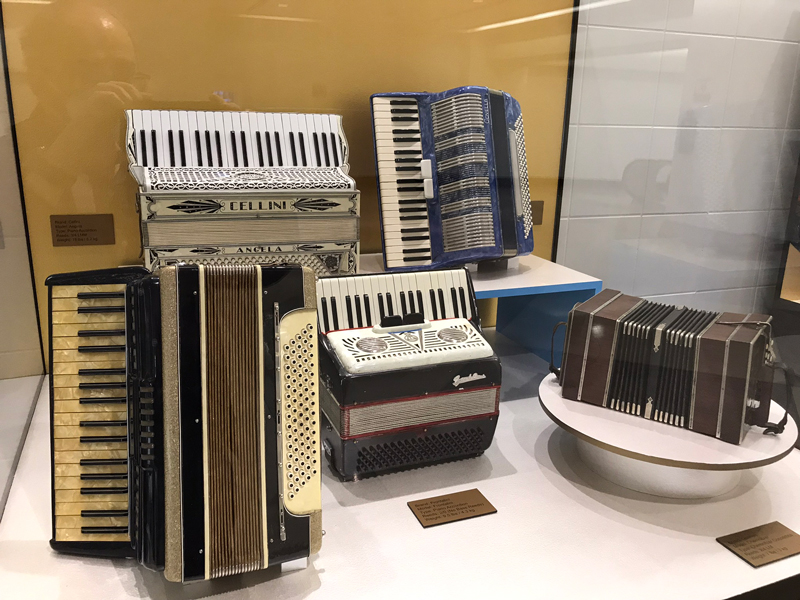
The exhibition Making The Accordion Great Again: Liberty Bellows took place at the Philadelphia International Airport from March 25, 2022 – December 8, 2022. The exhibition featured various displays of different types of sccordions.


Liberty Bellows, founded by Mike Bulboff, grew out of his discovery of an accordion in his father’s attic while he was in high school. His early interest in the instrument developed into a professional focus on introducing the accordion to contemporary players. The shop is widely regarded as the largest accordion store in the United States, with an inventory of more than 1,000 instruments.
Liberty Bellows specializes in piano, chromatic, diatonic accordions and concertinas. The store also provides repair services, online and in-person lessons led by its artist-in-residence, and instructional video demonstrations. Bulboff notes that the accordion appears in many styles, including classical, Cajun, folk, jazz, polka, klezmer, pop, rock, tango, traditional Irish music, and Zydeco. The business aims to make the accordion more accessible and to support a community of players so the instrument remains active for future generations.
Compilations:
Books
- The Accordion in the Americas: Klezmer, Polka, Tango, Zydeco, and More! (Music in American Life)
- Accordion Revolution: A People’s History of the Accordion in North America from the Industrial Revolution to Rock and Roll
- Squeeze This!: A Cultural History of the Accordion in America (Folklore Studies in Multicultural World)
- Made in Louisiana: The Story of the Acadian Accordion
- Hal Leonard Accordion Method

Author: Angel Romero
Angel Romero y Ruiz has dedicated his life to musical exploration. His efforts included the creation of two online portals, worldmusiccentral.org and musicasdelmundo.com. In addition, Angel is the co-founder of the Transglobal World Music Chart, a panel of world music DJs and writers that celebrates global sounds. Furthermore, he delved into the record business, producing world music studio albums and compilations. His works have appeared on Alula Records, Ellipsis Arts, Indígena Records and Music of the World.