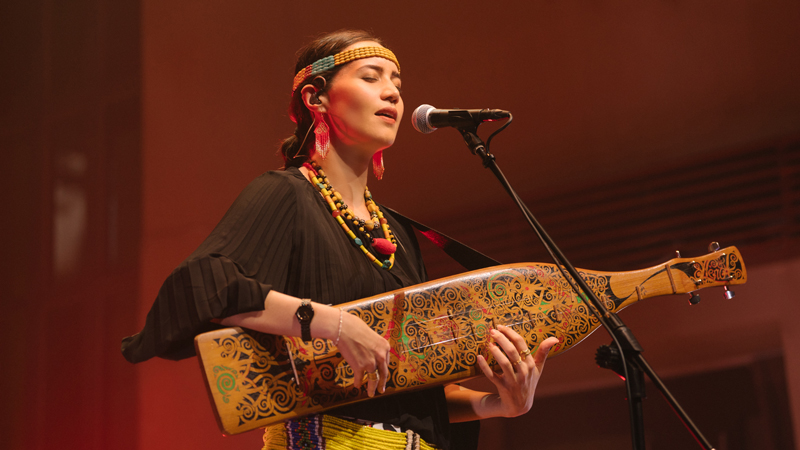
(headline image: Alena-Murang – Photo by Yu Chung Chen)
Nothing conjures the essence of Sarawak quite as eloquently as the sound of the sapé. The boat-shaped lute echoes the serene and intriguing atmosphere of its homeland. On the island of Borneo, the Malaysian state boasts many proponents of sapé-based music today, across many ethnic groups. But by the late 90s, the art was almost lost to time. Local icon of the sapé, Mathew Ngau Jau along with his uncle Uchau Bilong sparked a musical revival. The tradition is again alive and thriving in the hands of a new generation. Stages at the annual Rainforest World Music Festival feature solo artists and groups playing the old songs and modern interpretations. They perform ceremonial dance and share ancient legends, often adorned in tattoos of traditional designs.

Alena Murang has carved a stellar career as a renowned singer, songwriter, artist and sapé player. Her connection to her father’s indigenous Kelabit heritage drew her to Mathew (of the Orang Ulu Kenyah ethnic group) as a potential teacher. She was among Mathew’s first students and the first females to learn how to play sapé.

“I learnt alongside six girl cousins of mine,” she explains. “From what I understand from Uncle Mathew, we were actually his very first students. When we asked him if he would teach us sapé, he actually did not say ‘Yes’ straight away. He went home and thought, ‘Should I be teaching these young girls sapé? What’s the community going to say about me?’ Because girls aren’t even supposed to touch sapé. But no-one from his generation was learning how to play, so he wanted to teach. We had those early lessons at different cousins’ houses and sometimes at my mum’s English center. [In Kuching, Sarawak’s capital.] We were different age groups, going to different schools. We really enjoyed the chance to catch up with each other every weekend. Sometimes for an hour, sometimes three, with breaks in between. Many of us did study other instruments – some studied piano and I studied classical guitar. So, we knew how to read notes. But with sapé and with Uncle Mathew, there were no notes to be read. Nothing written down on paper. We watched what he was doing, listened and just imitated him. Uncle Mathew did not know western notation – no CDEFG, no ‘do re mi fa so…’ So, we were tuning to whatever pitch his sapé was tuned in and all tuned to each other. There were no names for the notes. Sometimes he would vocalize the notes. Some classes, he would record cassettes tape for each of us to take home and study. He also taught us how to sing.”

“Personally, I don’t remember hearing feedback from other elders directly. We would hear it from our mothers. I think a lot of elders were very impressed and encouraging that sapé was being picked up again. But there were a few who didn’t think it was appropriate. Because firstly, it was taboo for young girls to touch sapé. Also, because of singing certain types of songs that were probably a little bit linked to the pre-Christian times. So, our mothers told us about that but shielded us from ever having to deal with it. I still to this day receive feedback from my elders which is [Alena laughs] interesting… “
Mathew Ngau Jau, also an artist and instrument maker, has been honored with many prestigious awards. Most recently, he and Alena were chosen to be featured in the Hall of Fame at the Malaysian Pavillion for World Expo 2025 in Osaka. Both convey their love of nature and advocacy for environmental preservation. Alena would later train under the guidance of Saloman Gau, another sape’ master. While Alena writes songs incorporating contemporary pop-folk influences, her dedication to heritage and storytelling remains. Her performances include compositions from solo recordings (Flight, Sky Songs) alongside familiar songlines from the past, such as ‘Liling’ and Lan E Tuyang’.
“When I was very young, I did not hear sapé being played by relatives. I am Kelabit and Kelabit people live very closely to Kenyah, so traditionally a lot of culture was exchanged but not many Kelabit people played sapé. There were a few, although I never got to meet them. But I always heard stories about them. My dad had one of their sapés at home, but he doesn’t play. I remember, when I was about eight, meeting Sarawakian sapé master Tusau Padan when he was very, very sick. We went to his house to visit him. I didn’t hear him play, but I knew who he was. My earliest memory of hearing sapé was hearing his CD Masters of Sarawakian Sapé. [Recorded by Randy Raine-Reusch] My cousins and I were learning the dances that went along to sapé music. So, my weekends were filled with that recording. I thought it was beautiful and that’s why I then decided to learn how to play.”
“I also heard it at the first Rainforest festival when I was nine. I do remember seeing Uncle Mathew there. And in later years, Jerry Kamit on the contemporary sapé. I think maybe at that age, I didn’t really know it was a dying instrument or its significance because, for me, it was my world. I was always surrounded by it. In a way, it always reminds me of home.”
Originally, sapé had only 2-4 strings. New models bear six or more. “Now, I still play some form of traditional sapé as compared to more contemporary sapé,” Alena says. “More to Uncle Mathew’s style. That is four strings, in pentatonic scale. The frets are movable, so sometimes I can have a minor note in there. Mine was custom-made by a sapé maker in Miri, Matt Linggi. He doesn’t make very many sapés because he works offshore. I asked for Adau wood, the original wood of the sapé. It has a very nice sound. I asked for it to be a bit thinner than usual so it’s a bit lighter. But I still wanted a big resonance. I didn’t ask him to, but he put my name on the head of the sapé. It’s kind of nicely camouflaged within the traditional design. So, it’s not too obvious. I use guitar strings now. When I first started learning, I was using fishing line. [Mathew says, “In older days with the healing ritual of the shaman, the strings were fashioned from the fibers of a jungle vine. From the iman tree, a type of creeper from the jungle. Like hair, black in color.”] Then later I got an acoustic pick-up installed by a luthier in Kuala Lumpur. It picks up the resonance of the sapé. I used to have an electric one and that picks up the sound of the strings. I wrote my latest song ‘Borneo Rain’ actually starting on the guitar, which I’ve never done before, so it was nice to pick up the guitar again.”

As the first woman to professionally play the sapé of Borneo’s highland people, Alena has charmed audiences in 20 countries, from Iceland to Australia, Thailand, and the USA. Her videos capture the unique lure of the elements, where all are welcome in the land of the longhouse.

Author: Chris Lambie
