
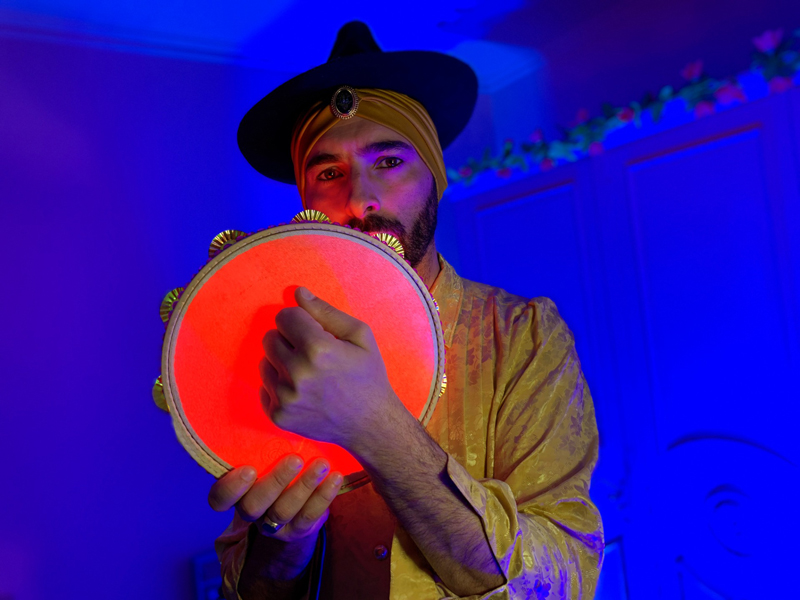
Xurxo Fernandes, a Spanish artist from A Coruña, is recognized for his innovative contributions to ethnomusicology and traditional music. Since the age of 14, he has conducted extensive fieldwork in Galician villages, documenting oral traditions and hand percussion techniques passed down by the pandeireteiras—female tambourine players central to Galician folk culture. Over time, his research extended beyond regional borders, leading him to explore musical traditions in countries formerly part of the Ottoman Empire. This expanded focus allowed Fernandes to build a unique artistic perspective that bridges Galician and Sephardic musical heritages. Notably, he is fluent in Ladino, a Judeo-Spanish language he actively incorporates into his work.
Fernandes leads several musical projects, including Radio Cos, which released two albums, and Pandeireteiras Sen Fronteiros, a collective that fuses Galician rhythms with global traditions. He also spearheads creative initiatives such as Jako el Muzikante, inspired by the café amán culture of the 1920s, and Levaino!, a performance that unites his Galician and Eastern influences.
Radio Cos featured Xurxo Fernandes (vocals, percussion) and Quique Peón (vocals, percussion). They conducted ethnographic research in Galicia and toured throughout Spain performing melodies extracted from their archives of field recordings. With their first album, Sete Cuncas (Fol Música, 2013), they established themselves as one of the most interesting projects in Galician music.
Notably, Radio Cos performed at the official WOMEX 2016 showcase, the leading world music conference in the globe. Their band featured Pedro Lamas on bagpipes and soprano saxophone; Nikolay Velikov on violin; and Xan Pampín on accordion.
In 2019, Fernandes released Ven al Luna Park, the debut album of his alter ego Jako el Muzikante. This project pays tribute to early 20th-century Sephardic urban music, particularly that of displaced communities in the Eastern Mediterranean following the collapse of the Ottoman Empire. Drawing inspiration from the café amán, underground music venues frequented by outcasts, refugees, and artists, Ven al Luna Park evokes a forgotten era of hybrid identities and cultural fusion. These cafés, often located in port cities like Thessaloniki and Izmir, became melting pots where Greek, Turkish, Armenian, Slavic, and Sephardic Jewish traditions intertwined. In these spaces, music served both as survival and resistance.
Jako el Muzikante emerges from this historical backdrop as a fictional yet historically grounded character: a roguish Sephardic dandy who ekes out a living performing at weddings and bar mitzvahs, while scheming among the intoxicated patrons of the café amán. Many of the melodies featured on the album had faded from collective memory due to the traumatic displacements of the early 20th century. However, Fernandes has recovered several of these pieces through oral histories and archival research, breathing new life into a repertoire that resonates with contemporary longings for identity, exile, and continuity.
The artist’s connection to Sephardic music began serendipitously at the turn of the millennium, when he encountered Bulgarian musicians speaking a variant of archaic Spanish at an airport. This chance meeting sparked a deep interest in the Judeo-Spanish diaspora. Subsequently, Fernandes traveled to Israel and Turkey to study the musical and linguistic remnants of Sephardic communities expelled from Spain in the late 15th century. He applied the same ethnographic rigor that once guided his exploration of Galician folk traditions to the study of early 20th-century Sephardic repertoire.
Today, Fernandes stands out as the only young artist capable of speaking and writing fluently in Eastern Ladino. One track on the album, originally performed by Rosa Askenazi, was translated by Fernandes from Greek into Ladino, showcasing his linguistic skill and historical sensitivity. His command of this language, marked by its mix of Old Spanish, Turkish borrowings, and French influence, enriches the authenticity of the project.
Ven al Luna Park is not only an album but a comprehensive cultural artifact. It takes the form of a book-CD set, richly documented and written in three languages: Ladino, English, and Hebrew script (Rashi). Produced by Fernandes himself, it represents the first fully realized project dedicated to reviving the urban music of Spanish-Jewish descendants. The title references the phrase “Luna Park,” a term for amusement parks that entered multiple languages, including Polish, Dutch, and Turkish, after the original Luna Park opened in Coney Island in 1903.
The album was recorded in Coruña at Nakra Studios and features an international ensemble: Wafir Shaikheldin (Sudan) on oud, Andrea Samek (Hungary) on violin, Alexandre Guitart (Spain) on percussion, and the late José Luis Yagüe (Spain) on double bass. Additional contributions come from clarinetist Georgi Yanev “Yoro” (Bulgaria) and vocalists Antía Vázquez Pantín, Eduardo Bolaños, Guillermo Reiriz, and Paco Ulloa.
In 2021, Xurxo Fernandes released Levaino!, highlighting his two creative facets: on the one side his work as a well-known Galician music ethnographer; on the other side, his passion for the urban Jewish music from the Ottoman Empire reflected on his project Jako el Muzikante.
On Levaino! Xurxo Fernandes presents twelve songs collected by himself in places like Coristanco, Samakov, A Mezquita, Salihli, Tordoia, Larache and Tel Aviv. Thereby, Levaino! travels through a dozen of little known soundscapes that start in the Middle East and finish in Galicia. Both in the CD and on stage, Xurxo was accompanied by a band that amalgamated Galician and Middle Eastern music. The lineup included Pedro Lamas (bagpipe, dulzaina and sax); Rubén Montes (percussion), Rafa Morales (bass); Roberto Comesaña (keyboard) as well as the vocals and frame drums of the Pandeireteiras Sen Fronteiros.
Throughout his career, Xurxo Fernandes has combined research, teaching, and artistic creation. His work continues to redefine traditional Galician music while fostering new dialogues between cultures once intertwined and now rediscovered.
Discography:
Radio Cos (Fol Música, 2013)
Pasatempo, with Radio Cos (2016)
Ven al Luna Park, as Jako el Muzikante (self-release, 2019)
Levaino! (2021)

Author: Angel Romero
Angel Romero y Ruiz has dedicated his life to musical exploration. His efforts included the creation of two online portals, worldmusiccentral.org and musicasdelmundo.com. In addition, Angel is the co-founder of the Transglobal World Music Chart, a panel of world music DJs and writers that celebrates global sounds. Furthermore, he delved into the record business, producing world music studio albums and compilations. His works have appeared on Alula Records, Ellipsis Arts, Indígena Records and Music of the World.