
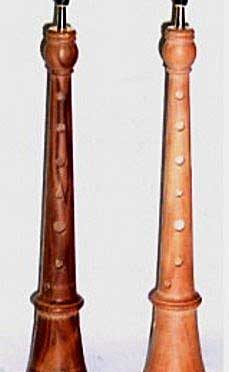
The dulzaina is a traditional Spanish double-reed woodwind instrument belonging to the oboe family. It typically measures about 70 cm in length and features a conical wooden bore with several finger-holes along its body. The dulzaina’s sound is notably intense and penetrating, a loud, reedy tone that can carry across open air, making it ideal for outdoor performances.
This instrument is a mainstay of Spanish folk music and is commonly paired with a small drum in performance. In various regions of Spain it goes by different names, such as dolsaina in Valencian, pita in La Mancha and Murcia, gralla in Catalonia, or even simply gaita (not to be confused with the bagpipe) in parts of Navarre and Castile. Despite these local names and slight variations, the dulzaina remains a symbol of popular tradition across Spain, widely used to enliven festivals, parades, and community celebrations.
Historical Development
The dulzaina’s roots trace back to antiquity. Its precursors were ancient double-reed instruments that existed in Mesopotamia around 3000 B.C., collectively referred to by the Sumerians as abub. These early shawms featured a conical bore and vibrating reed, characteristics that would be passed on to later instruments like the aulos in Ancient Greece and the tibia in Roman times. Such instruments were widespread around the Mediterranean and often had powerful, penetrating sounds that dominated early ensembles.
Some early shawms even used two pipes, one melodic and one drone, similar to a bagpipe’s setup. After the fall of Rome, however, the use of double-reed instruments declined in Western Europe (supplanted by brass horns during the early medieval period). It was not until the Arabic influence in medieval Spain that shawms were reintroduced: Moorish musicians brought their zolami (an Arabic term appearing in Al-Andalus texts) which rekindled the tradition of double-reeds in the Iberian Peninsula. Thus, the dulzaina’s forerunners were likely reestablished in Spain by the 8th–9th centuries through this Arabic influence.

By the High Middle Ages and Renaissance, the instrument had become integrated into Iberian musical life under various names. The earliest specifically Castilian name for a shawm was albogue, mentioned in literature as early as the 13th century (for example, in the Libro de Alexandre). In subsequent centuries, historical sources reference instruments that we recognize as dulzaina-type shawms. Medieval and Golden Age authors often used the term chirimía (from chermia, a cultivated form of shawm) alongside dulzaina and albogue in their works.
Miguel de Cervantes in Don Quijote (1605) notably distinguishes between the chirimía and the dulzaina, implying a difference in status and size: chirimías were the longer, courtly oboes (about 50–60 cm long), whereas dulzainas were shorter folk instruments (roughly 30–40 cm) used by common people. This passage underscores that by the 16th–17th centuries the dulzaina was seen as a rustic relative of the oboe, prevalent in popular celebrations, while the refined chirimía (early oboe) served in elite contexts. From the 18th century onward, the dulzaina firmly took root as an “indisputable part of Spanish folklore”, as one historian notes, while the classical oboe continued its evolution in art music.
In the 18th and 19th centuries, dulzainas were ubiquitous at local festivities, and the instrument’s design remained essentially simple and diatonic. Unlike orchestral oboes, the traditional dulzaina had no keys and a limited melodic range, yet it thrived in folk settings. Toward the late 19th century and early 20th century, some innovations emerged. In 1902 the craftsman Ángel Velasco of Valladolid added a system of eight metal keys to the Castilian dulzaina, extending its chromatic capabilities. This “dulzaina castellana” with keys could play a complete chromatic scale and reflected an effort to modernize the instrument for more versatility. Before this addition, as musicologist Felipe Pedrell described in 1901, the dulzaina had preserved its “primitive and simple form” since medieval times, essentially a small double-reed pipe that had not incorporated the acoustic refinements of the baroque oboe. Indeed, as Pedrell noted, the folk dulzaina carried various old names (frestel, chirimía, chalemel, etc.) but remained a rustic instrument “devoid of keys” that passed into the hands of the common people. This divergence meant that while the oboe became a complex, “refined” instrument by the 17th–18th centuries, the dulzaina continued in parallel as a simpler popular instrument, preserving the old shawm tradition.
Even experiments like making dulzainas out of metal occurred. For example, in the Basque provinces of Vizcaya and Guipúzcoa around the late 19th century, metal-bodied dulzainas were manufactured and gained some acceptance, but by and large the wooden form prevailed. The 20th century thus saw both the maintenance of regional dulzaina traditions and modest adaptations (keys, new materials) aimed at keeping the instrument viable in changing musical contexts.
Regional Variations
In Spain the dulzaina is not a singular, uniform instrument but rather a family of regional variants, each with its own local name and nuances in construction or playing style. Despite these differences, all are recognizably part of the same oboe-like family. Below are some of the prominent regional manifestations of the dulzaina across Spain:
Castile and León / Madrid region:
In the central regions of Castile (e.g. provinces like Burgos, Segovia, Valladolid) and historically in Madrid, the instrument is typically just called dulzaina. This is often considered the dulzaina castellana (Castilian dulzaina), which in its classic form has six finger holes and one thumb hole, and sometimes additional keys. Makers in the late 19th and early 20th centuries added up to eight keys to some Castilian dulzainas, creating fully chromatic instruments especially useful for playing along with modern bands. Even so, the traditional keyless dulzaina continued to be favored in folk contexts.
In Castile, dulzainas became emblematic of local dances such as the jota and other village dance tunes. They were customarily played in duos or small bands; in many towns one could find parejas de dulzaineros (dulzaina pairs) or a dulzaina and drum duo animating weddings, religious feast days, and street parties. The Castilian dulzaina typically has a slightly mellower tone than the higher-pitched Navarrese gaita, and when equipped with keys it can cover repertoire beyond the modal folk tunes. Today, Castilian-style dulzainas (with or without keys) are played in areas ranging from Burgos and Segovia to parts of Ávila, Salamanca, and Madrid, often preserving a rich local repertoire of pasodobles, processional marches, and dance pieces. They typically accompany the gigantes (giants) and cabezudos (big headed people) parades durting local festivities.
The Aragonese Dulzaina
The Aragonese dulzaina has played a central role in the folk music of Aragón for centuries. Its origins trace back to the medieval period, where it was commonly used in public celebrations, religious ceremonies, and festive gatherings.
Over time, the instrument has undergone various changes in both design and playing technique, adapting to evolving musical preferences. Typically crafted from boxwood or ebony, the dulzaina’s powerful and penetrating sound allows it to be heard clearly in both large outdoor ensembles and smaller acoustic settings.
Today, the dulzaina remains an integral part of Aragonese musical tradition. For example, the gigantes y cabezudos parades, people in giant or large head costumes . It also appears in a range of ensembles, including brass bands, folk groups, and charangas. Its expressive range supports both lively, celebratory tunes and more introspective, emotional pieces.
Two key publications explore the instrument’s history and performance technique: La dulzaina aragonesa: Estructura y técnica interpretativa by José Ángel González Lázaro, and Dulzaina aragonesa: Manual Teórico-Práctico by Pedro Velasco.
Valencian Community (Eastern Spain):
Here the dulzaina is known as the dolsaina, dulzaina or chirimita. It is a defining instrument of traditional Valencian music and is typically accompanied by a small drum called the tabalet or tamboril. The dolsaina players lead many festive events in Valencia, from street processions and pasacalles (musical street parades) to performances of the traditional songs.
In modern times, Valencia has seen a strong revival of this instrument: organized ensembles of 20–30 players have become common, performing not only at folkloric parades and the famous Moros y Cristianos parades and festivities, but also giving formal concerts with expanded repertories. The dolsaina in Valencia usually comes in two tunings (commonly in G and in F) to accommodate different musical contexts.
Navarre, La Rioja, and Basque Country (Northern Spain):
In Navarre and adjacent regions, the dulzaina is most commonly called the gaita or gaita navarra (not a bagpipe, but the shawm). Navarrese gaita players (gaiteros) traditionally perform in pairs, accompanied by a large drum known as the tambor de gaita. This ensemble is a fixture of Navarrese town fiestas and famously leads the street processions in the San Fermín festival in Pamplona. The high-pitched, piercing gaita navarra is well-suited to outdoor festivities and is often heard playing lively dianas (dawn fanfares) and dance tunes to wake towns on festival mornings.
In neighboring La Rioja it is known as dulzaina. In the Basque Country, similar instruments also exist. In Rioja Alavesa (southern Basque region) the dulzaina is used and likewise referred to simply as gaita.
Some old Spanish terms like chirimía (or local variants chirimita, charambita) were historically used for these instruments in the north, but today that terminology has mostly faded. The majority simply call it gaita or dulzaina and cherish it as part of their regional heritage, whether accompanying the dances of gigantes y cabezudos or adding flair to rural romerías (pilgrimage festivals).
Murcia and La Mancha (Southeast and Central Spain):
In the Region of Murcia and parts of Castilla-La Mancha (especially the provinces of Albacete and Cuenca), the dulzaina is affectionately known as the “pita.” The player is called el tío de la pita (“the piper fellow”), a term that evokes the image of the itinerant village musician. The Murcian/La Mancha pita is essentially a type of dulzaina, typically keyless and producing a slightly different timbre that locals recognize. It is most often played alongside a snare drum or frame drum, which provides the rhythmic accompaniment.
The music of the pita is inseparable from the celebrations of that region, its sound is strongly associated with popular fiestas, street processions, and pasacalles. For example, small towns might honor their patron saint with morning parades where the tío de la pita and a drummer lead the way, or a couple might hire these musicians to enliven a wedding procession. Though called by a different name, the pita fulfils the same cultural role: heralding joyous occasions with its vibrant, reedy melodies.
Catalonia (Northeastern Spain):
In Catalonia, the dulzaina is called dulzaina catalana or gralla (particularly in the Tarragona area). Grallas are famously used in festivals such as the building of human towers (castells/castillos humanos) and in accompanying parades of giant figures, as in other parts of Spain. They often play in groups, providing the musical signals for the human castle members and lively tunes for folkloric dances. The gralla’s design and fingerings are akin to other dulzainas.
It should be noted that beyond these regions, similar double-reed folk oboes exist in other parts of Spain under additional names (such as gaita charra in Salamanca). However, all share the core characteristics of the dulzaina. Despite minor variations in size (length can vary roughly from 30 cm up to about 50 cm in different types), tuning, or adornments, the family resemblance is clear. Each community has embraced the instrument as its own, hence the proliferation of names like charamita, donsaina, chirimita, vozaina, and more in local dialects, but fundamentally they are analogous instruments: conical-bore, double-reed shawms that carry the soul of Spanish folk music.
Playing Technique and Construction
From a construction standpoint, the dulzaina is a relatively simple aerophone, yet it requires skillful technique to play well. It is typically crafted from hardwoods such as granadillo (grenadilla), boj (boxwood), or palosanto (rosewood), materials chosen for their resonance and durability. The instrument’s body is conical, usually made in two main sections: an upper body (cubilete) where the reed is inserted, and a lower body ending in a flared bell (campana).
The dulzaina’s finger-hole arrangement traditionally consists of six finger holes on the front and one thumb hole on the back, much like a recorder or oboe. Some regional variants add a seventh hole for the lower pinky (as in certain Aragonese dulzainas) to extend the scale. Meanwhile, modern Castilian dulzainas with keys will have metal keywork mounted on the wooden body to cover additional tone holes, thereby enabling chromatic notes beyond the basic diatonic scale. Despite these enhancements, many dulzainas remain diatonic instruments focused on the traditional scales and modes of folk music.
At the top of the dulzaina is the reed assembly, which is crucial for sound production. The dulzaina uses a double reed (caña) similar to that of an oboe or bassoon: two pieces of cane bound together that vibrate against each other when blown. This reed is typically attached to a short metal staple or tudel, which in turn fits into the wooden body’s socket. The tudel may be a fixed size or occasionally a telescoping tube that allows the player to adjust tuning by lengthening or shortening the air column. Players spend considerable care on their reeds, selecting quality cane, trimming and tying reeds by hand, since the reed’s response greatly affects tone and playability.
When playing, the musician places the reed (sometimes inserted into a small wooden pirouette or just the staple) between the lips. The embouchure for dulzaina can be quite firm; many players partially cover the reed with their lips (as in oboe technique) to control the intonation, while others use a looser capeta style (more common in Valencian dolsaina tradition) where the lips focus the air without much pressure on the reed.
Cultural Significance
The dulzaina holds a highly regarded place in the cultural life of Spain, particularly in its role as the soundtrack of popular fiestas. Throughout Spain, the dulzaina has been associated with a variety of communal events. During religious festivals (such as patron saint days, Corpus Christi, or Christmas celebrations), dulzaina music often accompanies processions of the faithful, sometimes alongside church bells and other instruments.
One of the most iconic roles of the dulzaina is in parades and street performances. In many regions, pasacalles (marching through the streets) and gigantes y cabezudos have the dulzaina as the lead instrument.

The dulzaina also carries symbolic weight as a marker of regional identity and continuity. Many local governments and cultural organizations have honored dulzaineros for keeping traditions alive. In rural Castile, certain family lineages became famous as dulzaina players passed their craft down through generations, becoming minor folk legends (with nicknames like “El Famoso” or “Tío Casto” attached to renowned players).
These musicians were treasured members of their communities: they were called upon to “cheer up” the town whenever there was a cause for festivity. Because of this, the sound of the dulzaina evokes a sense of nostalgia and cultural pride. It represents the heritage of the people, the fiestas patronales, the village dances under ancient oak trees, the collective memories of celebration and togetherness.
However, the cultural journey of the dulzaina has not been without challenges. With the advent of modernity in the mid-20th century, traditional instruments like the dulzaina faced a steep decline. The rise of gramophones, radio, and later television introduced recorded music into communities, reducing the demand for live folk musicians. Simultaneously, new musical tastes favored modern bands with trumpets, saxophones, clarinets and the like, which could play popular songs and dance tunes that the diatonic dulzaina could not. Starting roughly in the 1940s and accelerating by the 1960s, many young would-be dulzaineros opted to learn those modern instruments or join charanga bands, seeing them as more fashionable. Older dulzaina players retired or passed away, often without apprentices to continue the tradition, leading to a precipitous drop in the number of active performers
By the early 1970s, the situation was dire in some areas: a 1974 report from Burgos warned that only about eight dulzaineros remained in the entire province (five in villages and three in the city). Headlines like “La dulzaina se muere” (“The dulzaina is dying”) appeared in local newspapers, sounding the alarm that this old tradition was on the brink of extinction. In effect, the dulzaina had gone from being the life of the party to a near relic, superseded by more modern entertainment.
Fortunately, this decline sparked a conscious folk revival and preservation movement in the late 20th century. Enthusiasts, musicologists, and local cultural authorities began taking action to save the dulzaina and re-integrate it into contemporary cultural life. Festivals and contests were organized to showcase remaining dulzaina players, hoping to inspire a new generation. For example, in 1973 the first “Festival Castellano de Dulzaina” was held in Segovia, bringing together dulzaineros from various provinces to perform traditional pieces and even awarding prizes to encourage excellence. Folk music workshops and dulzaina schools were established. The same 1974 Burgos article suggested creating a dulzaina and drum school as a remedy, a vision which materialized in subsequent decades through cultural associations and conservatory courses.
Veterans like Maestro Justo del Río in Burgos took on students and helped transcribe folk melodies for teaching purposes. In Valencia, existing bands of dolsaina players saw renewed enrollment as younger musicians embraced their regional instrument. Slowly but surely, the dulzaina experienced what has been described as “the miracle of its rebirth”, achieving in recent years a true renaissance and even a new era of splendor.
By the 1990s and into the 21st century, many areas of Spain witnessed a dulzaina comeback: folk festivals now proudly feature dulzaina music, regional governments fund traditional music schools, and instrument makers are once again crafting dulzainas to meet demand. In Valencia, the instrument is officially taught and dozens of youth ensembles have formed. In Castile and León, groups of young dulzaineros perform at town events where none could be found a generation ago. Indeed, the dulzaina has effectively reasserted its role as a living tradition.
Today, the Spanish dulzaina remains both a historic artifact and a vibrant emblem of cultural identity. Its shrill, joyful melodies continue to ring out during festivals, connecting present-day listeners with a musical legacy spanning centuries.
Dulzaina Name Variations in Spain:
Aragón: gaita, dulzaina, donzaina, donsaina, chuflaina, trompa and grallón.
Cantabria: bozaina, dulzaina, donzaina and chirmía.
Castile la Mancha, Castile and León, Madrid region: dulzaina, gaita, pita, turutaina and chirimía.
Catalonia: gralla, gaita, dulzaina, dolsaina, tarota and cheremia.
Navarra: dulzaina and gaita.
Valencia region: dolsaina, donsaina, dulzaina, gaita, verinoca, pita, tarota and chirimita.
La Rioja: dulzaina, gaita.
Murcia: pita and chirimaita.
Basque Country: dultzaina, dulzaina, gaita, bolin-gozo and chanbela.
Leading Dulzaina players
Agustín Pindado, Alfredo Ramos, Fernando Díez, Germán Alameda, Jesús Costa, Luis Ángel Fernández, Guillermo Moreno, and Javier Dueña.
Dulzaina Books
- El libro de la dulzaina aragonesa, método y repertorio by Blas Coscollar Santaliestra (Exco. Ayuntamiento de Zaragoza, 1987)
- Método G.A.B. para dulzaina, Vol. 1 – Técnica, Digitacion y estudios by Germán Alameda Berrojálviz
- Método G.A.B. para dulzaina, Vol. 2 – Digitacion, articulacion y ritmo by Germán Alameda Berrojálviz
- Método G.A.B. para dulzaina, Vol. 3 – Técnica avanzada by Germán Alameda Berrojálviz
- Dulzainadas – 14 composiciones para grupo de dulzainas by Germán Alameda Berrojálviz
- La dulzaina castellana en la fiesta palentina by Pedro Pablo Abad Hernán
- Dulzaineros y redoblantes palentinos del SXX hasta 1985 by Pedro Pablo Abad Hernán (1985)
- Al son de la dulzaina (2020) by Roberto Hernández Yustos (photography) and Carlos de Miguel Calvo (historical ethnographic annotations) Diputación de Segovia
- La dulzaina de Castilla by Isidoro Tejero Cobos
Dulzaina Schools
- Asociación cultural Escuela de Dulzaina (Catueso Nº 6, 3º H, Segovia)
- Escuela Caja y Dulzaina de Golmayo (Soria)
- Escuela de Dulzaina de Ávila
- Escuela de Dulzaina y Tambor de San Esteban de Gormaz (Soria)
- Escuela la Dulzaina de Aluche (Madrid)
- Escuela de Música de Ejea de los Caballeros (Zaragoza)
- Escuela de Música Tradicional Tierra de Pinares (Valladolid)
- Escuela Municipal de Dulzaina (Burgos)
Sources: The information in this article is drawn from Spanish-language sources including scholarly folklore journals and regional studies. Notable references include the Revista de Folklore of the Fundación Joaquín Díaz, the Spanish Wikipedia entry on the dulzaina, and ethnographic research on dulzaineros in various provinces.

Author: Angel Romero
Angel Romero y Ruiz has dedicated his life to musical exploration. His efforts included the creation of two online portals, worldmusiccentral.org and musicasdelmundo.com. In addition, Angel is the co-founder of the Transglobal World Music Chart, a panel of world music DJs and writers that celebrates global sounds. Furthermore, he delved into the record business, producing world music studio albums and compilations. His works have appeared on Alula Records, Ellipsis Arts, Indígena Records and Music of the World.