
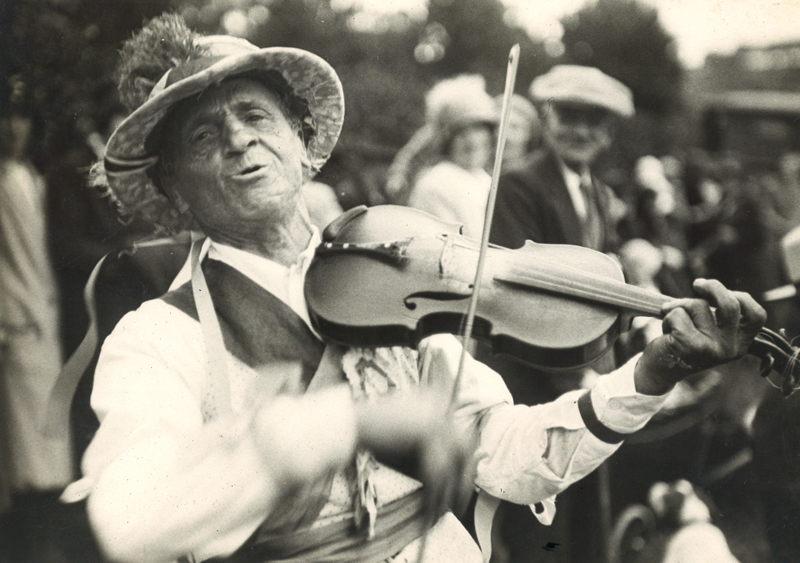
(headline image: Sam Bennet – Photo from The James Madison Carpenter Collection, Archive of Folk Culture, American Folklife Center, Library of Congress, AFC 1972/001 Photo 036. Reproduced with permission.)
Writer and musician John Phillpott takes a walk down the leafy lanes of Warwickshire, the land of William Shakespeare’s birth and also that of Sam Bennett, the English county’s legendary fiddle player…
Warwickshire is England’s most central county, and until the coming of the Industrial Revolution in the middle of the 18th century, was a predominantly land-locked rural area.
However, drastic changes to lives and landscape had started to come about even by the lifetime of the county’s most famous son, William Shakespeare.
For the vast Arden Forest, celebrated by the Bard in his A Midsummer Night’s Dream and As You Like It – was already being steadily reduced because of charcoal burning, while the former small towns of Birmingham and Coventry were already becoming fast-growing industrial hubs.

Nevertheless, the great human exodus from the countryside to these new cities started in earnest around the 1840s and 50s, and along with these huddled masses would also have gone the indigenous folk music of the English Midlands.
Today, it is very hard for the musicologist to find songs specifically associated with Warwickshire. Young Henry the Poacher and Green Grow the Rushes-O are believed to have county origins, and there is of course David Garrick’s fiercely patriotic homage set to martial music, The Warwickshire Lad.
The latter became the predominant march of the now-disbanded Royal Warwickshire Regiment. Today, it can still be heard at 11 o’clock on Fridays, when the bells of St Mary’s Church, Warwick, chime out the tune.
Green Grow the Rushes-O is what is known as a cumulative song, where each verse builds upon the previous one, often with religious or symbolic interpretations.
The Warwickshire origins of Young Henry the Poacher are also disputed by some folklorists, the tune having been recorded by East Anglian singer Harry Cox in 1966.
It is a ‘cautionary tale’ song of woe, relating how the man in the title is caught poaching game, convicted, and sentenced to be transported to Van Diemen’s Land, the original name for Tasmania.
Transportation of felons to the British colonies was a standard practice in the 18th and early 19th centuries. Many people in Australia and Tasmania today owe their ancestral origins to convicts from Britain.
So. What would the instrumental folk music of Warwickshire have sounded like in that long-lost, pre-industrial age? Perhaps we should look no further than Samuel Bennett, fiddler of the Ilmington Morris.
Morris dancing has a long, and very ancient history, with its origins lost in the mists of time. It is traditional to England, and may have had connections with early pagan rituals, to encourage the earth to be fertile.

These fertility rites were performed by men from two or three families within the community, the tradition having been handed down from father to son.
However, the origins of the term ‘Morris’ has for years also been the subject of argument. Some believe that it stems from the word ‘Moorish’ which therefore might explain the ‘black face’ nature of some Morris sides.
Others attribute the blacking-up as being simply a disguise adopted by poor farm labourers while they danced in villages for extra pennies to supplement their meagre incomes.
Sam Bennett was born on November 5, 1865, the seventh of 11 children of farmer James Bennett and his wife Martha. James was an ambitious man, who had built up a farm in the village of Ilmington, south Warwickshire.
In 1861 he had 31 acres of land, and by 1871, this had grown to 181 acres. Around 1881 he’d moved to nearby Mickleton to farm 294 acres. He died suddenly, aged 57, in 1883.
It’s known that James gave Sam a second-hand violin to encourage his son’s musical talent, so this must have been before the boy was 18. The 1891 census records that his widowed mother had returned to Ilmington with Sam, then aged 25, with his younger brother Henry, 19.
Regarding the young man’s musical ability, it is said that he couldn’t read music notation, but had a wonderful memory. He once wrote to the local Press: ‘I have played more than 100 tunes on the fiddle in an evening and know more than 40 songs, while the country dances I picked up from bands of old fiddlers as they were danced a quarter of a century ago’ (from the Stratford-upon-Avon Herald, August 18, 1910).
Sam married Mary Elizabeth Barnett at St Mary’s Church, Ilmington on October 17,1899 and they subsequently had two children – Martha and Samuel. The family lived at Foxcote Hill in the village.
Sam was a soft fruit merchant, selling everything from plums to blackberries and gooseberries, all grown on a very large allotment. He had a van to transport his goods and was very active in community life.
At some stage he was visited by the American collector James Madison Carpenter, who not only recorded Sam’s playing, but also took several photographs.
Sam Bennett revived the Ilmington dances with a new young side around 1906. Renowned folklorist Cecil Sharp’s Folk Dance Notes vol 1 p80, written in August 1909, confirm this.
Although none of Sam’s immediate family seems to have participated in the Morris before him, he began learning Morris tunes from Tom Arthur (c1802-1890), the old pipe and tabor player.
In 1886 Tom’s son James Arthur (1828-1906) had also taught some Morris tunes to John Robbins of the Bidford Morris men. This quickly prompted a revival of the Ilmington Morris, which had lapsed approximately 20 years previously.
Sam was a natural musician, picking up tunes and songs as he went, and was a born entertainer. For example, in April 1909 he led a social evening at nearby Newbold-on-Stour, performing both a broom dance and a ‘bacca pipes’ dance and playing (with a piano accompanist) for dancing until 3.30am.
Above all Sam was a great enthusiast for folk material, customs and traditions. The young Morris side, which Sam had trained, performed publicly at a garden fete in Ilmington on August 22, 1907.
They then busked at Stratford-on-Avon on Saturday, May 9, 1908, and ‘greatly delighted the visitors and residents’.
The troupe included Henry Bennett (Sam’s younger brother) aged 36; Joseph Aston, 31; Tom and John Newman, 25 and 18; John Cooke, 18; Frank and Robey Rouse, 22 and 20; accompanied by a hobby horse (A Terry) and a clown (John Terry).
Bennett, then aged 42, was described as ‘manager, trainer and fiddler’. The team impressed the organisers of the Shakespeare Festival enough to invite the troupe back to take part during May 1909 in the Old English Games and Sports programme, where their dances were ‘exceedingly well executed’.
This information has been gleaned from the Evesham Standard and West Midland Observer dated April 17, 1909, August 17, 1907, May 16, 1908, and May 8, 1909.
Despite these various plaudits, doubts would be raised as to the ‘authenticity’ of Sam’s dances. Cecil Sharp himself first met Sam on January 12, 1909, when he noted the song The Keeper (which doubles as an Ilmington dance) as well as ten Morris tunes. These included Maid of the Mill and Bumpus o’Stretton.
Sharp next visited Sam on April 5, 1909, when he noted the figures for five dances. He saw Sam again at the Ilmington troupe’s appearance at Stratford Festival on May 6 and awarded Sam first prize in the folksong competition for his singing of The Keeper.
However, Sharp was dissatisfied with his efforts. He visited Sam again in August to check all previous dance figures and to make definite revisions to Maid of the Mill.
He achieved this by watching the troupe performing at the flower show at Stretton-on-the-Fosse on August 12, 1909, when he also took down a new dance, Shepherd’s Hey.
Sharp also felt obliged to note down two more songs from Sam, Thorney Moor Woods and Admiral Benbow.
After these three visits, Sharp expressed some disappointment that ‘the steps were very poor’ but that ‘evolutions, stick-tapping and clapping were good’. At this time Sharp was struggling to fix some universal rules of Morris stepping and was developing rather high-minded ideas about ancient traditions and purity of transmission.
When in April 1910 he visited Michael Johnson, one of the ‘old’ Ilmington dancers (from 1886), he was relieved in a way when ‘Johnson danced the step to me exactly as Kimber dances it’ (Folk Dance Notes).
Johnson was generally very critical of Sam’s ‘new’ side, as old men sometimes are of any changes to their cherished ways.
Sharp never interviewed Sam Bennett again. But Sam was his own man and began to collaborate with Mary Neal and the new Esperance Guild in public events in 1910.
She had already interviewed Sam in the summer of 1909 and published the Maid of the Mill ‘linked-hanky dance’ in her Esperance Morris Book Part 1 which came out in March 1910.
In May 1910, Sam Bennett appeared at a major Esperance event in London. Such developments irritated Sharp, so that when he eventually published the Ilmington dances in the revised Morris Book Pt 1 in 1912, he did not even acknowledge Sam’s help at all.
Sam was subsequently interviewed by Clive Carey, the new musical director of the Esperance Guild in November 1910 and again in June 1912. Four more Ilmington dances appeared in Esperance Morris Book Pt 2 in 1912.
Because of Sharp’s intransigence, some researchers have drawn the conclusion that he actually missed out on a lively Morris tradition.
Sam Bennett continued to teach the Ilmington dances in his native village, and despite some lapses and interruptions in the 20th century, the current Ilmington Morris side has a good repertoire of tunes and dances to perform.
In the 1930s, the American song collector James Madison Carpenter recorded Sam Bennett singing several old ballads, all of which can be heard online courtesy of the Vaughan Williams Memorial Library.
These include Lord Bateman, Barbara Allen, Blow Away the Morning Dew, Lord Lovel and Our Goodman.
Peter Kennedy recorded an 85-year-old Bennett singing several songs in 1950. The full recording is available via the British Library Sound Archive. Sam Bennett died on February 13, 1951, aged 85.
The Ilmington Morris Men credit him with the survival of their local tradition. Dancing in Ilmington underwent a series of revivals, with resulting variations in the dancing.
The modern side was started in 1974, largely by men with connections with the village, or from Shipston-on-Stour. The side still uses the horse made by Sam Bennett in 1899.
It was preserved in Ilmington by the village school during the period before the current side was started. This is the only traditional horse with close connections to traditional Morris.
Up until the end of the 19th century, many Cotswold villages had their own Morris dance side, usually comprising a team of six dancers and a musician.
Occasionally, a side would have a ‘fool’ and a ‘hobby horse’ to complement the dancers’ performance, keep the crowd under control, and add to the general entertainment.
Performances were usually given on May Day, Whitsun, Boxing Day, and any other notable dates during the year. Nowadays, the Morris is performed all the year round to entertain the public, preserve the tradition, and because the participants enjoy performing the dances and playing the tunes.
Thanks are due to the following researchers: Keith Chandler’s Morris Dancing in the English South Midlands, 1660-1900; Elaine Bradtke’s article Sam Bennett: a case study in the English Fiddle Tradition from James Madison Carpenter’s ethnographic field collection (The Elphinstone Institute 2008 online); and to Paul Bryan, ‘Bagman’ and historian of Ilmington Morris.

Author: John Philpott
Author and journalist John Phillpott has written for many newspapers and magazines during a career that spans more than 50 years. His latest book Go and Make the Tea, Boy! is a memoir of his days as a young reporter.