
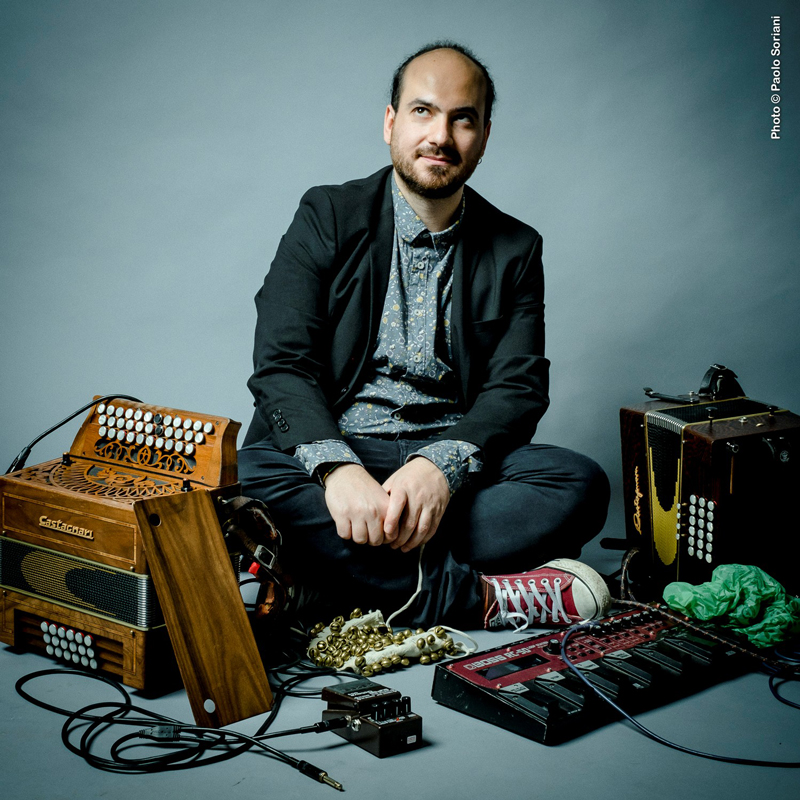
Alessandro D’Alessandro was born in Coreno Ausonio, a small town in southern Lazio. He grew up playing the organetto, a traditional Italian diatonic button accordion. As he got older, D’Alessandro began to explore new musical practices and experiment with the instrument, eventually incorporating electronics into his performances. He also reinterpreted well-known songs, including Italian pop classic “I giardini di marzo,” using a slow, almost free-rhythm style that amplifies the emotions conveyed in the original lyrics. D’Alessandro’s pioneering approach to the organetto has expanded its potential and created new possibilities for musical expression.
At the age of thirteen, Alessandro D’Alessandro discovered the full potential of the organetto when he was invited to perform with an orchestra. He realized that this instrument allowed him to play multiple parts simultaneously, to breathe new life into existing pieces, and even compete with other performers and composers.
This experience led D’Alessandro to form the Orchestra Bottoni, comprised of organettos with varying registers, voices, and rhythms, and collaborate with musicians from diverse backgrounds and nationalities. As he sharpened his skills, he began experimenting with a chromatic instrument, a departure from his childhood instrument, and working with improvising musicians to expand his creative abilities.
D’Alessandro’s pioneering spirit prompted him to incorporate “light electronics” into his organetto, creating what he called a “prepared organetto.” This innovative electronic arrangement, built with digital processes, provided him with unparalleled versatility and freedom to perform any kind of music with anyone.
Rather than creating entirely new compositions, D’Alessandro chooses to reinterpret familiar songs. This practice is still pioneering in the world of organetto playing, as the instrument lacks a substantial body of literature. His approach to these songs, both famous and obscure, allows him to unearth unexpected nuances and conjure echoes of a bygone era.
D’Alessandro’s process involves manipulating the original song with a combination of his finger memory, prior experimentation, and aesthetic preferences. This results in dreamlike renditions that reflect his selective sensibility and desire to create something truly unique.
Discography:
Canti, Ballate e Ipocondrie D’Ammore (Squilibri, 2016)
Canzoni (Squilibri, 2021)

Author: Angel Romero
Angel Romero y Ruiz has dedicated his life to musical exploration. His efforts included the creation of two online portals, worldmusiccentral.org and musicasdelmundo.com. In addition, Angel is the co-founder of the Transglobal World Music Chart, a panel of world music DJs and writers that celebrates global sounds. Furthermore, he delved into the record business, producing world music studio albums and compilations. His works have appeared on Alula Records, Ellipsis Arts, Indígena Records and Music of the World.