
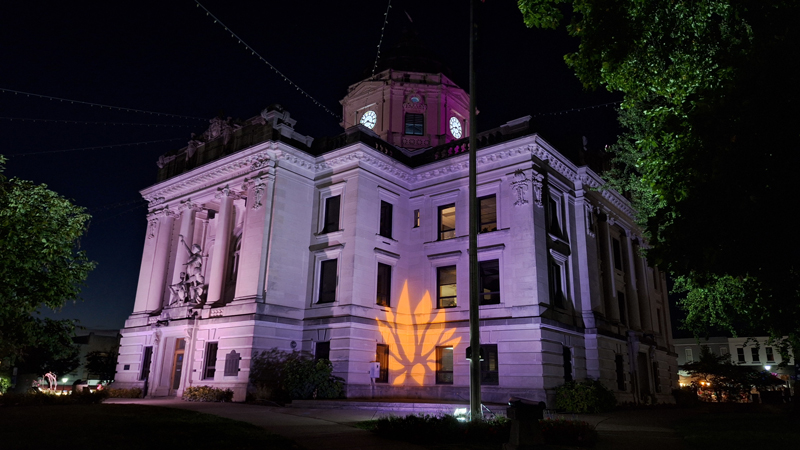
The 32nd Annual Lotus World Music & Arts Festival lit up Bloomington from September 25 to 28, 2025, and once again transformed the city into a hub of global music and art. For me, this year’s edition felt especially memorable because I was able to see it not only through my own eyes, but also through those of my four-year-old, who became an active little participant in the festival.
One of the highlights was the kids’ programming at the 6th Street stage, in the area called Arts Alley. My child spent nearly an hour happily experimenting with different ethnic instruments and even joined a collaborative project to knit a giant lotus flower. On Saturday, we found ourselves carving limestone for almost an hour, another free hands-on activity for children and parents. This year, Lotus finally made it possible for kids to participate in the festival for free, and it was a joy to see so many young listeners discovering folk music. Just two years ago, at the 2023 edition, the audience was noticeably more grey-headed.

The city itself seemed to move in rhythm with Lotus. Many of my colleagues from the MS in Arts Administration program, as well as Indiana University (IU) professors and staff, were busy working as volunteers. They admitted that things behind the scenes could be messy, especially with this year’s changes in volunteer training. For the first time, Lotus opened its online training to everyone rather than just returning helpers, which meant that many volunteers didn’t have site experience, and some ended up in roles that weren’t the best fit. About fifty more were added at the last-minute during festival week. Despite these challenges, what the audience saw was smooth and welcoming. For festivalgoers like me, the event felt well run and easy to navigate.
The music itself offered plenty of variety, though I noticed some repeating trends. I spent plenty of time with Puuluup duo, whose looping style (and comedy stand-up between short musical pieces) felt familiar to anyone who follows Nordic or Baltic musicians. Not quite to my taste.

Duos like Teho from Finland and Symbio from Sweden also leaned on loop stations, and it made me wonder if folk-electronic fusion is becoming a broader Northern European wave. Zar Electrik from Morocco and France added a more danceable touch; their beats reminded me a bit of Bab L’Bluz or Monsieur Doumani.
For me, the standout performance was House of Waters from the USA and Japan. Their concert at the First Christian Church on Friday evening combined jazz, world music, and progressive rock in a way that was powerful and deeply engaging.

Another moving moment came from Native American artists Shelley Morningsong and Fabian Fontenelle. Fabian celebrated his 66th birthday during the festival, and the audience joined in singing “Happy Birthday,” creating a warm, emotional scene.
There were also some delightful surprises outside the official folk music program. On Saturday evening, the IU Marching Drumline performed near the courthouse, energizing the crowd with their rhythms. Street musician Lee Mysliwiec brought a lighter touch with his fiddle and a toy rabbit that “played” a violin, entertaining passersby.

Performers like Cathy Fink, Marcy Marxer, and Chao Tian, as well as the Swing Time Big Band, gave concerts that were simply joyful. And for those interested in movement, dance workshops in salsa, bachata, merengue, and swing added another layer of participation, even if my own child chose to sit them out in favor of snacks.

The physical layout of the festival made it easy to enjoy. With four main venues: Buskirk-Chumley Theater, the open-air 6th Street stage, Waldron Center, and First Christian Church, all within a few minutes’ walk, the city center was alive with people moving safely from one performance to another. It felt festive and secure, which matters in today’s world. The 6th Street tent and stage, brought back this year thanks to $30,000 raised by donors, showed how much the community values keeping these traditions alive.
As always, there were points that gave me pause. The choice of Colombian headliner Nidia Góngora, who had just performed at Moscow’s revived Intervision contest, raised questions for me about the intersection of politics and art. While some independent Russian folk artists who left Russia after 2022 remain unable to perform abroad due to nationality, others find platforms in politically charged contexts without much scrutiny. These complexities are part of the global music landscape.
Still, what stays with me most from Lotus 2025 is the sense of community and joy. Despite volunteer challenges and the occasional programming question, the festival offered so many moments of connection, discovery, and celebration. It gave children and adults alike the chance to make, play, and listen together. Bloomington once again welcomed the world, and in return the world offered its music, and its stories. I congratulate the Lotus team, the volunteers, and the entire community for creating another successful edition of this remarkable festival.
More about the Lotus World Music & Arts Festival: lotusfest.org.

Author: Daryana Antipova
Daryana Antipova has been working as a journalist since 2001 and is involved in radio (Scythian horn program), print (The Moscow News, Russia Beyond the Headlines, Fanograf) and online media related to world music. Drummer in Vedan Kolod folk band, director at Scythian horn agency and label. Her main focus is on traditional folk music, Siberian music and Russian world music in general.