
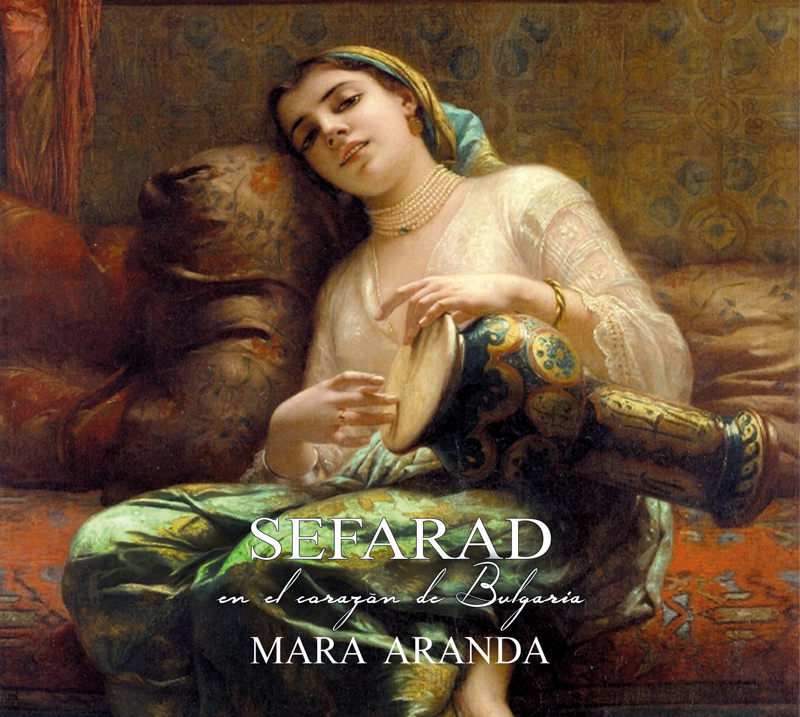
Mara Aranda – Geografías de la Diáspora Vol. IV: Sefarad en el Corazón de Bulgaria (self-release, 2025)
In the fourth installment of her five-part series Geografías de la Diáspora, Sefarad en el Corazón de Bulgaria, Spanish vocalist and researcher Mara Aranda turns her attention to Bulgaria. Indeed, she continues on her determined mission to recover and revitalize neglected Sephardic musical traditions. Drawing from rare and often unpublished recordings held in the National Library of Jerusalem’s sound archive, Aranda brings to light engaging songs that have long remained in scholarly obscurity or silent in oral memory.
This volume centers on the Sephardic Jewish communities exiled from the Iberian Peninsula in 1492. Over centuries, these communities preserved their Judeo-Spanish language (known as Judezmo in the former Ottoman Empire) and musical traditions, particularly through the voices of women, mothers, grandmothers, and daughters, who passed down kantikas, romances, proverbs, and folk tales across generations.
The twelve tracks featured in Sefarad en el Corazón de Bulgaria reflect centuries of adaptation and survival, shaped by the cultural currents of the Byzantine and Ottoman Empires. The songs, performed by legitimate heirs of this oral tradition, offer listeners a glimpse into a once-thriving heritage. as a consequence, Aranda skillfully and beautifully combines Spanish roots music with early music and Balkan influences using a stellar cast of musicians from various corners of the globe. The song lyrics are grounded in Spanish, although they also contain Turkish, Greek, Albanian, Italian, French, Romanian, German, Yiddish, and Bulgarian linguistic influences.
Aranda’s commitment extends beyond performance. Her fieldwork has taken her to Thessaloniki, Istanbul, and Jerusalem to understand the historical and cultural environments in which this music evolved. She is also the director of the Centro Internacional de la Música Medieval, an institution dedicated to preserving and celebrating medieval musical traditions.
Linguist Marcel Israel highlights the richness of Judezmo in Bulgaria, noting its unique blend of borrowed words across centuries of displacement. The Nobel Prize-winning writer Elias Canetti, born in Ruse to a Sephardic family, also underscores this linguistic heritage. In his memoirs, he recalls the Judeo-Spanish songs and sayings of his childhood as vital ties to his cultural identity—memories he never relinquished, even as his life led him to the German language and intellectual acclaim.
As Canetti once wrote, “Only by seeking the void can you find the path to avoid it.” This volume honors a legacy nearly lost—and affirms that, as the Sephardic proverb reminds us, “Sin memoria no hay avenir.” Without memory, there is no future.
The album’s booklet includes extensive notes in Spanish and English with historical details, comments by Marcel Israel and lyrics.
Musicians: Omran Adrah on qanun and psaltery; Milena Fuentes on violin; percussionist Fernando Depiaggi on duff, saggats, doholla, reqq, bells, cymbals, tambourine, Persian daf, doka nay, husseini nay, duff, darbuka, davul and mazhar; Julia Chiner on cello, gheychak and vocals; and Mara Aranda on vocals.
Guests: Housam Hamoumi on kawala; Jota Martínez on baglama; and Rafa Gisbert (Cato) on clarinet and Bulgarian gaida.
Recorded, mixed and mastered by Rafa Gisbert at Estudis14 studios in Muro de Alcoy/Muro d’Alcoi (Alicante, Spain) during the month of August 2023.
Buy Sefarad en el Corazón de Bulgaria.

Author: Angel Romero
Angel Romero y Ruiz has dedicated his life to musical exploration. His efforts included the creation of two online portals, worldmusiccentral.org and musicasdelmundo.com. In addition, Angel is the co-founder of the Transglobal World Music Chart, a panel of world music DJs and writers that celebrates global sounds. Furthermore, he delved into the record business, producing world music studio albums and compilations. His works have appeared on Alula Records, Ellipsis Arts, Indígena Records and Music of the World.