
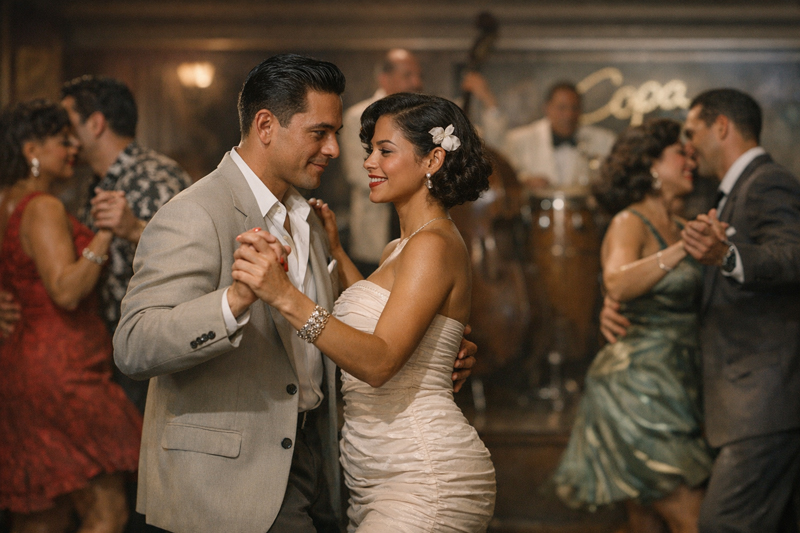
Chachachá, a spirited dance style with Cuban roots, has captivated enthusiasts globally with its lively movements, syncopated steps, and infectious rhythm. The genre was born in the 1950s, influenced by mambo and other Cuban genres.
Enrique Jorrín, a prominent Cuban violinist, conductor, and composer, is credited with creating chachachá in 1948. As he observed the challenges faced by some Cubans in dancing mambo, he innovatively crafted this new rhythm, easier to dance.
The first chachachá composition, “La engañadora,” composed by Enrique Jorrín in 1948, quickly became a sensation in 1953. It is important to note that this song was performed many years later by Cuban pianist Rubén González (Afro-Cuban All Stars and Buena Vista Social Club) on his Introducing Rubén González album released worldwide by World Circuit in 1997.
Also in 1953, numerous Cuban and Latin dance orchestras embraced the transition from mambo to chachachá. For example, Dámaso Pérez Prado’s “El cerezo rosa” was performed in the new style.
The name chachachá has intriguing origins, with multiple theories attempting to unravel its etymology. One theory attributes the name to the distinctive brushing sound created by dancers on the floor, echoing “chachachá.” Another theory attributes the nomenclature to Enrique Jorrín, who supposedly derived inspiration from observing a maid sweeping the floor while immersed in chachachá music. The most likely origin is onomatopoeic: the rhythmic repetition resembles the identifiable sound of a güiro (scraper), seemingly chanting “chachachá.”
Notable compositions in the chachachá repertoire include “El bodeguero”, “La engañadora”, “Los marcianos”, “Rico vacilón”, “Me lo dijo Adela”, “Corazón de melón”, “Cuéntame”, and “Que vengan los bomberos.”
The emergence of chachachá owes much to the innovation of dancers in Havana clubs. They skillfully devised steps that harmonized with the distinct characteristics of this evolving dance style, creating a rhythmic brush that marked the dance floor with precision: one, two; one, two, three.
Chachachá was incorporated into Latin jazz by artists such as Tito Puente in the 1960s and much later, in the 2020s, by the big band Jazz at Lincoln Center Orchestra with Wynton Marsalis, Cha Cha Toda la Noche.
One of the most famous chachachá songs is “Oye Cómo Va,” originally composed by Puerto Rican-American musician Tito Puente in 1962. The song was later recorded and released by Santana in 1971 infused with Latin rock. Santana’s “Oye Cómo Va” became an international hit. In the United States, it reached number 13 on the Billboard Hot 100.
In 2020, Gladys Palmera published the book Cha-Cha-Chá: un baile y una época de Colección Gladys Palmera (Cha-Cha-Chá, A Dance and an Era in Gladys Palmera Collection). The deluxe 146-page hard cover book is available in two separate editions, in Spanish and English.

Author: Angel Romero
Angel Romero y Ruiz has dedicated his life to musical exploration. His efforts included the creation of two online portals, worldmusiccentral.org and musicasdelmundo.com. In addition, Angel is the co-founder of the Transglobal World Music Chart, a panel of world music DJs and writers that celebrates global sounds. Furthermore, he delved into the record business, producing world music studio albums and compilations. His works have appeared on Alula Records, Ellipsis Arts, Indígena Records and Music of the World.