
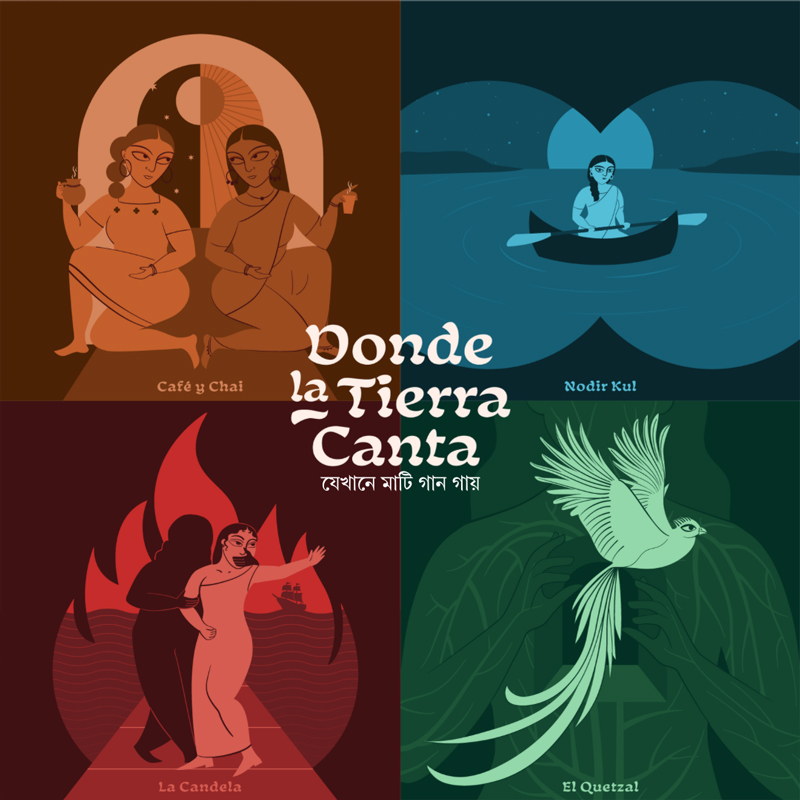
Koyel Basu – Donde La Tierra Canta | যেখানে মাটি গান গায় (Where The Earth Sings) (2026)
British-Bengali independent artist Koyel Basu has recently released her debut EP, Donde La Tierra Canta | যেখানে মাটি গান গায় (Where The Earth Sings). The project presents beautifully made acoustic world-folk music deeply grounded in Bengali spiritual tradition and joyful Mexican folk music, with succulent, delightful songs performed in both Bengali and Spanish.
The major influences are mystical Baul-inspired Bengali folk and the rhythms and instrumentation of Mexico’s son jarocho, one of the most beautiful Mexican folk traditions, from the Veracruz area. Notably, the EP was created in close collaboration with musicians from Veracruz, Mexico. Koyel Basu incorporated Veracruz’s charming jarana and leona guitars, supported by the percussive zapateado footwork along with the Bengali dotara lute and bamboo flute, plus various percussion instruments.
“La Candela” (The Candle). This song presents a son jarocho related to the abduction of enslaved women by pirates in 1680s Veracruz. It also draws a parallel with similar kidnappings in colonial Bengal.
“Nodir Kul” (The River Shore). This track combines the Bengali Bhatiali ballad “Nodir Kul” with the son jarocho piece “El Fandanguito.” Here, the river serves as a metaphor for life’s unsettled but continuous passage.
“El Quetzal” (The Quetzal, a colorful bird from Central America and southern Mexico). This song brings together Lalon Shah’s Baul composition “Khachar Bhitor Ochin Pakhi” and original Spanish verses. It focuses on spiritual freedom and inner release.
“Café y Chai” (Coffee and Tea). This composition contrasts Bengal’s morning tea customs with Mexico’s evening coffee traditions. At the same time, it highlights tea and coffee as colonial imports that later became part of everyday cultural identity.

Koyel shared: “Like the Baul —“one possessed by the wind”—I am driven by a hunger for new traditions and untold stories. This path led me to Mexico, where I found echoes of Baul’s spirit in son jarocho a folk tradition from Veracruz shaped by indigenous, Spanish, and African influences. Through this journey, I came to realize that the earth sings to you—no matter where you come from. La tierra siempre canta.”
Musicians who play on the album:
Koyel Basu, a Bengali musician, storyteller, and self-described ethnomusicophile, crafts her music influenced by folk traditions as a way to examine human experience. She was born and raised in Kolkata, where she absorbed a wide range of Bengali musical forms, from Rabindra Sangeet to regional folk repertories. At the same time, she trained in Western classical voice and piano.
Later, a period in London introduced her to genre-crossing collaborations. However, her return to Bengal marked a decisive shift toward deeper engagement with Baul, the devotional tradition centered on spiritual inquiry through song. There, she adopted the dotara lute.
Her current work brings together various world music traditions into direct dialogue, based on the idea that music carries shared meaning across cultures.

Meanwhile, Santiago Serrano, originally from Sonora and now based in Xalapa (or Jalapa), contributes electric guitar, tabla, bansuri flute, and percussion. His influences are jazz, Afro-Latin music, and Indian classical practice, with an emphasis on cross-genre collaboration.
Diego Ricardo Alarcón Solórzano, a bassist and music educator from Mexico City with family roots in Veracruz and Chiapas, is currently enrolled at Universidad Veracruzana, where he studies jazz and music education. He plays son jarocho with the leona guitar.
Nathalie Ramírez brings experience in both Western classical and Hindustani music. In 2010, she received a scholarship from the Indian Council for Cultural Relations to study Hindustani classical singing in Delhi under Jyotika Dayal Paust. She also composes and arranges for Nik&Nat Productions, the group behind the BollyJazz project.
Raymundo Rafael Pavón Lozano, a jarana player and producer from Xalapa, founded La Calandria to explore new directions for son jarocho in conversation with other genres. Since 2022, he has toured internationally as part of De Todas las Flores Tour by Natalia Lafourcade, with appearances at Carnegie Hall and alongside the Los Angeles Philharmonic under Gustavo Dudamel.
Finally, Aurora Flores represents the foot dance tradition of southern Veracruz. She specializes in teaching zapateado to children and remains active in fandangos across the region, where she frequently collaborates with musicians in the son jarocho community.

Author: Iliana Cabrera
