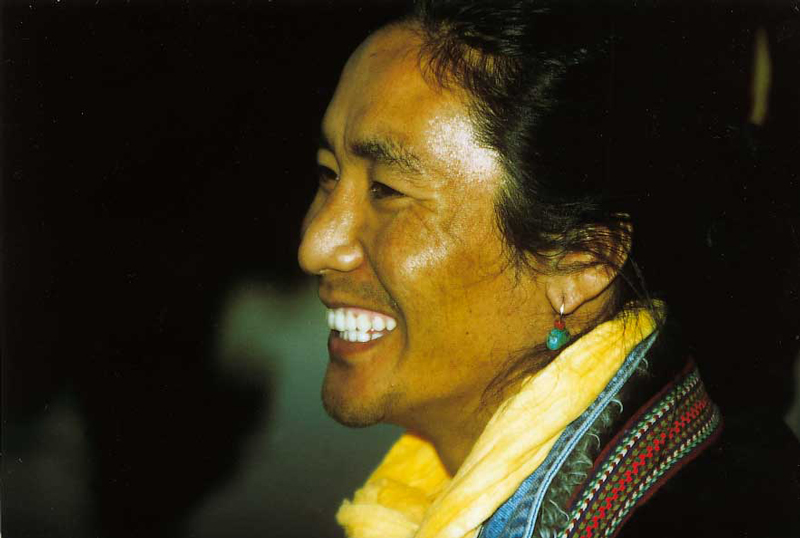
Australian-based Tibetan artist, Tenzin Choegyal has enjoyed many highlights across his decades-long career. The latest is a collaboration with his friend Philip Glass and a special ensemble. Their album, Be The Sky, honors His Holiness the 14th Dalai Lama for his 90th birthday. Tenzin says, “One of my Tibetan friends said it’s almost like a sonic stupa. I thought, ‘Wow, that’s so beautiful.’”
“My friendship with Philip probably goes back to the first invitation to perform at Carnegie Hall close to 20 years ago. It was for the Tibet House annual concert that he directs,” Tenzin explains. “I was already in Australia then. At that time, I didn’t know what Carnegie Hall was. Philip invited me, and we formed our friendship, not only through music but also our spiritual practice. I think Philip is a much better Buddhism practitioner than myself. I’m pretty sure in his past lives he was a practitioner anyway. This lifetime, I was born into it, and he chose to be a Buddhist.”

Their masterwork Be The Sky is a divine celebration, presented as a musical offering of love, devotion, and gratitude. The first single, ‘Snowy Mountains – Gangi’ was released in July. The track combines Tibetan traditional music and contemporary classical composition, with spoken word and poetry among the vocals. Also featuring over 100 children from the Tibetan Children’s Village, the song was premiered at Carnegie Hall in March for the 38th Annual Tibet House Benefit Concert, featuring a choir of Tibetan children living in Jackson Heights, Queens. “It was fun,” says Tenzin. “We ran little workshops a week before.” Accompanying Tenzin’s vocals, dranyen and lingbu (bamboo flute) are piano and saxophone (by co-producer Amex Ring Gray) and strings by Grammy-winning Scorchio Quartet.
Tenzin explains, “Some of the words are from the old ancestral lineage, like from the poet Yogi Milarepa. Also, one of His Holiness’s favorite stanzas, which is from Shantideva. There’s one small little poem that I wrote, ‘Who Am I?’ that I put to music. I’m so happy because I was able to bring together Philip with the music. (Glass plays piano on the title track, with spoken word from Saori Tsukada.) In one track (‘Until Space Remains’), I was able to bring in His Holiness’ voice as well. Then the kids from the orphanage, the village school I grew up in.” Exiled from Tibet and separated from family, Tenzin spent 12 years boarding as a student in India before finally settling in Australia. “All the collaborators have been my friends.”
The Grammy-nominated Tenzin is no stranger to collaboration. He has shared stages with Laurie Anderson, Patti Smith and Anoushka Shankar. His previous album Snow Flower was recorded with Australian singer-songwriter Matt Corby. He has performed for His Holiness the Dalai Lama. Be The Sky sees his craft take full flight, working again with Glass now 88. “Actually, I’m in New York right now in his place”, he says. “This morning I had a really nice time with him. He was playing piano and I pulled out my flute, making some music, just jamming.” The rich and intricate layers of the ensemble are anchored by the cinematic minimalism and repetition of Glass’s epic touch. Both complex and warm, it resonates physically and emotionally.

We speak of a universal search for meaning. Listening to Be The Sky, in the right environment, is akin to meditation. Tenzin offers, “If music was a religion, then I think I would choose that as my religion. For me, Buddhism is more like a science of mind than a religion. It’s quite accessible in that regard.” From the many compositions rehearsed, seven were chosen for the album. “There is more we could have put in, but I thought it was a good number.” Indeed, a significant number in the Buddhist tradition.

“I started planning for this album about four years ago. Even though it’s a very simple, beautiful album, it did take that long. And my dear friend Alex, who lives at the Dunvagen Music Publishers office, was able to help put it together when I was sending sound files over to New York. On the day of the release, we did a listening party at Tibet House, for about 100 people who came along. We played each song off the record and told stories. Then I did a big concert in upstate New York, at Skidmore College music center. Instead of the Tibetan kids we had American kids singing ‘Snowy Mountains – Gangri’. I also had my brother who is a sacred dancer (Tsering Dorjee Bawa) joining us. It was an amazing, beautiful time.”
Philip Glass could be described as a storyteller – even without words. His film and stage scores and recordings have earned him legendary status as one of the greatest contemporary composers. Tenzin says, “His music has that quality … I don’t even have words to describe his work. He is the master of what he does. I’m fortunate that I’m able to tell the stories of Tibet through my simple flute and my 3-stringed dranyen. I call her Metok. It means flower. So she’s been able to take the stories of Tibetan people and my individual stories. I think the dranyen carries a lot of burden of telling many of the Tibetan stories.”

For the past 20 years, Tenzin has performed a special concert at the Woodford Folk Festival in North Queensland. An annual highlight. “I do this concert at four in the morning to bring in the New Year. Looking at the sacred Glasshouse Mountains, four or five thousand people watch the sun rise over the horizon. With a couple of my friends, we create the soundtrack for the sunrise. As soon as the sun is out, then we finish the concert at around 4.45am. Even during COVID I went up there and did it myself. I can’t break this ritual.” Tenzin is a master at bringing people together. From the track ‘Who Am I?’: “Why search for more / when nothing is missing? … Why seek separation when there is oneness to embrace!”

Author: Chris Lambie
