Nearly twenty years after its inception, the project Kulin Ban continues to defy categorization. Founded by musician and writer Vladimir Savić, it began as a one-off experiment uniting contrasting sensibilities, but soon evolved into a vessel for exploring the depths of sevdah and its many cultural layers.
I first stumbled upon Kulin Ban’s music about ten years ago on a Russian page dedicated to Balkan sounds, and one of those tracks has remained among my personal playlist favorites and on my radio show ever since, — which makes the release of a new album especially exciting.
Ad Drinum (2025), recorded over nearly a decade, draws inspiration from the Drina River as a symbol of constancy, memory, and connection. Blending traditional instruments with underground and experimental sounds, it tells both local and universal stories of longing, love, and spirituality. In this conversation, Savić reflects on the origins of Kulin Ban, the making of the new record, and the delicate balance between preserving tradition and pushing its boundaries.
Vladimir, the Kulin Ban project, was founded in 2005. What was your original vision when creating it, and what purpose does it serve today?
Vladimir: Everything began quite spontaneously at a wedding in Vranje (Southern Serbia). My friend Željko Erić was fascinated by a concert of the group Ved, the band around which we were initially gathered. Željko and his wife wanted to leave a legacy, both for their family name and for art and culture in general. They sponsored the album of the band I later named Kulin Ban.
The group consisted of four people with completely different sensibilities and musical affinities. The only common ground was a rock ’n’ roll background, and nothing more. That very diversity was the challenge, to create an album that wouldn’t rely on compromise but on dialogue and fulfillment through difference. The album fully achieved its goal. It was originally conceived as a foundation-like, non-profit project and was released in 2006 by the national label PGP RTS.
Unfortunately, the very diversity that had inspired us collapsed at the first obstacle: the attempt to turn the project into an active band failed. Kulin Ban performed several concerts in different lineups, but only once in the original lineup, on January 27, 2007. After that concert, the initial project ceased to exist. I retained the rights to the name. Being originally from Bosnia, I named the band after the Bosnian ruler Ban Kulin (1180–1204).
By late 2006, through theater productions, I began shifting towards the music of my homeland, sevdalinka. From then on, Kulin Ban became tied to various projects, primarily sevdah and fusion forms.
Your new album is a collection of music recorded over almost a decade, since 2015. Why did you decide to bring these recordings together now?
Everyone has their own life philosophy. I’ve never planned much. Things, moments, people, places, they simply happen. I don’t separate art from religion, and to me, such events are gifts, little miracles. Our task is to recognize them.
In the small town on the Drina where I’ve lived for nearly 20 years, I met many remarkable people. Among them was the artist Mate Lajoš, with whom I first recorded a song and then the promo video Ad Drinum, a multimedia work worth every attention.
The Drina became my leitmotif of eternity: always flowing, connecting, carrying, soothing, witnessing… a constant. Several later projects in literature and traditional music also carried this name.
Only after publishing my third book, encouraged by my wife, did I devote myself to completing the album. Between 2021 and 2025, I recorded it track by track, often remotely with musicians. The working title was Kulin Ban and Friends, but in the end Ad Drinum imposed itself naturally. I felt the recordings should exist together, not only as singles but as a complete album.
How many albums has Kulin Ban released so far, and how does this latest one connect to or differ from earlier works?
- Kulin Ban – Kulin Ban (2006)
- Arsias & Kulin Ban – Ad Drinum (single & promo film, 2016)
- Kulin Ban – Ad Drinum (2025)
Listen here on YouTube:
This album is entirely different from the first. Even the sevdalinka I performed back then, Kad ja pođoh na Bentbašu, had a world music form accessible to listeners anywhere. By contrast, this new work is deeply underground, not meant for everyone.
It tells a local story of Zvornik, the Drina, and Bosnia, but also a universal tale of sevdah, of love’s suffering, and of the soul’s longing for God. It intertwines makams, Byzantine and Sufi influences, Eastern Orthodox chants, and sevdalinka, layered with melancholic pop guitar and piano motifs, alongside traditional sounds of the saz, kaval, bendir, daf, and morchang.

The project is closely tied to sevdalinka and the traditional urban music of Bosnia, Serbia, and Montenegro. What personally drew you to this repertoire?
The inspiration here is Bosnian sevdah. Serbian and Montenegrin sevdah each have their own distinct flavor. Since I can remember, sevdalinka has been present alongside rock ’n’ roll in my environment. In Bosnia, it held an almost sacred character. It wasn’t sung casually, nor by just anyone, it was approached with deep care and devotion.
My mother is from Montenegro, my father from Bosnia. Both sang beautifully. I carry childhood memories of them singing in different moments, those images remain engraved. Even among my rock ’n’ roll friends, there was a special respect for sevdalinka.
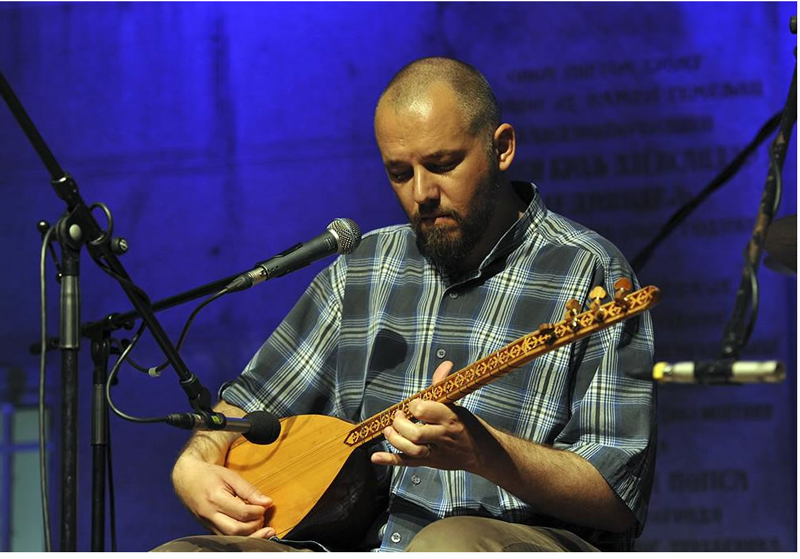
I am not a traditional saz performer. I’ve absorbed Western genres, Oriental traditions, and much more. My musical journey is complex, and over time I’ve shaped my own style. What you hear is my personal experience and interpretation of the music I was born into.
Kulin Ban has collaborated with many musicians, producers, and studios across the region. How important was this collective effort for shaping the final album?
The album is, in every sense, a joint work of all who contributed; every performer, every collaborator, every person who helped bring it to life.
The group has been praised for preserving the authentic atmosphere of sevdah. How do you balance tradition with experimentation, fusion, and contemporary acoustic elements?
Easily, by refusing to place music into rigid frameworks. Music is an event, an interaction, something that happens in the moment, something that fulfills and transcends. It can be a single note, a voice, an instrument, or a full orchestra; it doesn’t matter.
What matters is your perception of music’s sacredness, what you convey, what you reveal. You can unite the seemingly irreconcilable, heaven and earth, because, in truth, one cannot exist without the other. The danger lies only in becoming slaves to forms that mean nothing in themselves.
Does Kulin Ban perform actively today? If so, what kinds of concerts or festivals do you prefer? If not, why?
Our last major performance was in 2018 at the Jewish Cultural Center during the Ethno Fusion Fest, with members of Shira U’tfila.
Kulin Ban is essentially my alias. Music is just one part of my work. Alongside prose and poetry, I’m active in documentary and short films, socially engaged projects related to cultural and historical heritage, teaching, and serving as a deacon in the local parish. With so many commitments, it’s simply impossible to do everything.

Compared to other Serbian and Bosnian folk or ethno projects, what makes Kulin Ban unique in its artistic approach?
I was interested in the source, where this unique musical expression comes from. That’s why my path led East.
Sevdalinka is based on melody (modal systems) rather than chords (harmony). Sevdah is a result of layered heritages: Slavic culture, the Eastern Orthodox Church, Islamic musical-poetic traditions (with distinctions between rural and urban songs, turkije and ašik poetry, dervish orders, spiritual music, Ottoman court traditions), as well as the broader Arab-Persian heritage. Add to that the Sephardic contribution and, finally, Western music’s influence, distinct from Eastern traditions but eventually naturalized into sevdah.
Few musicians have truly studied this heritage. Traditional performers or instrument makers pass on the legacy, but rarely explain it. On the other hand, many contemporary artists continue the tradition through various fusions, often unconsciously relying on Western patterns.
Your new album was released through the “17th September” Library in Mali Zvornik. Is it only digital, or is there a physical edition for listeners and collectors?
I chose a local publisher to remain as independent as possible. My experiences with big labels haven’t been great. This release also has a physical edition (in a small run) with a very specific mission: to serve as a regional work and to promote this area. Once again, as I’ve done all my life, I give myself fully to culture and art. The release is non-profit.
Looking ahead, what’s next for Kulin Ban? Will you continue focusing on sevdalinka, or do you plan to explore new musical directions?
Musically, I have a traditional sevdalinka album with saz and my own compositions ready. If it’s ever recorded, I’d like to make it fully underground, set in a world of ambient sound and mysticism.
I’ve also written a few rock songs for friends. There’s one I’d love to record, envisioned with distorted bass and drums, harmonized vocals reminiscent of Alice in Chains, but with mystical motifs of Orthodox church singing. We’ll see, if and when the time comes.
My next major project, God willing, may be my most challenging yet: a documentary film about the bands of Zvornik and Mali Zvornik during and after the war.

Author: Daryana Antipova
Daryana Antipova has been working as a journalist since 2001 and is involved in radio (Scythian horn program), print (The Moscow News, Russia Beyond the Headlines, Fanograf) and online media related to world music. Drummer in Vedan Kolod folk band, director at Scythian horn agency and label. Her main focus is on traditional folk music, Siberian music and Russian world music in general.