
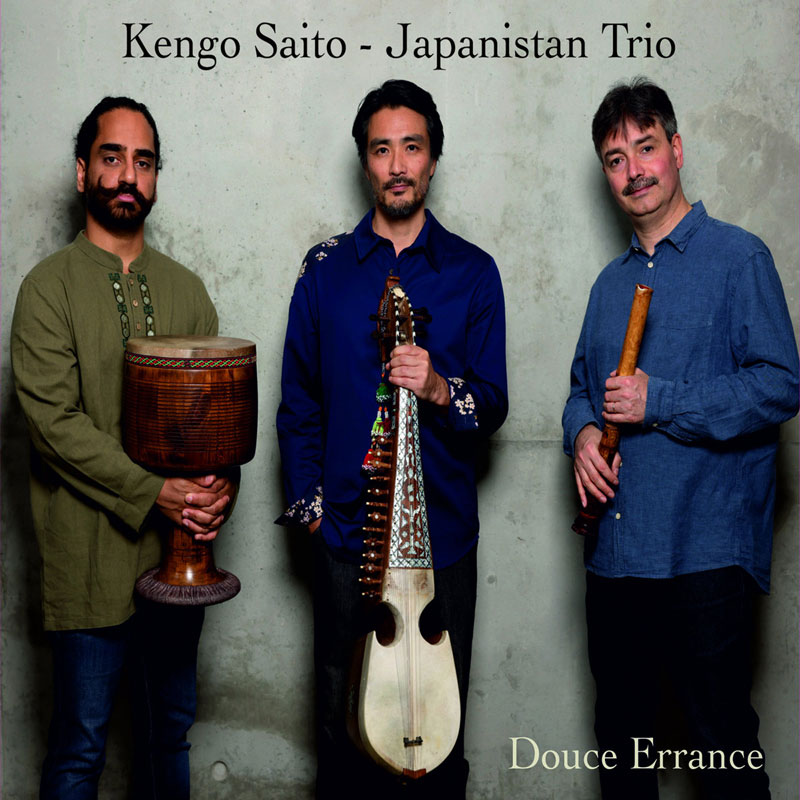
Kengo Saito / Japanistan Trio – Douce Errance (Felmay, 2025)
On Douce Errance, the Japanistan Trio weaves Afghan rubab, Japanese shakuhachi, and Persian tombak through original compositions and traditional arrangements. The result is a contemplative, cross-cultural sound that connects East Asia with the music of the cultures found across the ancient Silk Road and echoes the cosmopolitan spirit of Paris, where the trio is based.
Japanese multi-instrumentalist and composer Kengo Saito leads the ensemble. Initially trained in classical Indian sitar and tabla, he later embraced Afghan rubab, developing a distinctive voice that draws from multiple modal traditions. Saito’s collaborations span genres and geographies. His projects include collaborations with the Hangzhou and Shenzhen Philharmonic Orchestras, French electropop artist Thérèse, Malian kora master Ballaké Sissoko, Vietnamese vocalist Huong Thanh, Greek singer Xanthoula Dakovous, Turkish vocalist Gülay Hacer Toruk, Chinese yangqin player Yaping Wang, and jazz guitarist Nguyen Lê.
The trio’s formation grew from a spontaneous moment when Saito played Japanese melodies on the rubab. The resulting sound evoked the tonality of koto and shamisen, prompting a deeper exploration of musical affinities across Asia. The group’s approach highlights shared modal frameworks and rhythmic flexibility between Afghan, Japanese, and Persian traditions.
Douce Errance excemplifies this lovely dialogue through diverse textures. The shakuhachi, played by Suizan Lagrost, introduces breath-driven nuance, while Ershad Tehrani’s daf and tombak add rhythmic depth rooted in Persian classical music. Together, their interplay feels organic and accessible, suggesting an unspoken historical link between the instruments.
The album balances reinterpretations of traditional Japanese and Afghan pieces with original works that allow space for improvisation. One notable departure is “Polonaise,” an adaptation of a movement from J.S. Bach’s Orchestral Suite No. 2 (BWV 1067), which reimagines Western harmony through a modal lens. The piece was commissioned for the Bach festival Passe Ton Bach d’Abord in Toulouse.
Musicians: Kengo Saito on Afghan rubab, composition, arrangements; Suizan Lagrost on shakuhachi; and Ershad Tehrani on tombak, daf.
Track list:
Invocation (Suizan Lagrost) – 01:51
Méristème (Kengo Saito) – 04:25
Anar Anar (Afghan trad.) – 05:56
Fuyu No Hikari – Reflet de neige (Kengo Saito) – 06:39
Leili Libellule Fish In The Sky (Trad. Afghan & Japan) – 06:19
Kora-Son (Kengo Saito) – 03:33
Le Dernier Chant Des Oiseaux (Kengo Saito) – 05:08
Beshnaw Az Nay (Afghan trad.) – 02:38
Fleuve Tranquille (Kengo Saito) – 03:37
Douce Errance (Kengo Saito) – 06:15
Malkauns (Kengo Saito) – 04:46
Polonaise (J.S. Bach) – 06:43
Buy Douce Errance.

Author: Madison Quinn
