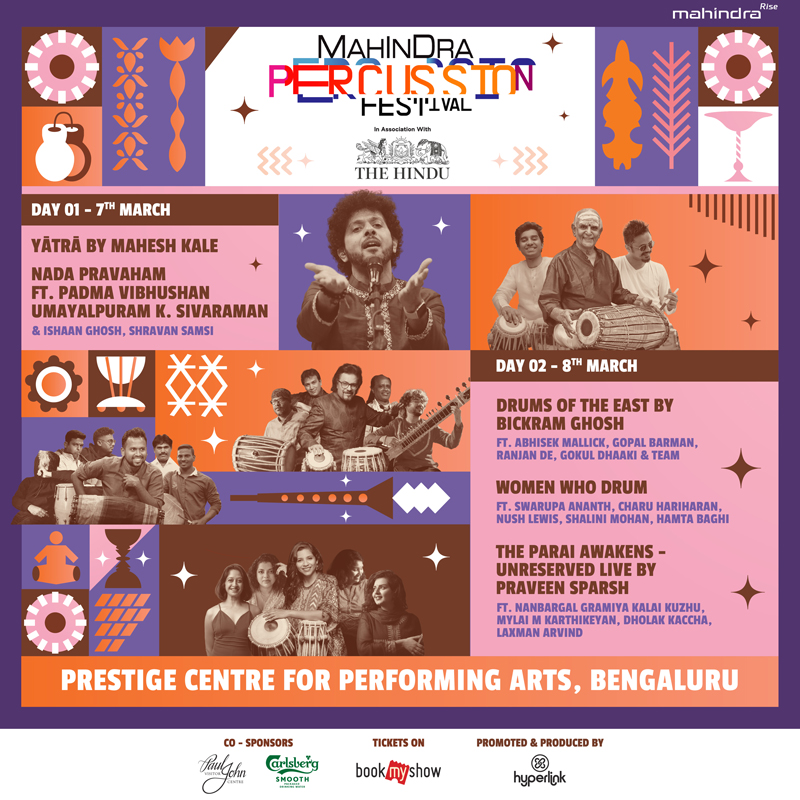
The fourth edition of the Mahindra Percussion Festival kicks off in Bangalore this weekend at the Prestige Centre for Performing Arts, with an impressive lineup of performers from across India. See our earlier writeups on the 2025, 2024 and 2023 editions.
The festival is one of series of annual cultural events organized by India’s Mahindra Group of manufacturing, agricultural and IT companies. These include the Mahindra Theatre Festival, Mahindra Blues Festival, Mahindra Kabira Festival, and Mahindra Roots Festival.
The 2026 lineup features Women Who Drum (Swarupa Ananth, Charu Hariharan, Nush Lewis, Shalini Mohan, Amirthavarshini Manishankar) and The Parai Awakens (Praveen Sparsh, Nanbargal Gramiya Kalai Kuzhu, Mylai M Karthikeyan, Dholak Kaccha, Laxman Arvind).
Other performances include YATRA by Mahesh Kale, Nada Pravaham (with Umayalpuram K. Sivaraman, Ishan Ghosh, Shravan Samsi), and Drums of the East (Bickram Ghosh, Abhisek Mallick, Gopal Barman, Ranjan De, Gokul Dhaaki).


The lineup includes established as well as emerging artists from across India. “It is our attempt to keep this common cultural identity relevant for the future generations, bridging the past and present, and actively contributing in the quest to shape the future of Indian music,” Jay Shah, Vice President of Cultural Outreach at Mahindra Group, tells World Music Central.
“Through diverse cultures coming together, this festival is a pan-India celebration of the interconnectedness of our culture that is rooted in musical history,” adds festival producer VG Jairam, Founder of Hyperlink Brand Solutions.
Bickram Ghosh

“Percussion in India is a magnum opus. There’s a huge world in percussion out there, and it is one of the most evolved traditions in the world,” observes tabla maestro and curator Bickram Ghosh.
Folk traditions can be kept alive via initiatives like featuring them in a contemporary setting, where the form of music is more amenable to larger audiences. “Folk has an incredible power of its own, and the right settings can take this to the next level,” he adds.
At a time when digital technologies like artificial intelligence (AI) are disrupting the creative industry, Ghosh observes that AI can actually be helpful. “In my field of work, which is about creativity, the human element and virtuosity, I do not see AI as a threat at this point. Live music has a great platform today; it is thriving,” he observes.
Umayalpuram K. Sivaraman

All of 90 years old, mridangam virtuoso Umayalpuram K. Sivaraman continues combining tradition with novelty. “I am adjusting to the present trends. I am always trendy. That is why I am not stagnant. That is why I am always a positive man, not a negative man. Suppose you give a different color to tradition and usage, then the same thing will appear as new to the audience,” he explains.
“The challenge for older generations of musicians is to take their legacy to young people, who are now distracted by several genres of music. When you explain the different forms of music and their values, they will understand it and relate to it,” he suggests.
He cautions that one should not always think that everything old is good, or that everything new is bad. “People with wisdom will always like the best in the old and best in the new,” Sivaraman explains.
He, too, is not worried about the effect of AI on music. “AI is becoming a durable encyclopedia of knowledge. However, humans excel in creativity and performance, and can even collaborate with technologies like AI,” he adds, pointing to the already high prevalence of tech in the music world.
Praveen Sparsh

Effective collaboration is needed between different musicians when a new project or band is being formed. “Since I am a part of few bands, each band feels different. I see this as two categories: one is like-minded people who have had very similar life experiences, come together and create something. Here, the creation is slightly easier, and you indulge more on the craft level,” percussionist-producer Praveeen Sparsh observes.
The second kind of collaboration is unusual. “People who have had very different music trainings, lifestyles, and walks of life, come together to collaborate. These conversations may not always be ‘successful’. But I believe these collaborations create one of the most unique experiences for both the collaborators and the audience because it is so unusual that sometimes it is even drastic for the mind to process,” he adds.
Sparsh started learning the mridangam when he was five years old. “I love playing at traditional Carnatic music concerts, and not just in the big venues. I truly enjoy a small temple concert, to play for three hours and sweat it out,” he describes.
He also grew up with computers and played around with a number of digital tools. “The moment you consciously take a decision to either go traditional or contemporary, then you are force-fitting an idea in the process of making art, and it shows,” Sparsh says.
Women who Drum

Spearheaded by tabla player and multi-percussionist Swarupa Ananth, Women Who Drum also features Charu Hariharan on mridangam.
“Every folk or tribal art form needs to be valued for its entire history and journey over generations. There are many ways to preserve and promote them. To be able to make a livelihood from art is definitely one. To be able to understand the context and culture behind the music and let that thrive is also really important. Otherwise, the truth of the music gets lost over time,” Hariharan explains.
Preservation cannot only mean archiving or documentation. “It has to include viable futures. If folk and tribal percussion traditions are to survive meaningfully, the communities that carry them must be able to sustain themselves with dignity,” Ananth adds.
When folk percussion is placed in conversation with contemporary performance spaces, new audiences can engage with it. “Long-term support structures like residencies, commissions, and education initiatives are crucial if we want these traditions to evolve rather than disappear,” she adds.

She sees her collective, Women Who Drum, as much more than just a performance project. “It is about reimagining how percussion ensembles can exist: as spaces of dialogue, care and shared ownership of the music. It is deeply rooted in the idea of sisterhood, in creating a space where women support each other, learn from each other, and build something together over time. The larger dream is to grow this into a lasting community, not just a one-off performance,” Ananth affirms.
Mahesh Kale

Many folk forms of percussion are unfortunately fading away. “It pains me to see that many folk instruments are finding their places more in museums than concert circuits. To bring them back to the concert circuit, some collaborations featuring these instruments is necessary,” suggests Indian American classical vocalist Mahesh Kale.
“It would be a shame to lose an ornament that has been passed to you as ancestral wealth. I feel Indian classical music and instruments are a part of this wealth that has been passed down to us across generations. We need to make sure that we not only preserve, but also nurture and grow it,” he recommends.
He is working on a number of music projects. “I am trying to find a sound that will appeal to youngsters. I am trying to find poems that have been away from the mainstream public eye, putting them to tune. So, I am kind of stretching out from the old repertoire up to the new sound and everything in the middle,” Kale says.
“We have Indian classical music, a beautiful tradition that has been passed onto us for so many years. It is our joyful responsibility to take this forward. I would appeal to aspiring musicians to forge a path far and wide and introduce this music to the world,” Kale signs off.

Author: Madanmohan Rao
Madanmohan Rao is an author and media consultant from Bangalore, and global correspondent for world music and jazz for World Music Central and Jazzuality. He has written over 15 books on media, management and culture, and is research director for YourStory Media. Madan was formerly World Music Editor at Rave magazine and RJ at WorldSpace, and can be followed on Twitter at @MadanRao.