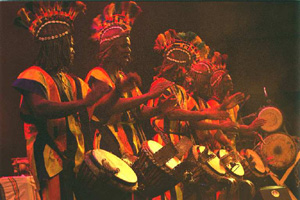
(headline image: Badenya les Freres Coulibaly – Photo by Atelier images)
The jembe is a rope-tuned, skin-headed goblet drum associated above all with Mandé cultural worlds in Mali, Guinea, Burkina Faso, Ivory Coast, Senegal, and Gambia.
The instrument’s history is partly oral. Many accounts associate it with ancient Mandinka/Maninka blacksmith caste, or numu. Its distribution is often linked to the historical Mali Empire, founded in the thirteenth century, though firm dating remains difficult.
A traditional jembe is carved from a single hardwood log and covered with rawhide, most frequently goatskin. The tensioning system has changed, moved from older pegs or hide cords to modern synthetic rope and metal rings. Preferred woods include dense West African species such as lenke (Afzelia africana), diala (acaju), dugura, gueni, gele, and iroko (Milicia excelsa). Dense woods amplify higher overtones and sound projection.


In performance, the jembe rarely stands alone. It typically belongs to an ensemble with other jembes and dunun drums, where repeating parts interlock with dance, song, clapping, and social participation. The lead player, or jembefola, answers dancers, marks steps, and improvises within known rhythmic formulas.
In Guinea, especially Upper Guinea and Hamana, the jembe is closely tied to Malinké dance repertories and the dununba family of rhythms. Famoudou Konaté, born in Sangbarala in 1940, became one of the major international representatives of that tradition after decades with the influential Les Ballets Africains. Mamady Keïta, also from Guinea, entered Ballet Djoliba as a teenager in 1964 and later founded Tam Tam Mandingue in Brussels, where he taught Guinean jembe to international students.
Mali presents another major center. There, the jembe is played in urban areas, although it is also a traveling musical form. In the Ivory Coast and Burkina Faso, the jembe appears within Mandé-related and regional dance contexts, but also within newer professional and tourist-oriented activities.
The twentieth century transformed the jembe’s public identity. Guinean state ballets, especially Les Ballets Africains and Ballet Djoliba, adapted regional ritual and village repertories for national and international stages after independence. Although this process “preserved” tradition; it also reorganized it through choreography, concert timing, state cultural policy, and exportable, engaging shows.
Gender is another changing field. Many West African contexts historically placed jembe and dunun performance primarily in male domains, while women more often danced, sang, or played supporting percussion. Contemporary groups such as Guinea’s Nimbaya challenged that boundary by presenting women as jembe performers.
Variations of the drum include differences in size, bowl depth, wood, carving style, skin, tuning method, and regional silhouette. Mali, Guinea, Burkina Faso, and Ivory Coast produce recognizable carving traditions, while exported instruments may use substitute woods, machine carving, synthetic heads, fiberglass shells, or mechanical tuning. The modern market has therefore created two overlapping instruments: the jembe as West African social drum and the jembe as a world music commodity.

The instrument is known by several spellings and pronunciations across West Africa, reflecting the region’s linguistic diversity and the movement of Mandé musical culture across national borders. Spellings include jembe, jenbe, djembé and yembé.
Jembefolas
Guinea
Guinea remains the most internationally influential center of modern jembe performance culture.
Major Living Players include Famoudou Konaté, former lead soloist of Les Ballets Africains; Mohamed Bangoura, internationally known performer and teacher; Nansady Keita, nephew of Famoudou Konaté; Babara Bangoura; Bolokada Conde.
Important Deceased Figures: Mamady Keïta (1950–2021), founder of Tam Tam Mandingue and among the most important international ambassadors of Guinean jembe traditions; Fodéba Keïta (1921–1969), founder of Les Ballets Africains; Papa Ladji Camara (1923-2004), one of the foundational early jembe soloists associated with Les Ballets Africains.
Major Ensembles: Les Ballets Africains; Les Percussions de Guinée; Ballet Djoliba; Amazones: The Women Master Drummers of Guinea; Nimbaya.
Mali
Mali is one of the historical centers of Mandé musical culture and early jembe development.
Major Living Players: Moussa Traore.
Significant Deceased Figures: Soungalo Coulibaly (1955 – 2004).
Major Ensembles: Ensemble Instrumental National du Mali; Ballet National du Mali.
Burkina Faso
Major Living Players: Adama Dramé; Désiré Ouattara; Seydou Dao; Salimata Diabaté.
Major Ensembles: Ballet National du Burkina; Farafina; Badenya Les Frères Coulibaly; and Djiguiya.
Female Jembefolas
In 1998, Mamoudou Condé, director of the influential Les Percussions de Guinée, introduced female jembe and dunun players into the ensemble despite resistance from several male members. Two years later, two female jembe performers joined the group’s U.S. tour, where audience response encouraged Condé to expand the initiative further.
As a result, he established an all-female ballet and percussion ensemble under the name Amazones: The Women Master Drummers of Guinea. The group later adopted the name Nimbaya! in 2010. In 2004, the ensemble launched its first U.S. tour and became the first all-female percussion group from Guinea to perform internationally.
Albums with Jembe Drumming:
Badenya Les Freres Coulibaly – Seniwe
Various Artists – Djembe & African Drums
Abdouli Diakite – Jebebara – The Bamana Djembe
Fa Kiyen Yiriwa – Les Djembe De Bobo
Adama Dramé: Rhythms Of The Mandings, Tambour Djembé, Djembéfola, Foliba, Sindi, Live, Dakan.

Author: Angel Romero
Angel Romero y Ruiz has dedicated his life to musical exploration. His efforts included the creation of two online portals, worldmusiccentral.org and musicasdelmundo.com. In addition, Angel is the co-founder of the Transglobal World Music Chart, a panel of world music DJs and writers that celebrates global sounds. Furthermore, he delved into the record business, producing world music studio albums and compilations. His works have appeared on Alula Records, Ellipsis Arts, Indígena Records and Music of the World.