ENGLAND was undergoing great changes during the 16th century. The country’s seafarers were setting out across the oceans bound for distant lands, the language was evolving into the form it would retain to this day, while music was also experiencing what became known as the Elizabethan Renaissance. And it was these three factors that – over time – would crucially combine to sow the seeds of sounds destined to set down roots in every corner of the English-speaking world. Writer and musician John Phillpott looks at the music being heard in England four centuries ago.
EVERY age has its own soundtrack. Today, thanks to the advance of technology and communications, it’s possible to access music of all kinds within seconds at the touch of a computer or mobile phone.
And yet… were it possible for our distant ancestors to travel down the centuries in some fantastic time machine, then they would perhaps discover a remarkable similarity between their own era and that of the present.
Right. Let’s just forget technical considerations for a moment. For several hundred years ago – as is the case today – music existed within boundaries that reflected not just taste and preference, but also class and social standing.
From the grand cadences reverberating around the pillars of the royal court, to the lowliest back street tavern, there was indeed something for everyone. Just as there is these days.

During the 16th century, there occurred an English musical renaissance, the echoes of which can still be heard today in a thousand folk, pop and early ballads that were destined to be transplanted by migration from the British Isles to the eastern seaboard of America and ultimately further inland.
The mother lode of this development was Elizabethan folk music, largely an oral tradition of ballads, dance tunes, and working songs, characterized by simple melodies, social singing, and instruments like the pipe, tabor, and fiddle.
For the musician and researcher, this proves to be a seam that becomes endlessly richer and more fascinating the deeper one digs down.
And while the story of how the music migrated to ‘new worlds’ during the 17th and 18th centuries is well documented enough, perhaps it is not always appreciated how diverse was the role played by music for both the rich and poor in Elizabethan England.
The 16th century was not only the great era of European exploration. It was also a time when the arts flourished as the English language emerged from the mediaeval period like a butterfly bursting forth from its chrysalis. It was no coincidence that this was to be the age of Shakespeare, a man who harnessed the new language to great effect.
For during the reign of Queen Elizabeth I (1558–1603), art and high culture reached a pinnacle known as the height of the English Renaissance.
And music flourished like never before. Key elements included broadside ballads, iconic tunes like Greensleeves and social dancing, bridging rural traditions with emerging popular styles.
Five hundred years ago, the City of London was alive with song. In 1597 the lutenist and composer John Dowland published his First Book of Songs, giving a gentrifying structure and form to a music previously performed roughly in taverns and on street corners.

Elizabethan music experienced a shift in popularity from sacred to secular music and the rise of instrumental music. Professional musicians were employed by the Church of England, the nobility, and the rising middle-class.
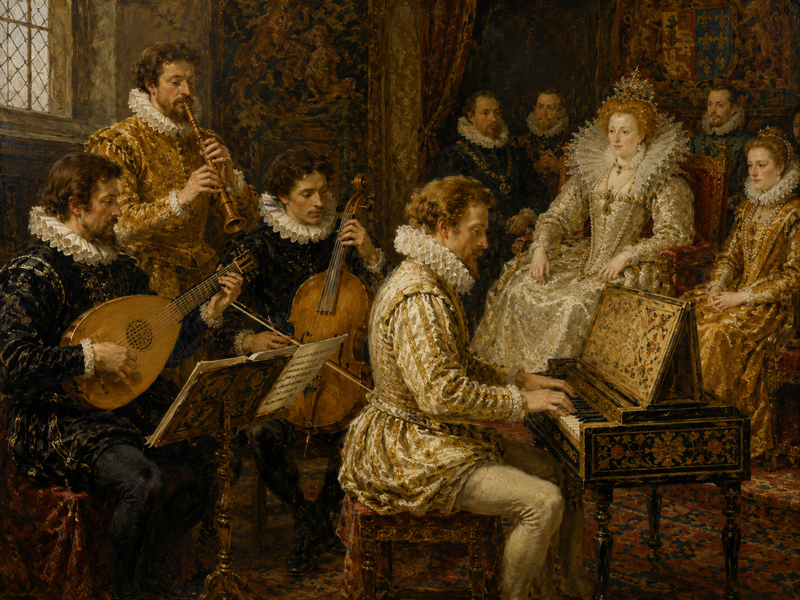
Elizabeth herself was fond of music and played the lute and virginals, sang, and even claimed to have composed dance music.
She felt that dancing was a great form of physical exercise and engaged musicians to play for her while she danced. During her reign, she employed more than 70 musicians.
The interests of the queen were expected to be adopted by her subjects. All noblemen were duty-bound to be proficient in playing the lute and “any young woman unable to take her proper place in a vocal or instrumental ensemble became the laughingstock of society.”
Music printing led to a market of amateur musicians purchasing works published by those who received special permission from the Queen.
Despite England’s break with the Roman Catholic Church in 1534, English had not become the official language of the Church of England until the reign of Elizabeth’s half-brother Edward VI.
His reign saw many revisions to the function within the Anglican Church until it was frustrated by the succession of the Catholic Queen Mary.
However, Elizabeth re-established the Church of England and introduced measures of Catholic tolerance. The most famous composers for the Anglican Church during her reign were Thomas Tallis and his student William Byrd. Both composers were Catholics and produced vocal works in both Latin and English.
Secular vocal works became extremely popular during the Elizabethan era, with the importation of Italian musicians and compositions. The music of the late Italian madrigal composers inspired native composers who are now labelled as the English Madrigal School. These composers adapted the ‘polyphonic writing’ of the Italians into a uniquely English genre of madrigal.
Thomas Morley, a student of William Byrd’s, published collections of madrigals which included his own compositions as well as those of his contemporaries. The most famous of these collections was The Triumphs of Oriana, which was made in honour of Queen Elizabeth and featured the compositions of Morley, Thomas Weelkes and John Wilbye among other representatives of the English madrigalists.

Instrumental music was also popular during the Elizabethan era. The most popular solo instruments of the time were the virginals and the lute. The virginals was a popular variant of the harpsichord among the English and one of Elizabeth’s favourite instruments to play.
Numerous works were produced for the instrument including several collections by William Byrd, namely the Fitzwilliam Virginal Book and Parthenia. The lute was strung with sheep gut and became the most popular instrument of the age. Lutes could be played as solo instruments or as accompaniment for singers.

Compositions of the latter variety were known as ‘lute song’. The most popular Elizabethan composer for the lute and of lute songs was John Dowland.

The lute mainly used during Elizabeth’s time had six, seven or eight courses, and was used both for solo and accompaniment purposes. Although the lute came in various sizes, the tenor was most popular. Similar instruments included the cittern, orpharion and bandora.

The next most popular stringed instrument, made in varying sizes and played in consorts or alone, was the viola da gamba. The viol had six strings, and frets of gut tied around the neck, rather than embedded in the fingerboard.
The shape of the body was somewhat like the violin family instruments, but with deeper ribs, a shallow top plate, and a flat back in two parts with the upper part angled to give clearance to the player. There were three main sizes – treble, tenor and bass.

Several families of instruments were popular among the English people and were employed for group playing. If all the instruments in an ensemble were of the same ‘family’ they were regarded as being in ‘consort’. Mixed ensembles were said to be in ‘broken consort’. Both forms were equally popular.
With the gradual shift in the early Baroque period, England experienced a decline in musical standing among European nations. After Dowland, the greatest English composer was Henry Purcell, whose death left a void in English music history until the Victorian era.
The Church was a major influence for music in the 16th century. However, the Puritans wanted to do away with all church music, but the will of the people to sing only made it more predominant.
Many composers who wrote for the church also wrote for royalty. The style of the church music was known as choral polyphony. Hundreds of hymns were written for the church.
At the most elegant of weddings, usually those of the nobility, the processional included musicians who played lutes, flutes and violins. It was also very common at that time for ordinary people to have music played for them whenever they wanted.
These musicians were known as ‘waits’, the equivalent to that of a modern town’s band. The waits had been in existence as far back as the mediaeval period and their role was to perform at public occasions. They played original composed music.
Today, Britain’s Mellstock Band is made up of a number of musicians who perform songs and tunes from England’s rural musical heritage, including that of the ‘waits’.
Street musicians or travelling minstrels tended to be looked down upon. They were sometimes unwelcome in a community, and eventually grew out of fashion, being replaced by the tavern and theatre musician.
Nevertheless, street music was often heard at markets and fairs, the tempo employed being usually light and quick. This was performed using fiddles, lutes, recorders and small percussion instruments, the musicians attracting crowds whenever they played.
The songs they performed and sang were traditional favourites, a far cry from the sophisticated and refined music of the Elizabethan court.
Theatre became increasingly popular when music was added. Being placed on stage meant everything to a theatre musician, the location’s acoustics giving certain effects to the sound produced.
This could be the impression of distance or providing an atmosphere to the plays and performances done. Theatre music became even more popular with the rise of William Shakespeare in the 1590s.

Many composers of the period are still known by name today, musicians such as John Bull (1562–1628), Robert Johnson, John Taverner, Orlando Gibbons and John Blitheman.
Today, Renaissance instruments are largely unfamiliar to modern listeners. Most instruments came in ‘families’, with sizes of the same instrument associated with the ranges of the human voice: descant (soprano), treble (alto), tenor, bass. In some cases, these were extended up (sopranino) and in others, down (quart bass, contrabass, etc.)
The common wind instruments included shawms, recorders, cornetts, sackbuts (trombones). Trumpets were used for the announcement of the arrival of royalty and during military exercises.
The fife was a wooden pipe with six finger holes used with the drum in army marching formations. Single reeds were used for the drones of bagpipes, but chanters used double reeds.
Other Elizabethan instruments included the portative organ, which was a type of small organ played with one hand while the player operated a bellows on the back of the instrument with the other. There were also the grand church organs and harps of various sizes.

Nowadays, specialist musicians interested in period music attempt to reproduce these lost sounds and, in recent times, there has been a modest revival of interest across Britain in ‘waits’, The Mellstock Band being the most notable exponents.
But tantalisingly, the folk process of the oral tradition and the absence of any aural – or in some cases notated evidence – will, to some extent, inevitably still keep even the most avid of players and listeners guessing as to how this music really sounded like more than four centuries ago.

Author: John Philpott
Author and journalist John Phillpott has written for many newspapers and magazines during a career that spans more than 50 years. His latest book Go and Make the Tea, Boy! is a memoir of his days as a young reporter.