
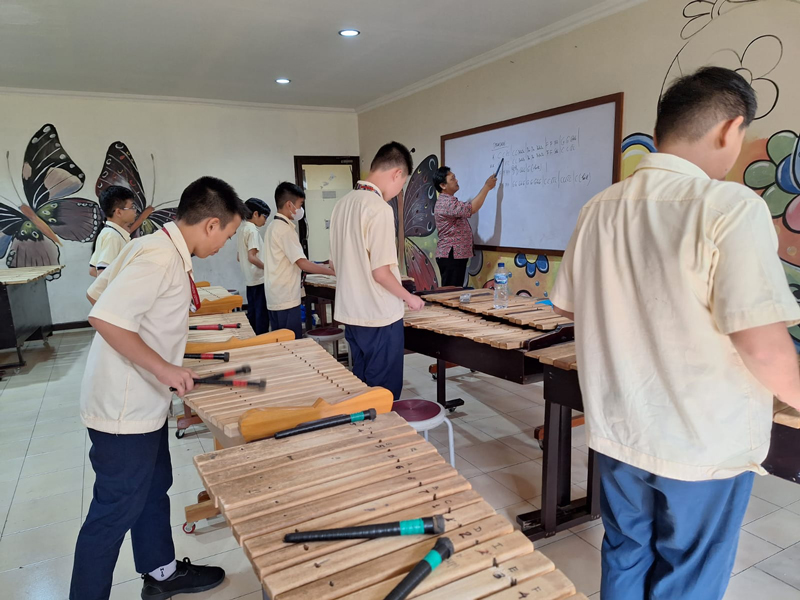
(headline image: Kolintang class in middle school. As a regular curriculum in some schools in Indonesia, it is a way to pass the technique of playing the instrument through generations. Photograph: Julius Widjojono © Manado Independent School, Indonesia, 2023)
The Kolintang is a traditional wooden xylophone deeply embedded in Indonesian culture. The musical instrument first appeared in the Minahasa region of North Sulawesi, Indonesia. Local folklore credits its invention to a legendary woodcarver who crafted a more melodious instrument than a golden flute. Traditionally, early kolintang consisted of a few wooden bars laid across the player’s legs, and later on banana tree trunks, as improvised supports.
The addition of resonator boxes to kolintang sets began around 1830, influenced by the introduction of Javanese gamelan instruments during the exile of Prince Diponegoro to Sulawesi.

Photograph: Julius Widjojono © Minahasa, North Sulawesi, Indonesia, 2023
Kolintang music was originally tied to animist beliefs and used in rituals honoring ancestral spirits. With the spread of Christianity in the 19th century, those ritual uses waned, leading to a decline in kolintang practice. However, the tradition was revitalized in 1940 by Nelwan Katuuk, who reintroduced kolintang by tuning it to the Western diatonic scale. This revival marked the instrument’s modern development: starting with a single melodic kolintang of about two octaves accompanied by guitar or ukulele, and later expanding into larger ensembles with greater tonal range by the mid-20th century.
Continuous innovations have since extended the kolintang’s range (to over four octaves) and improved its design, ensuring the instrument’s relevance in contemporary music while rooted in its historical origins.
For the Minahasa people of North Sulawesi, kolintang music carries deep cultural significance that has evolved over time. In the past, kolintang was played in sacred contexts, such as rituals to communicate with or venerate ancestral spirits. As social and religious practices changed (especially with the decline of ancestral worship), kolintang found new life in secular and interfaith settings. Today, it is commonly performed to accompany traditional dances, folk songs, and entertainment at various celebrations.
Kolintang ensembles perform at weddings, community parties, Thanksgiving (pengucapan syukur) festivals, and to welcome honored guests, making their music a staple of Minahasa hospitality and festivity. This shift from ritual use to popular use demonstrates the instrument’s adaptability while still embodying Minahasa cultural values. Kolintang music, with its bright tones, now serves to bring people together in celebration, bridging the region’s past spiritual traditions with its present communal life.
Inscribed in 2024 (19.COM) on UNESCO’s Representative List of the Intangible Cultural Heritage of Humanity

Author: Angel Romero
Angel Romero y Ruiz has dedicated his life to musical exploration. His efforts included the creation of two online portals, worldmusiccentral.org and musicasdelmundo.com. In addition, Angel is the co-founder of the Transglobal World Music Chart, a panel of world music DJs and writers that celebrates global sounds. Furthermore, he delved into the record business, producing world music studio albums and compilations. His works have appeared on Alula Records, Ellipsis Arts, Indígena Records and Music of the World.