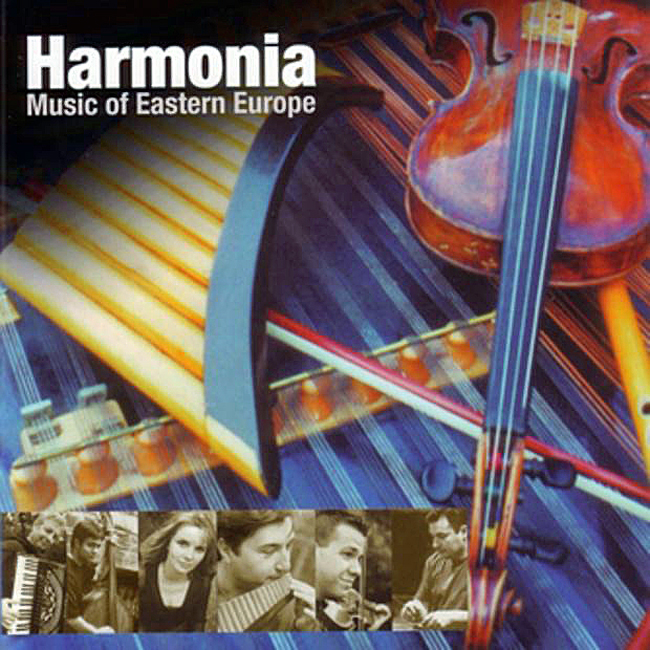
Harmonia – Music of Eastern Europe (Traditional Crossroads CD 4313, 2003)
It’s always been the case that the various ethnic immigrant groups traveling to the USA have settled in polarized neighbourhoods in different cities across the ‘States. New York City is the most obvious example, with its large ex-pat Jewish, Irish and Latin American communities, but it’s a fact that Cleveland,
Ohio, the city where many from Eastern Europe settled at the end of the 19th century, has more Slovenians than any other city in the entire world (including, apparently, anywhere in Slovenia itself).
Bolstered by a substantial new influx in the post-communist 1990s, Cleveland’s older Eastern European society, which includes Ukrainians, Slovaks, Croats and Hungarians, received a substantial shot in the arm of old-country culture, which has considerably re-enlivened the traditional music scene there. Harmonia is the direct result of this new wave blending with and inspiring the existing population.
Accordion player and founder Walt Mahovlich has grandparents who come from Croatian and Hungarian
backgrounds and Marko Dreher (violin, tamburica) has a Croatian father, whilst Cimbalom expert Alexander Fedoriouk (see also his excellent solo album on Traditional Crossroads), flutist Andrei Pidkivka and singer Beata Begeniova – two Ukrainians and a Carpatho-Rusyn respectively – are recent arrivals. The final group member, bassist Adam Good, clearly has different ethnic origins.
Arrival in the USA has provided the immigrant musicians with a new opportunity too – to blend their particular cultural style with that of those from neighbouring countries/cultures. In Fedoriouk’s words – “Beata and I lived only a 7-hour drive apart. We could have visited each other. But I had no idea
of what was happening there musically. I didn’t know her music.”
With a similarity in instruments, aspects of composition and performance across the entire region of Eastern Europe, there is much to be shared between these musicians, including being able to explore new musical directions as well as finding common currents. Harmonia manage a very elegant cross-cultural fusion on this set of fourteen songs, dances, and instrumentals out of tradition, from Slovakia, Bukovina (Romania/Ukraine), Romania, Croatia, Ukraine, and Hungary.

Author: Dave Atkin
