
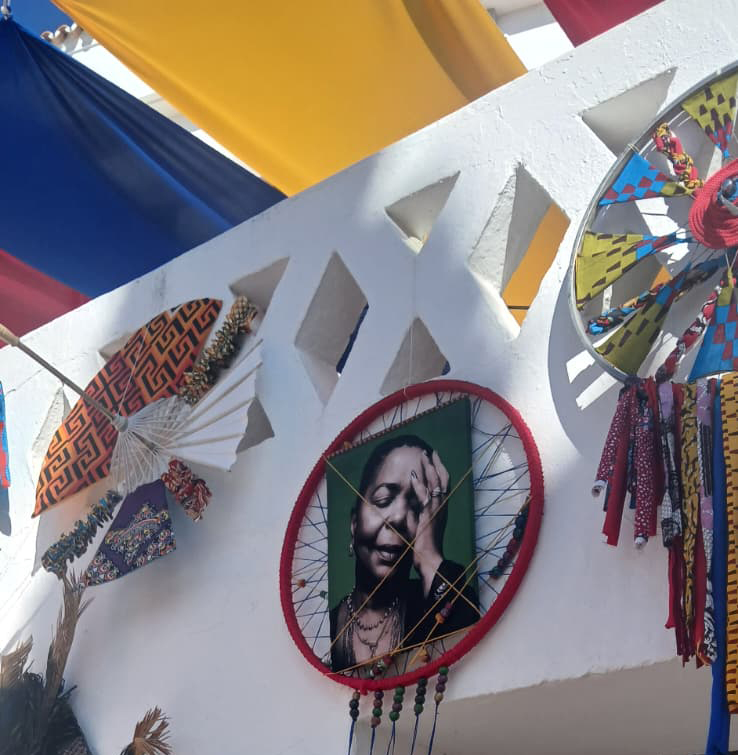
On Friday, June 27, at Festival MED 25, dedicated this year to Cabo Verde, not only did more people arrive, but we were also greeted by a suffocating heat. Yet, the intense warmth did nothing to dampen the festive spirit; the atmosphere grew even more vibrant as everyone eagerly embraced the celebration.
At 8:30 PM, as day faded into night, two men quietly took the Chafariz stage in Louie, Portugal. No electronic gadgets, just pure, authentic instruments. Justin Adams, a British musician wrapped in an orange scarf, drew raw emotion from his electric guitar and pedalboard rooted in rock. Beside him stood Mauro Durante, an Italian with bare arms and a tamburello in hand, releasing a cascade of violin melodies and heartfelt vocals. Their set, including songs like “Ghost Train” and “Talassa,” gracefully bridged tradition and modernity.
We drifted next to the Cerca stage, where A Garota Não, Cátia Mazari Oliveira, stood ready. Singer-songwriter, yes, but more than that: a witness to a world spinning through crisis after crisis. The audience leaned in, hushed, eyes fixed. Her lyrics weren’t written to entertain; they were meant to confront. Love and anger. Nostalgia and domestic violence. Gentrification and Inequality. Hatred and xenophobia. Each word struck a chord. And when her last note faded, a wave of voices from the crowd broke out, one shared memory refusing to be erased: “No to fascists. Always April 25.”
At 10:15 PM, we headed to the Matriz stage for the Orquestra Cesária Évora, led by Humberto Ramos, Cesária’s longtime pianist. This wasn’t a resurrection, it was reverence. Carefully arranged songs. An intimate atmosphere. A collective invocation of legacy.
Four voices stepped into Cesária’s shadow. Lucibela offered a wistful, restrained take on “Bésame Mucho.” Ceuzany channeled the emotional tides of the Atlantic in “Mar Azul.” Teófilo Chantre, a close collaborator, sang “Mãe Carinhosa” with tenderness rather than spectacle. And the young Elida Almeida closed with “Sodade,” that soul-aching hymn to exile that Cesária made immortal.
Each singer performed three songs from Évora’s canon, not to show off, but to surrender to the music. What lingered was reverence. They didn’t perform; they allowed the songs to live through them. And the audience, nearly devout in their attention, felt it. This was no imitation. It was communion. Though Cesária Évora left this world in December 2011, her spirit echoed in every note.
We stayed in Matriz, where The Gladiators carried reggae forward as a family legacy. Al Griffiths, the lead singer, swayed his hips with ease, taking short steps across the stage. His dance was minimalist, mostly marching and jumping to the beat, his arms tracing slow circles in the air. Meanwhile, a young crowd stood entranced, as the heartbeat of roots reggae pulsed at full volume. The rhythm was driven by Anthony Griffiths on drums, while vocalist Al kept time with a steady, measured cadence.
Together, the brothers, Al and Anthony, uphold the legacy of the band founded by their father, the late Albert Griffiths, in 1968. The Congos, another legendary Jamaican band, were also on the bill, but we didn’t stay to see them, eager to discover what the Cerca stage had in store.
At the Cerca stage, past midnight, physically worn from the weight of memorable moments and fatigue, we closed Friday’s musical journey with Fulu Miziki from Congo. At first, the group didn’t captivate us, their sound felt monotonous, distancing us from the stage. From the press area on the second floor, partially blocked by two elegant cypress trees, we later watched as the band at last ignited the crowd.
If there was one regret today, it was missing performances by Balqeis Aboomar, Walter Lobo, Sofiane Saidi, Cerys Hafana, and Homem em Catarse. Catching it all is impossible, but another night of joy and music at Festival MED still lay ahead.

Author: Rafael Mieses
