
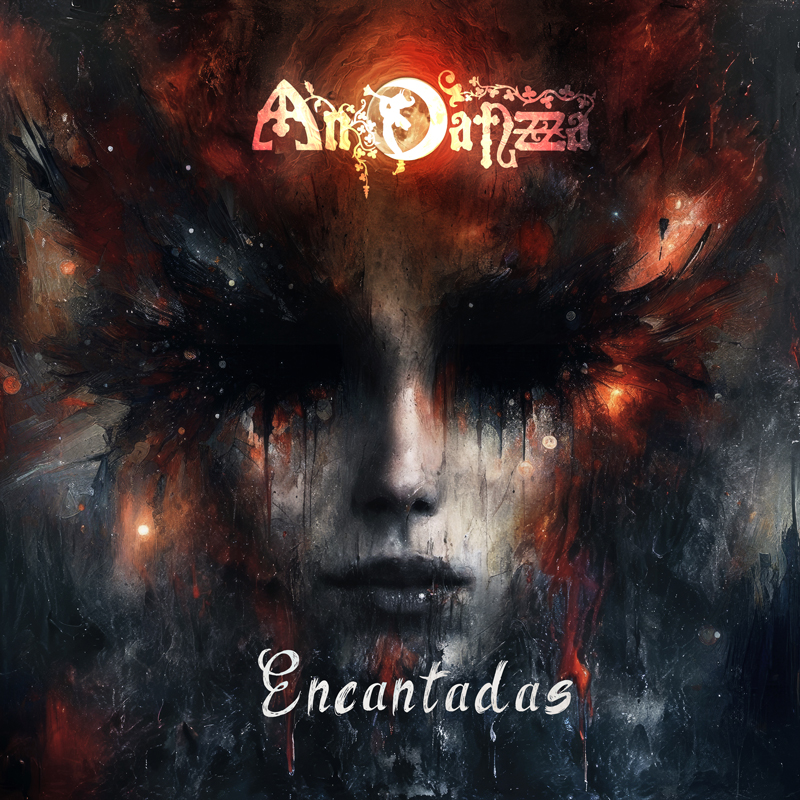
An Danzza – Encantadas (self-release, 2025)
An Danzza, the Spanish fantasy folk music project, released its tenth album, Encantadas (enchanted), in March 2025. The album explores legends of fairy-like beings from Spain and Portugal in the Iberian Peninsula, including mouras, alojas, and anjanas. These are ancient, mythical figures linked to fountains, rivers, and caves, particularly on the Night of San Juan (Saint John). The stories originate from regions such as Madrid, Murcia, Cantabria, the Basque Country, Extremadura, Asturias, Galicia, Catalonia, and Portugal.
The band seamlessly combines charming medieval and progressive folk music influences, alternating between festive and melancholic tones. Encantadas reflects An Danzza’s signature progressive folk style with a scintillating mix of Spanish roots and medieval music using a mix of frame drums, fiddles, flutes, guitar, hurdy gurdy, bagpipes and swooping, engaging vocals. Three singles, “Moura,” “Dama de Anboto,” and “Alojas” were released ahead of the full album.

Throughout the Iberian Peninsula, folklore is richly woven with tales of “encantadas,” supernatural women who haunt the margins of nature and time, suspended between curse and legend. These figures, though varied in form and function, consistently embody themes of enchantment, transformation, and the enduring human fascination with the unknown. An Danzza’s album introduce the following legends in Encantadas, drawn from distinct regions of Spain and Portugal.
1. La encantada de Usanos [The Enchanted Woman of Usanos] (Guadalajara)
In the village of Usanos, within the province of Guadalajara, local tradition holds that during the mystical night of Saint John, a spectral woman appears on Castillejo Hill. Residing in a cave beside a stream, she is typically seen combing her long hair with a golden comb while clutching a dagger in her other hand. Trapped by enchantment, she yearns for liberation, which may only be granted through substitution. In the most prevalent version of the tale, the woman offers travelers a choice among three objects: a comb, a mirror, and a dagger. Choosing either of the first two results in the traveler becoming ensnared in her fate, taking her place within the spell. Only by selecting the dagger can one resist her enchantment, forcing her to remain imprisoned for another year.
2. Xana (Asturias and León)
Originating in Astur-Leonese mythology, Xanas are forest spirits closely linked to nature and water. Although generally benign, their beauty and elusiveness can also become fatal. The legend of Xana Carissia, set alternately in Asturias or León, intertwines myth with Roman history. According to the tale, General Titus Carissius was dispatched to subjugate the Asturians. While stationed near the Narcea River, he encountered a breathtaking woman combing her golden hair with a golden comb. Enchanted by her presence, the general pursued her through the forest. Each time he neared her, she vanished deeper into the wilderness, ultimately diving into a lake. Captivated beyond reason, Carissius followed her into the water and drowned, his ears filled with the mocking laughter of the Xana.
3. Alojas (Catalonia)
Catalan mythology introduces the Alojas, timeless aquatic beings who dwell beneath lakes in crystalline palaces. Despite their ancient origins, they always appear youthful, marked by a luminous star on their foreheads. These beings are most active on full-moon nights, when they emerge to dance and sing on the lake’s edge. The legend associated with Lake Bañoles/Banyoles warns of the Alojas’ lethal charm; men drawn to their radiant beauty are lured underwater, never to be seen again. Consequently, local lore advises caution and avoidance of the lake during these enchanted nights.
4. Moura (Galicia)
Galician and Portuguese folklore abounds with stories of the Moura, a female guardian spirit bound to geographical features such as caves, springs, and ancient ruins. One particularly vivid tale is that of the Moura from Castro de Negros in Pontevedra. By day, she appears as a beautiful young woman, but by night she transforms into a formidable serpent. The path to her liberation is both specific and perilous: a man must ascend the mountain on Saint John’s Night and, as she coils around him in her serpentine form, pluck a carnation from her mouth using only his lips. To date, no one has succeeded. Fear inevitably overcomes each would-be rescuer, and some have even fallen to their deaths, thus perpetuating the Moura’s eternal captivity.
5. La Encantá (Murcia)
Murcia’s folklore teems with narratives of Moorish enchantresses, of which the tale of La Encantá from El Palmar is among the most compelling. According to legend, a young man named Pepurro stumbled upon a remote fountain guarded by an unsightly old woman. Thirsty, he attempted to drink, but the woman imposed an unusual condition: he must first kiss her. Initially repulsed, Pepurro eventually acquiesced, either out of despair or drunkenness, as some versions suggest. Upon kissing her, she transformed into a stunning young Moorish woman who offered him treasure and marriage. However, when Pepurro invoked the Christian expression, “Jesus, Mary, and Joseph!,” she vanished instantly, taking with her the riches and the fountain.
6. Las hadas del Hayedo de Montejo [The Fairies of Montejo Beech Forest] (Madrid)
The ancient Hayedo de Montejo, a beech forest in Madrid, harbors an unsettling legend. It is said that its flora and fauna once included humans, transformed into stones, animals, or plants by forest fairies. These magical entities still dwell in its depths and are known to manifest through laughter, whispers, and fleeting lights. According to lore, to heed these sounds is perilous, for those who follow them may be transformed themselves, doomed to become a part of the forest’s enchanted ecosystem.
7. Fecha os Olhos [Close Your Eyes] (Portugal)
From the rugged paths near Zebreira in Portugal comes the tale of a Moura whose spell is both irresistible and perilous. On Ascension Thursday, she emerges to display her treasure beneath the sunlight, while calmly combing her dark hair. This rare appearance, however, serves a darker purpose. Any onlooker who gazes upon the treasure becomes instantly enchanted, taking her place within the spell’s binding grip. Thus, villagers have learned to avoid the Ovelha do Carreiro path on that particular day. The accompanying song, sung in Portuguese, is a tribute to An Danzza’s Portuguese-speaking fans.
8. Cantamora (Extremadura)
In Usagre, Extremadura, in western Spain, the legend of Cantamora combines historical tragedy with mythic transformation. She is depicted as a half-human, half-fish entity who sings sorrowful melodies by the Fuente de la Luná on the night of San Blas (Saint Blaise). Her origins, however, are deeply human. In the 13th century, she was a young woman, the daughter of an Arab warden, permitted to leave the castle only once a month to fetch water. During one such outing, she encountered a Christian man and fell passionately in love. Their secret romance, marked by joyful singing and sudden vitality, aroused her father’s suspicion. Upon discovering the affair, he ordered the Christian’s execution. That same night, the grieving woman threw herself into the spring.
9. Dama de Anboto (Basque Country)
High atop Mount Anboto, straddling the provinces of Biscay and Álava, lies a cave believed to be the residence of Mari, an elemental goddess at the heart of Basque mythology. Unlike other encantadas who are victims of enchantment, Mari is sovereign and divine. She embodies the natural world and governs the elements, capable of summoning storms or rewarding truthfulness. Her dominion is absolute, and those who visit her must observe strict ritual conduct: one must never sit in her presence and must leave her cave through the same route by which they entered. Every seven years, she changes her dwelling, and when she travels, she is said to fly through the skies in a chariot of fire.
10. Anjanas (Cantabria)
Cantabrian legend introduces the Anjanas, guardian spirits of the forest who embody both the nurturing and volatile aspects of nature. The tale of two Anjana sisters, residing near the Asón River, exemplifies this duality. One sister, with golden hair, was gentle and protective. The other, bearing silver hair, delighted in mischief, playing relentless pranks on nearby villagers. Eventually, the golden-haired Anjana, weary of the chaos, cast a spell that imprisoned her sister beneath the river’s source, her flowing silver hair forming the dazzling Cailagua Waterfall. Overcome with remorse, the elder sister sought to reverse the incantation but failed to recall the necessary words. She now haunts the library of Brenavinto Lake, endlessly searching for the spell that will restore her sibling.
11. Encantadas — A Coda
The final track of the EncantHadas album serves as a lyrical meditation on the tragic archetype of the enchanted woman. Whether cursed for vanity, punished for love, or simply woven into the fabric of a place, these figures are condemned to remain in limbo. Their fates are cyclical—bound to caves, springs, lakes, or mountains—reappearing under rare conditions, perhaps on a holy night or at a celestial alignment. They do not age, yet they do not live; they wait, suspended between desire and doom. Thus, their stories persist, whispered through generations, nourished by fear, wonder, and the faint hope that one day, they might finally be freed.
Currently based in Madrid, An Danzza has its roots in the region of Murcia in southeastern Spain.
The Core Members of An Danzza

Andrés Campuzano (Guitar & Bouzouki) – A multi-instrumentalist and the creative force behind An Danzza, Campuzano draws inspiration from artists like Enya, Loreena McKennitt, and Mike Oldfield. His expertise in music production and his enigmatic stage presence make him central to the band’s sound.

Haydée Mariñoso (Vocals & Percussion) – An expressive and versatile vocalist, Mariñoso shifts seamlessly between delicate and powerful tones. She is a certified vocal coach (Institute for Vocal Advancement) and has training in acting and belly dance.

Roberto Rodríguez (Violin) – A seasoned musician with experience in symphonic orchestras and music education. Rodríguez studied at the Conservatorio Superior de Música de Córdoba and the Conservatorio Luigi Cherubini in Florence. He brings western classical expertise to An Danzza’s folk arrangements.
Discography: Visions of a volva (2023), Ancestrance (2021), Song of the rushes (2020), The claws of dawn (2018), Whispers of the forest (2016), Scintilla (2014), Tierra de Andanzas (2013), Canción de los juncos (2011), Last Autumn Tears (2010).
Buy Encantadas.

Author: Angel Romero
Angel Romero y Ruiz has dedicated his life to musical exploration. His efforts included the creation of two online portals, worldmusiccentral.org and musicasdelmundo.com. In addition, Angel is the co-founder of the Transglobal World Music Chart, a panel of world music DJs and writers that celebrates global sounds. Furthermore, he delved into the record business, producing world music studio albums and compilations. His works have appeared on Alula Records, Ellipsis Arts, Indígena Records and Music of the World.