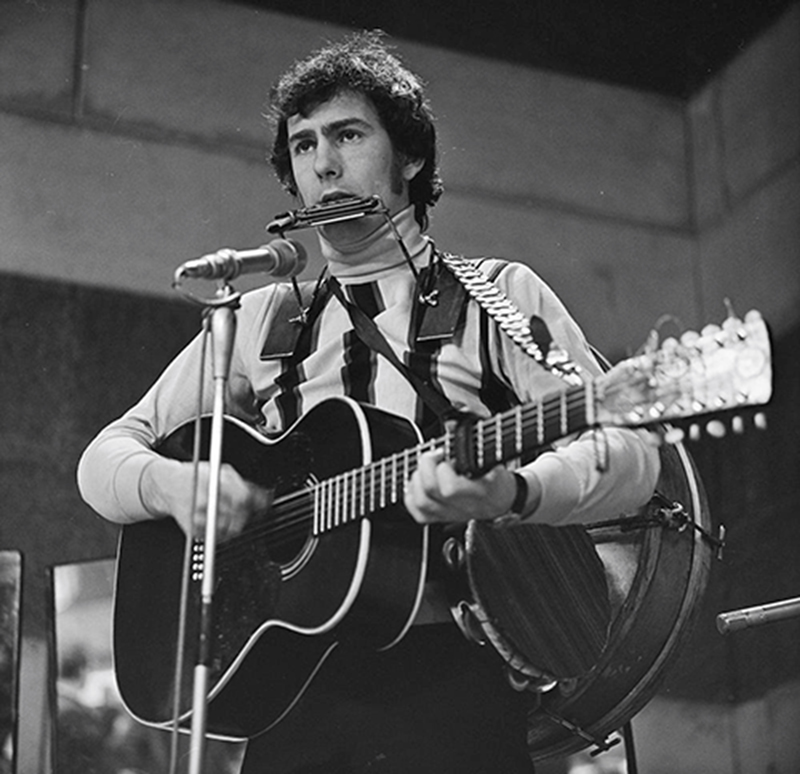
(headline image: Photograph by A. Vente or A & F. van Geelen – Don Partridge. Dutch TV program Fenklup, recorded 8 March 1968, broadcast 15 March 1968., CC BY-SA 3.0)
WRITER and musician John Phillpott recalls the arrival of the new kids on the block, hip young British men with guitars who set the London streets of the 1960s ablaze with their unique blend of folk, blues and popular song. One of these latter-day wandering minstrels was destined to stand out from the rest… a man by the name of Don Partridge, who would become known as the uncrowned King of the Buskers.
ACCORDING to English folklore, legendary poor-boy-made-good Richard Whittington had set out from his home village convinced that the streets of London were paved with gold.

The truth was, of course, far less palatable. Not that the unsavoury, rubbish-strewn mediaeval reality mattered all that much, because our 14th century wayfarer would eventually not only gain great riches, but also become Lord Mayor of his adopted capital city.
Immortality was assured. And since then, at every Christmastime, the folk version of Dick Whittington’s story is presented in pantomime form at theatres across Britain, the archetypical rags-to-riches story.
A few centuries later, another village boy would also set out on the road to London searching for great wealth of a different kind… the music of the streets.
And by the mid-1960s this was rapidly taking the form of a heady, ever-proliferating mixture of what’s now termed as Americana. For back then, ‘Roots music’ was rapidly setting down… well, roots.
In the spring of 1967, the fabled Summer of Love was about to dawn. So at the age of 17, and with increasingly itchy feet, I left my parents’ home in the English Midlands to visit the city that, while perhaps not being paved with gold, most certainly boasted roads blessed with a veritable smorgasbord of sound.
Buskers. From Carnaby Street to Portobello Road, Oxford Street to The King’s Road, the highways and byways of the great city rang to the sound of guitars, banjos, harmonicas, saxophones and numerous other instruments as musicians entertained the crowds, hoping that their efforts would be rewarded by passers-by dropping coins into wide open instrument cases.

Music seemed to be around every corner of the capital. English folk songs, blues, ballads, ragtime, you-name-it. Time and again, this callow youth from the provinces would eagerly reach down and drink from an ever flowing and intoxicating musical cup.
And it was in Berwick Street Market, London, one sunny morning in early May that I came across the man dubbed King of the Buskers, energetically plying his trade, regally resplendent in snakeskin jacket, blue jeans and cowboy boots.
The King was surrounded by a large crowd of admirers, converts and perhaps just the plain curious. For this fresh-faced teenager, it was exotic beyond belief.
And gazing in wonder as the busker held his Gibson acoustic guitar high to maximise its sound, bass drum booming and cymbal crashing in time, and with a neck harness ready to reverberate to a wailing harmonica and rasping kazoo, I was utterly entranced.
As the one-man band busker played, a slightly built, blonde-haired young woman darted through the crowds, rattling a bucket and collecting donations. I later discovered that this part of the operation was conducted by a ‘bottler’.
I asked a member of the gathered throng if they knew the busker’s name. Yes, he did indeed. And although unknown to both of us, it just so happened that national fame was just around the corner for Don Partridge…
Don Partridge brought a breath of fresh air to the British pop charts in the late 1960s with the hit songs “Rosie” and “Blue Eyes.” The fresh air was literal, for Partridge’s forte was not the recording studio but playing outdoors — as a busker on street corners, in bus shelters and anywhere else he could find a pitch.
He was a veritable one-man band, blowing into a kazoo or harmonica while playing his guitar and crashing a bass drum and cymbal strapped to his back and which he controlled with his elbow and a pedal attached to his foot.
His chart achievement was based on his ability to turn this novelty street act into a warm and engaging sound on vinyl record.
At the height of his commercial success in 1969, he hired the Albert Hall, London, and gloriously filled its famous stage with a procession of the capital’s finest buskers and street entertainers.
Partridge led a colourful early life. He left home at 15 and had a variety of manual jobs. By the early 1960s he was an itinerant musician, travelling around Europe, as did many other English folk musicians of the time, including Davy Graham, John Renbourn and Donovan.
According to the Oxford dictionary, the definition of busking is “to play music or otherwise perform for voluntary donations in the street or subway”. Nearly as old as the oldest profession itself, street entertainers have been peddling their wares to passersby for a small remuneration since time immemorial.
In the 1950s, the guitar came into prominence via skiffle, and young would-be buskers took to the easily portable instrument like ducks to water. All they had to do was learn half a dozen chords, memorise a few lyrics, and away you go – hit the streets and make enough for the next meal.
If you were to ask people of a certain age to name a busker, nine times out of 10 the first name out of the hat would be Don Partridge. A self-confessed itinerant, Don plied his trade all over Europe long before fame came knocking.
Mostly, though, he worked the streets of London, where a daily cat-and-mouse game would be played out between the canny guitarist and the local policemen, who would either chase him off, or if caught, they would drag him up before the magistrates for a telling off and a two pounds fine.
This would be a small price to pay as a good busker on a prime pitch could earn quite a lot of money.
Donald Eric Partridge was born in Bournemouth on October 27, 1941, of gypsy stock, which goes some way to explaining his nomadic lifestyle. By the age of six, the family had relocated to Earls Court in London, where a young Don would often see street performers, such as the Happy Wanderers Jazz Band, working close to his home.
His father, Eric, a Django-Reinhardt-style jazz guitarist, bought him a ukulele banjo on which Don learnt a few tunes, mostly George Formby songs. He left school at 15 and worked at numerous labouring jobs.
Before long, he had headed for Dover and the Continent. He hitchhiked around France for six months and realised that if he took up busking, he could earn enough money to fund his travels indefinitely.
Returning to London, he bought a guitar, learnt a few chords, and for the next three years performed in coffee bars and folk clubs, sometimes as a duo with another budding folk singer, Alan Young.
When the constant hustling for gigs became a chore, the pair tried their luck on the streets. Don’s first pitch was outside Richmond railway station, where, 40 minutes later, he was moved on by an irate railway inspector. His takings amounted to an impressive 13 shillings.
As summer approached, Don and Alan struck out for the West Country with a companion called Pat in tow acting as their ‘bottle man’, the person responsible for collecting the money and keeping an eye out for the law.
Their first port of call was Weymouth, where they worked the promenade next to the clock tower before moving on to Dorchester. Back in London, they secured a pitch in Charing Cross Road where an intrigued reporter from the Evening Standard interviewed and photographed the new style of buskers – hip young men with guitars, as opposed to the typical rough-looking variety usually found in the West End.
Gradually the pair worked their way up to a lucrative patch in Leicester Square, where they entertained the evening cinema and theatre queues at the Odeon, Rialto Empire and Prince Charles.
During the day they could be found at the markets in Petticoat Lane, Portobello Road, and Brick Lane, or sometimes they would go across to Old Compton Street and perform a burst, a quick 10 minutes, as the crowds exited the Casino Cinerama Theatre.
Over time, Don branched out on his own and settled into a circuit that took him to Ireland in the winter and Europe during the summer months, taking in Geneva, Paris, the French Riviera, Germany, and Stockholm. During his travels he would hire a bottler.
While working a pitch in London with another busker, Pat Keene, the pair accepted an offer from a passing American record producer, Steve Rowland, to make an album. Apparently, this kind of overture was commonplace and usually came to nothing.
But for once the proposition was real, as Rowland’s portfolio included rock acts The Pretty Things and Salisbury’s Dave Dee, Dozy, Beaky, Mick & Titch. A couple of weeks later, the duo entered Denmark Street Studios with Rowland and session guitarist Alan Caddy and committed their repertoire of old folk and blues tunes, plus one Don Partridge original, I Gotta Go Now, on to tape in just under an hour.
For their troubles, they each received £10, two copies of the album, and months later, a royalty check for five shillings and nine pence. Released on the Fontana label, the album did absolutely nothing, the Melody Maker dismissing it as ‘middle-rate skiffle’.
Not long after his initial foray into the world of recording, Don kitted himself out with the paraphernalia of a one-man band – guitar, harmonica and kazoo in a neck harness; tambourine fixed under the arm; and a bass drum strapped to his back operated by a leather strap attached to his foot.
The concept wasn’t entirely new, as musicians dating back to the Middle Ages had found ways of playing multiple instruments simultaneously. In the 1930s and 40s, the bluesmen Jesse Fuller and Doctor Ross used guitar, harmonica, and drum set-ups. Fuller’s San Francisco Bay Blues would go on to become a staple of many apprentice guitar strummers.
In 1968, Don gained national recognition after he was spotted in Soho by the record executive Don Paul, previously of the rock group The Viscounts. He was invited to Regent Sound Studios to record a single containing two original compositions, Rosie c/w Going Back to London (released in January 1968), for the Columbia label.
To promote the single, he appeared on television’s Eamonn Andrews Show in a segment filmed on the Kings Road, Chelsea. The publicity pushed the single up to number four in the charts.
Don suddenly found himself in demand, becoming a fixture on the radio and regularly appearing on television in shows such as the Bobbie Gentry Show, Roger Whittaker’s Whistle Stop, Set ’em up Joe with pop star and talented British guitarist Joe Brown, the children’s show Hullabaloo, and on Top of the Pops, where the novelty of a one-man band caught the public’s imagination.
With agents and promoters clamouring to book this unique act, Don reluctantly took orthodox gigs in nightclubs and joined a package tour with Gene Pitney, Amen Corner, Status Quo, and Simon Dupree and the Big Sound.
However, the bright lights weren’t to his liking, and he quickly became increasingly bored playing his one hit.
Nevertheless, the royalties came flooding in, helping him fulfil an ambition to stage a concert at the Royal Albert Hall on January 29, 1969, solely consisting of buskers.
Compere Nat ‘Paris Nat’ Schaffer introduced a motley array of tap dancers, accordionists, spoon players, jugglers, banjo pluckers, jesters, guitar pickers, violinists, escapologists, a strong man and a Punch and Judy Show.
An album of the event was recorded and released, simply entitled The Buskers.

However, Don’s subsequent single, Breakfast on Pluto c/w Stealin’ (released in January 1969), struggled to a lowly number 26 in the record charts. The novelty was wearing off.
In 1970, Don formed the acoustic folk/jazz/rock ensemble Accolade with guitarist Gordon Giltrap. He headed to Stockholm, where over a three-year period he married a Swedish girl and recorded an album, 1974’s Don Partridge and Friends.

Late into his career, Don found favour with the younger generation when he acted as support to the electronic duo Lemon Jelly and played gigs with the indie pop band British Sea Power. He also appeared on the TV comedy music quiz show Never Mind the Buzzcocks as an ‘identity parade’ guest.
His final days were spent in the town of Peacehaven, East Sussex, busking in the local shopping precinct and various resorts along the coast. But by now the years of carrying a heavy drum on his back had taken their toll and he preferred to sit with his bass drum on the floor.
Don died suddenly on September 21, 2010, of a heart attack while out walking. A year later, his partner Pamela Hall passed away from cancer. He had been married three times and is survived by four daughters and two sons.
For me, Don Partridge will always be a free spirit, a talented singer, songwriter, musician, and poet. And without doubt he richly deserved the accolade ‘King of the Buskers’ as I had discovered for myself on that sunny spring day all those years ago when – as far as I was concerned – the streets of London were paved with a wealth far greater than gold.
The author would like to acknowledge Bournemouth Beat Boom for biographical information supplied about the late Don Partridge, ‘King of the Buskers’.

Author: John Philpott
Author and journalist John Phillpott has written for many newspapers and magazines during a career that spans more than 50 years. His latest book Go and Make the Tea, Boy! is a memoir of his days as a young reporter.