
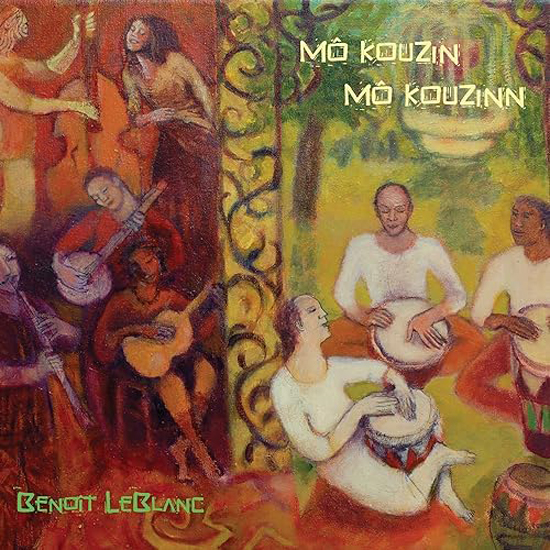
Benoît LeBlanc – Mô kouzin, mô kouzinn (self-released, 2025)
Mô Kouzin, Mô Kouzinn by Montreal-based singer, songwriter, and producer Benoît LeBlanc presents 27 pre-jazz songs rooted in slave cultural traditions, Afro-Caribbean rhythms, and early laments that shaped some foundations of North American roots music.
The album is the product of years of research into the overlooked musical traditions of enslaved and free people of color in the 19th and early 20th centuries. The repertoire resonates with sounds from Haiti, Martinique, and Guadeloupe, offering a counterpoint to the more widely known field hollers. While jazz historians often reference Congo Square in New Orleans as a birthplace of jazz, LeBlanc includes songs once performed there, restoring voices absent from mainstream accounts. Beyond music, the project underscores the survival of Kouri-Vini, a nearly extinct Creole language still spoken in southwestern Louisiana.
The album includes historical pieces such as Un nòt kankan, Kalinda, Dansé Marie Laveau, and Regrets d’une vieille mûlatresse. Through these songs, LeBlanc skillfully resurrects a repertoire with modern arrangements that bridges continents, languages, various musical traditions and generations.
LeBlanc first embraced rock as a teenager but soon traced its roots through blues, folk, country, and R&B. A turning point came in 1973 at Montreal’s inaugural traditional music festival, where he discovered the heritage of French-speaking communities in North America. This led him toward the musical traditions of Québécois, Acadians, Cajuns, and Louisiana Creoles. Influenced by poetic songwriters such as Georges Brassens, Félix Leclerc, and Gilles Vigneault, he expanded his horizons with trips to Louisiana in 1976 and France in 1977.
He formed the trio Chœur de pomme in 1979 and began performing in Quebec cafés. His talent gained recognition at the Labatt Blues Contest (1984) and the Festival de la chanson de Tadoussac throughout the 1980s. Performances abroad followed, including concerts in Australia.
From 1990 to 2004, LeBlanc hosted programs on Montreal’s community station CIBL-FM, specializing in Louisiana’s music traditions and later producing shows devoted to poetic song. During the same period, he contributed as a journalist to Chansons magazine and authored the section on Quebec song in Panorama de la littérature contemporaine au Québec.
His first album, Poursuivre (1995), earned critical praise for bringing together Louisiana and Maritime francophone traditions with Quebec’s chanson heritage. Subsequent works such as L’homme dans la Lune (2002) and La Voie des sources (2009) were lauded for their poetic lyrics, authenticity, and emotional depth. Later albums, including L’homme à l’arbre (2014) and Le pain, le pays, la paix (2017), offeerd a mix of biting, moving, and rhythmically rich pieces.
For Mô Kouzin, Mô Kouzinn, LeBlanc gathered an ensemble of skilled musicians: the incredible Daniel Bellegarde on percussion; Duane Larson on clarinet and flute; Jordan Officer on guitar, violin, and banjo; Pierre Perron on clarinet; Sara Rénélik on vocals; J.D. Slim on slide guitar; Éric Rock on banjo; and Érik West-Millette on bass and cuatro. Pascale LeBlanc contributed vocals, guitar, and percussion, while Benoît LeBlanc himself performed on guitar, mandolin, accordion, and voice.
Recording took place at studios led by Stacy LeGallee and J.D. Slim, with mixing by Boris Petrowski, Slim, and LeGallee. Mastering was handled by Slim, and West-Millette served as assistant producer.
Track listing:
- Un nòt kankan 05:13
- Mizè 01:11
- Lé zoñon 03:27
- Bon Djé 01:44
- Éy laba 03:46
- Pa kapab 00:29
- Kan mo té piti 04:14
- Moluron hé! (& Wara Sin-Malo) 04:51
- Blansh Toukoutou 02:55
- Youn tou tou 00:34
- Mishé Banjo 02:56
- Milatrès 01:24
- Patat-la kwit 02:47
- Rémon 01:04
- Aurore Bradaire 01:20
- Mo pa linmé ça 01:47
- Marshan de pwason 01:04
- Mô Kouzin, mô kouzinn 01:26
- Moulin 01:56
- Kalinda 03:08
- Kom ti koshon 01:05
- Si li lé bat 02:00
- Mokeur shanteur 03:41
- Salangadou 01:30
- Dansé Marie Laveau 07:40
- Regrets d’une vieille mûlatresse 02:02
- La misère d’Ulysses Picou 03:55

Author: Angel Romero
Angel Romero y Ruiz has dedicated his life to musical exploration. His efforts included the creation of two online portals, worldmusiccentral.org and musicasdelmundo.com. In addition, Angel is the co-founder of the Transglobal World Music Chart, a panel of world music DJs and writers that celebrates global sounds. Furthermore, he delved into the record business, producing world music studio albums and compilations. His works have appeared on Alula Records, Ellipsis Arts, Indígena Records and Music of the World.