
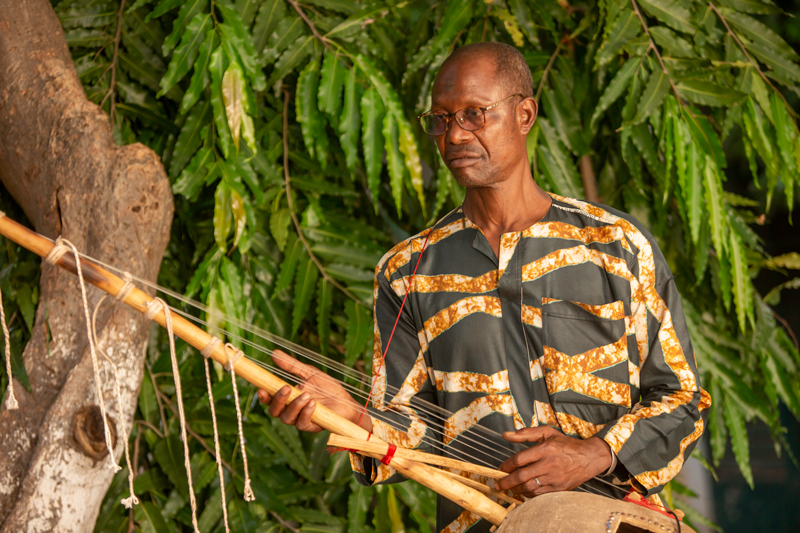
(Headine image: Benego Diakité – Photo by Aboubacar Traoré)
Brehima “Benego” Diakité (b. 1965) was born and raised in Siekorolé, in the Yanfolila cercle of southern Mali. He emerged as a defining voice in Wassulu (southern Malian) music through his command of the kamale ngoni (or kamel ngoni), often described as a youths’ harp. The instrument was developed in the 1960s as a secular counterpart to the donso ngoni (hunters’ harp), maintaining the same structure and tuning concept while typically sounding at a higher pitch. In Wassulu social life, the kamale ngoni became essential in gatherings where the community got together to enjoy dancing or music, alongside ensembles that might include singing, karinyan (scraper), bolon (bass harp), and soku (fiddle).
In 1985, Diakité co-founded Oumou Sangaré’s band in Bamako and became a key contributor to her landmark debut cassette Moussolou (1988). During the decades that followed, he remained Sangaré’s accompanist of choice as her career expanded from national prominence to international stature. His deeply rooted Wassulu approach to the kamale ngoni helped define the signature sound of Oumou Sangaré’s group.
Diakité’s major release in 2026 brought to light a different facet of his music. A Djinn and a Hunter Went Walking, a collaboration with Malian balafon maestro Neba Solo was released on February 13, 2026, co-produced by Nick Gold, Ousmane Haïdara, and Sonny Johns. The two-disc CD edition presents two complementary settings: disc one expands their acoustic instrumentals with vocals, percussion, and subtle additions of Mellotron, guitar, and strings. Meanwhile, disc two documents their original duo performances, recorded unadorned in a Bamako garden beneath a mango tree after sundown, with crickets audible in the quiet spaces.
The partnership traces back more than a decade, when Gold and Haïdara first imagined bringing together instruments rooted in neighboring Malian cultures while preparing sessions for Sangaré’s Seya album for World Circuit. Neba Solo, from Kenedougou, where the balafon has been traditionally played to accompany agricultural work, joined those sessions and developed an immediate affinity with Diakité, whose Wassulu background is closely tied to hunting culture and the donso ngoni tradition. That chemistry, heard in warm-ups and informal exchanges, led to dedicated recording plans. Neba Solo brought a customized balafon with an extended bass register; Diakité brought his deepest donso ngoni.
Discography:
A Djinn and a Hunter Went Walking, with Neba Solo (Etoile Audio/Nonesuch Records, 2026)

Author: Angel Romero
Angel Romero y Ruiz has dedicated his life to musical exploration. His efforts included the creation of two online portals, worldmusiccentral.org and musicasdelmundo.com. In addition, Angel is the co-founder of the Transglobal World Music Chart, a panel of world music DJs and writers that celebrates global sounds. Furthermore, he delved into the record business, producing world music studio albums and compilations. His works have appeared on Alula Records, Ellipsis Arts, Indígena Records and Music of the World.