
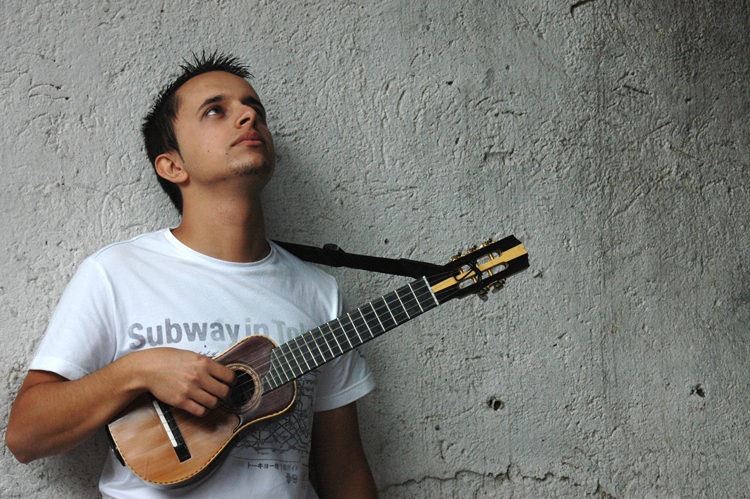
(headline image: Beselch Rodríguez holding a timple)
The timple, a small guitar with five nylon strings originating from the Canary Islands, Spain, is a quintessential instrument in Canarian traditional music artists. Variants with four strings exist, particularly in certain regions of Tenerife. Similar instruments can be found in the Spanish mainland and Spanish-speaking America, as well as Portugal and Hawaii.
Historically, the timple has roots in Spanish Renaissance and Baroque vihuelas and guitars. The Spanish string instruments arrived to the sparsely populated islands with Spanish sailors and settlers.
Initially, the timple was called tiple and camellito or camellillo. Its systematic production began in the 20th century, notably by Simón Morales Tavío in Lanzarote.
Crafted primarily from woods like white spruce, pine, and ebony, the timple includes a soundboard, neck, and pegbox. Traditionally played by strumming, it has evolved into a cherished solo instrument.
Totoyo Millares, frequently referred to as “the master of all,” holds a pivotal place in the history of Canarian music. Juan Antonio Ramos sought to honor Millares through the 2006 project Los Monos del Maestro. Millares had begun teaching Ramos the secrets of the timple when the latter was only nine years old and transmitted to him an approach to music that was both open and bold.
He partly withdrew from the stage for several years, disheartened by earlier indifference toward the timple. Nevertheless, Millares’ effect on Canarian music is indisputable. He devised the first formal method for the timple at around ten years of age, released the first solo recordings for the instrument (eventually producing approximately eighty), and founded the first official timple academy in 1954, through which nearly 50,000 students have passed. He composed the first concerto for timple and symphony orchestra, founded the popular music group Los Gofiones, and took the instrument beyond the Canary Islands, performing in mainland Spain and abroad in countries such as Russia, England, and France.
Argelio Rojas (“Rojitas”) and Agrícola Álvarez in Tenerife, Casimiro Camacho in Fuerteventura, and, above all, Totoyo Millares in Gran Canaria initiated the recognition of the timple as a solo instrument. Before the interventions of this pioneering generation, the timple functioned almost exclusively as an accompanying instrument in Canarian ensembles, and even in the latter half of the twentieth century its solo role was widely considered unthinkable. These musicians began recording works that placed the timple in the foreground and undertook a sustained, often undervalued effort to secure respect for the instrument and to increase its visibility nationally and internationally.
The work of figures such as professors Francisco Rojas and José M. Aldana also proved decisive. Their introduction of guitar techniques into timple performance provided a significant technical stimulus, expanding the instrument’s expressive possibilities and consolidating its status within contemporary Canarian musical practice.
While traditionally tuned GCEAD, variations exist, including omitting the first (D) string to emulate a four-string ukulele, though this is less orthodox.
The Casa-Museo del Timple in Teguise serves as a hub for understanding the instrument’s history, craftsmanship, and cultural significance, with occasional concerts showcasing its versatility.
The timple’s enduring presence in Canarian folklore, coupled with the emergence of young talents, underscores its continued relevance and vitality in the Canary Island’s music scene.
Notable timple players include the late Luis Millares Sall (Totoyo Millares) from Las Palmas de Gran Canaria; the late José Antonio Ramos (Las Palmas de Gran Canaria); Domingo Rodríguez Oramas “El Colorao” (Vega de Tetir, Puerto del Rosario in Fuerteventura); and Benito Cabrera (born in Venezuela, grew up in Tenerife).
Meanwhile, the new generation of timple musicians includes José Domingo Curbelo (Órzola, Lanzarote), Alexis Lemes (Lanzarote), Althay Páez (Fuerteventura), Beselch Rodríguez (La Laguna, Tenerife), Yone Rodríguez (Gran Canaria), Pedro Izquierdo (La Matanza de Acentejo, Tenerife), Germán López (Gran Canaria), Josele del Pino (Puerto de la Cruz, Tenerife), Gabriel García (Lanzarote), Abraham Ramos Chodo (Las Palmas de Gran Canaria), Abraham Ramos Sánchez (Ingenio, Gran Canaria), Javier Castro-Gomis (born in Venezuela, based in La Orotava, Tenerife), Juan Pablo Pérez López, aka Juan Pablo Magec (La Orotava, Tenerife), Hirahi Afonso (Gran Canaria), David Duque Infante (Tenerife), and Jesús Martín-Fernández (La Palma).
Although there are few female players, the most prominent include Laura Martel (Valsequillo de Gran Canaria), Julia Rodríguez, daughter of Domingo Rodríguez El Colorao (Fuerteventura) and Rosy Lorenzo (Fuerteventura).

Author: Angel Romero
Angel Romero y Ruiz has dedicated his life to musical exploration. His efforts included the creation of two online portals, worldmusiccentral.org and musicasdelmundo.com. In addition, Angel is the co-founder of the Transglobal World Music Chart, a panel of world music DJs and writers that celebrates global sounds. Furthermore, he delved into the record business, producing world music studio albums and compilations. His works have appeared on Alula Records, Ellipsis Arts, Indígena Records and Music of the World.
Updated the timple article with new historical details.