
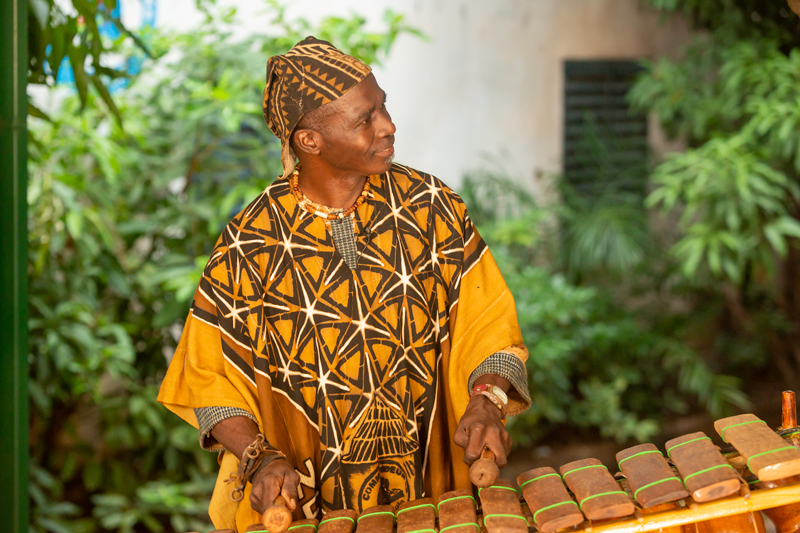
Malian musician Neba Solo (born Souleymane Traoré in 1969), is a leading contemporary figure of the pentatonic Senufo balafon tradition, known in Mali as the bala. Raised in the farming village of Nebadougou in southern Mali’s Kénédougou area, he was recognized early for his command as a balafon player, singer, and percussionist. Over decades of performances, recordings, videos, and television appearances, he has become widely associated with bringing bala music to larger audiences.
Neba Solo’s effect rests on both sound and design. He expanded the instrument’s possibilities by building a larger balafon with an extended bass register, then placed it in bigger ensembles that can include kit drums. His arrangements also introduced bass figures influenced by reggae and other contemporary rhythmic ideas, alongside new compositions that carried bala beyond its local context and into national popularity.
A turning point arrived in the run-up to Mali hosting the Africa Cup of Nations in 2002. After learning in 1999 that the tournament would take place in Mali, Neba Solo wrote “CAN 2002” as a celebratory anthem. The track has remained one of his signature calling cards, still circulating through radio, clubs, and sports culture, and it continues to be a frequent audience request at his shows.
On February 13, 2026, Neba Solo released A Djinn and a Hunter Went Walking, a collaboration with donso ngoni player Benego Diakité. The album was co-produced by Nick Gold, Ousmane Haïdara, and Sonny Johns. The project is a two-disc CD set presented in two complementary approaches. One CD features an expanded studio presentation that adds vocals, percussion, and selective touches of Mellotron, guitar, and strings. The other disc offers an intimate duo document recorded outdoors in Bamako under a mango tree, where the quiet moments leave room for the evening’s ambient sounds.
The partnership between Neba Solo and Diakité grew from earlier studio work in Bamako, where producers Gold and Haïdara brought Neba Solo into sessions connected to Oumou Sangaré’s album Seya. Although the balafon traditions of Kénédougou and the donso ngoni culture of nearby Wassulu sit close in geography, the instruments do not often meet as equals in a featured setting. Their musical affinity during informal playing in the studio led to a dedicated session designed around their instruments’ deepest registers: Neba Solo’s customized bass-extended balafon and Diakité’s low-voiced donso ngoni.
Partial Discography:
Kenedougou Foly (Cobalt, 1998)
Kene Balafons (Cobalt, 2001)
CAN 2002 (Mali K7, 2001)
Nèba Kady (Maestro Sound, 2009)
Tuma duma (Blanc Manioc)
A Djinn and a Hunter Went Walking, with Benogo Diakité (Etoile Audio/Nonesuch Records, 2026)

Author: Angel Romero
Angel Romero y Ruiz has dedicated his life to musical exploration. His efforts included the creation of two online portals, worldmusiccentral.org and musicasdelmundo.com. In addition, Angel is the co-founder of the Transglobal World Music Chart, a panel of world music DJs and writers that celebrates global sounds. Furthermore, he delved into the record business, producing world music studio albums and compilations. His works have appeared on Alula Records, Ellipsis Arts, Indígena Records and Music of the World.