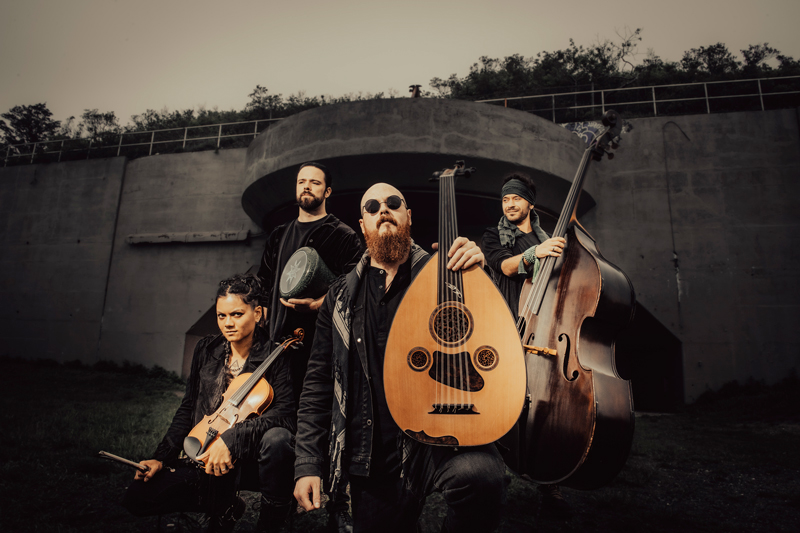
(headline image: Baklava Express — Photo by Aiden Grant)
Baklava Express is a New York City-based Mediterranean fusion ensemble led by oud player Josh Kaye. The group performs original music rooted in Arab and Turkish traditions, with additional influences from jazz, flamenco, Eastern European folk, Mizrahi, Sephardic, Greek, Armenian, and rock idioms.
Based in Brooklyn, Baklava Express brings together ancient and modern instruments in a high-energy format. Its members draw on varied musical backgrounds, which gives the band a distinct identity.
Kaye’s path to the oud was not direct. Born in London, he moved to the United States with his family at 13 and now considers himself a New Yorker. His Jewish heritage has been fundamental to his personal and musical identity, particularly through the synagogue music and religious songs he heard growing up. By contrast, his engagement with Arab, Turkish, and Armenian music came largely through secular contemporary music and celebratory traditions.
Music also ran through Kaye’s family. His grandmother was an accomplished jazz piano player, her sister was a classical pianist, and his late uncle was a skilled guitar player. As a child, Kaye listened to Fats Waller, Louis Armstrong, and Benny Goodman, an early interest that led him to jazz guitar. He later joined the band of French guitarist Stephane Wrembel, one of the leading contemporary interpreters of Django Reinhardt’s Gypsy swing music. Alongside his work with Baklava Express, Kaye continues to record and tour with Wrembel.
“I’d been a professional guitarist in New York for many years. Living in Brooklyn, in the community, I kept bumping into Arab music,” shared Kaye. “And one day I was walking home from a gig in my neighborhood, and I walked past the barber shop of an Egyptian man. The shop was closed, but I could see he was in there with his friends, playing music on the oud. He saw me looking and waved me in. We talked, hung out, and I tried to play the oud, but I couldn’t. But that night, on impulse, I bought one on Amazon. And that’s how I started. And I became totally fascinated and obsessed.”

He found a community of musicians to play this music, predominantly in Brooklyn, “and I started going to jams or to gigs and trying to watch and learn as much as I could.” After a couple of years of serious dedication, he started to get called for weddings, and parties. “And after developing a certain level of proficiency, I felt I could do something with it. I’ve always been a composer,” so the natural next step was writing new music using the oud as a songwriting tool.
Baklava Express’ first album, Dávka, came out in 2023. The band’s self-produced second work, Sabába, was released on April 17, 2026. “For Dávka, our first album, released in 2023, we went into the studio after having only played a few gigs as a group… I’m proud of how it came out. But for this recording, everyone’s been in the band for at least three years, so we’re playing music that we’ve performed hundreds of times. It not only sounds tighter, but we had much more freedom to improvise and make arrangements on the fly.”
“It’s not something that I’m consciously thinking about,” added Kaye. “Anyone who knows these traditions can immediately hear them in the music, be it Arab, Turkish, or Armenian music. These are not traditional songs, but are very close. I have a very good friend, an Arab musician who’s pushing 80 at this point, really steeped in tradition, and he would tell me: ‘I can hear the Arab roots in your music — but your music isn’t Arab music.’ He wasn’t judgmental. He was stating a fact. He would tell me: ‘It’s cool. Do your own thing.’ We are not a traditional music band. We play original music influenced by a variety of traditions.”
Sabába includes Kaye on oud; Daisy Castro on violin and cello; Eren Erdogan on ney and kaval; Lefteris Bournias on clarinet; James Lambrosse on guitar; James Robbins on bass, and Jeremy Smith on percussion.

Their diverse backgrounds have expanded and enriched the overall sound of the music, emphasized Kaye. “It’s something I really love about the band: each musician brings something personal, extra to the music.” For example, in “Adieu Henri,” you hear unexpected palmas (flamenco handclapping), played by Smith, an in-demand flamenco percussionist, according to Kaye.
“White Sauce, Hot Sauce” has “the clearest representation of Arab music. It’s dedicated to a street cart, a halal cart in the neighborhood I used to live in, a mostly Arab neighborhood. The song is dedicated to that community, to the diaspora of Arabic-speaking people in Brooklyn. And again, those melodic conventions will be something that anyone who listens to Arab music will hear and say, ‘Oh, this reminds me of Egyptian music, or Syrian music.’”
Meantime, the lively “A Very Narrow Bridge” incorporates Eastern European Ashkenazi Jewish musical tradition, while the closing track, “Begin Again,” takes the listener on an unexpected turn. It starts as a ballad, and it has “a kind of modern Turkish sensibility” in the melody, said Kaye. “And then kind of halfway through, it becomes a slow rock song… When I was starting to play guitar, I played rock, and even put out a metal EP in college,” says Kaye. “Heavy metal and rock are part of my aesthetic, too.”
“I feel that an instrumental song quite literally could mean anything to any person,” he clarified. “I often say, jokingly, ‘This song isn’t about anything. It’s about whatever you’d like it to be about this time – because perhaps the next time you hear it, it will be about something else.’ There are no limits. This music is about having a meeting place for everyone. I often don’t say it out loud, but I hope it’s obvious. I hope that organically it becomes a meeting place for anybody who wants to listen.”
Discography:
Dávka (2023)
Sabába (self-released, 2026)

Author: Angel Romero
Angel Romero y Ruiz has dedicated his life to musical exploration. His efforts included the creation of two online portals, worldmusiccentral.org and musicasdelmundo.com. In addition, Angel is the co-founder of the Transglobal World Music Chart, a panel of world music DJs and writers that celebrates global sounds. Furthermore, he delved into the record business, producing world music studio albums and compilations. His works have appeared on Alula Records, Ellipsis Arts, Indígena Records and Music of the World.