
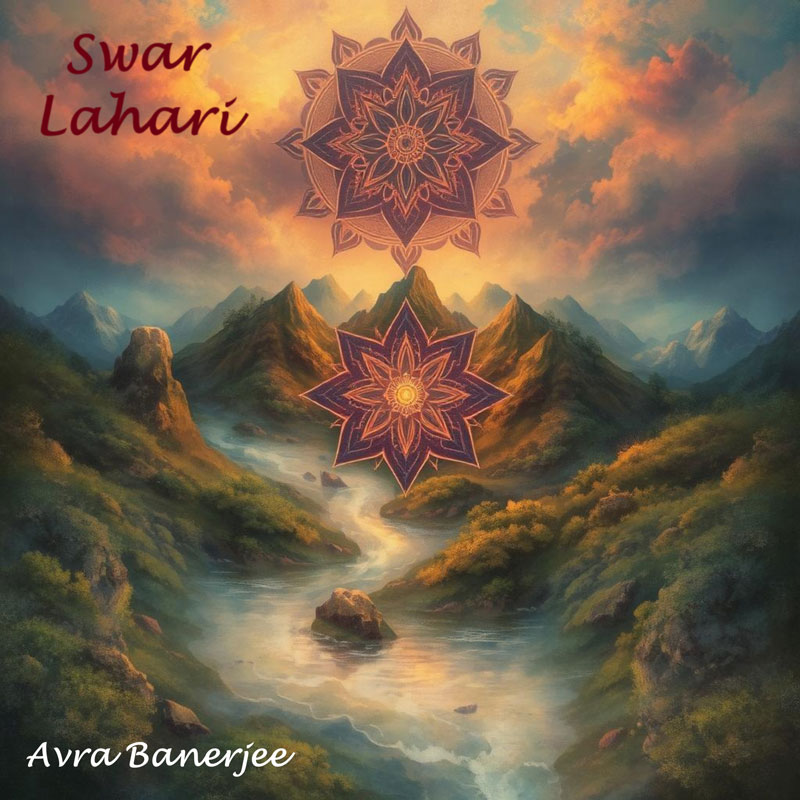
Avra Banerjee – Swar Lahari (self-release, 2025)
By seamlessly bridging centuries-old Indian classical forms with inventive rhythmic structures and modern instrumentation, Avra Banerjee’s Swar Lahari (2025) is a boldly inventive and exquisite musical of India’s heartland. Released in a period marked by genre-mixing and boundary-pushing, the album presents painstaking craftsmanship and reverent innovation. Each track operates as both homage and experiment, drawing from a rich palette of ragas and rhythmic cycles while introducing new contours through collaboration.
Banerjee, a composer and multi-instrumentalist known for his quiet command and curatorial ear, orchestrates a masterclass in musical synergy. Surrounding himself with a formidable ensemble, including luminaries like Ambi Subramaniam, Shashank Subramanyam, Murad Ali, Suchismita Das, Praashekh Borkar, and more, he offers deeply immersive experiences. From the flowing dialogs between sarod and sarangi to the nuanced tabla duets that anchor several pieces, the album revels in the intricacies of form without ever losing emotional clarity.
On “Harmony of Rhapsody,” time bends, melody soars. Opening with what could be described as the album’s thesis, “Harmony of Rhapsody” presents a stunning violin-flute conversation led by Ambi Subramaniam and Shashank Subramanyam. Set against an unusually lilting 8.5/4 cycle and moving between 9/4 and 8/4 improvisational passages, this piece thrives on its rhythmic elasticity. The transition from Raga Puriya Dhanashree to Basant Bahar isn’t merely technical. It paints a vivid emotional arc, from dusk to spring bloom, tethered by Tamal Kanti Halder’s keyboards and Sivakumar’s tabla.
There is serenity in sarod on “Love’s Lullaby.” Apratim Majumdar’s sarod speaks in hushed, poetic tones, evoking a pastoral calm steeped in Raga Mishra Piloo. This is music as balm, where every glide and pluck is placed with purpose. Supported by Kaushik Banerjee’s tabla and Halder’s gentle keyboard layers, the composition invites listeners to surrender to stillness. It’s one of the album’s most intimate offerings, where melodic restraint becomes a virtue.
“Classically Perth” features a Ghazal’s two-part harmony. Wryly titled and deftly constructed, “Classically Perth” develops as a multi-scene suite in Raaga Madhumanti. Beginning with Amitav Islam’s lyrical ghazal, the track evolves into a spacious sarod solo before climaxing in a tabla duet between Sivakumar and Gurpreet Singh. The movement from voice to instrumental to percussive crescendo mirrors the shifting moods of a classical mehfil (Indian cultural gatherings), structured yet spontaneous, refined yet fervent.
“Harmonious Flow” is a type of two-way mirror. The pairing of Murad Ali’s sarangi and Praashekh Borkar’s sarod yields one of the album’s most layered moments. Alternating between Ragas Yaman and Marwa within a 15/4 rhythmic cycle, the two instruments engage in an exchange that feels both ancient and newly born. The composition’s architecture, interlaced phrases mirrored and echoed, reflects not just technical virtuosity but philosophical inten. Here, conversation becomes composition.
Sarod is multiplied in “Triraga Conference.” A high-wire act of coordination and creativity, this composiiton masterfully assembles three sarod players, Pratik Shrivastava, Borkar, and Majumdar, for a swirling tour through Charukeshi, Chandrakauns, and Malkauns. Driven by Zuheb Ahmed Khan’s tabla in 7/4, the piece is a rhythmic kaleidoscope. Yet, despite its complexity, it never becomes academic. Instead, the sarods entwine and diverge like dancers in a tightly choreographed improvisation, maintaining momentum through every raga shift.
The final piece, “Mor Pankh” is the heart of the album. Closing with a flourish, “Mor Pankh” is perhaps the emotional anchor of Swar Lahari. Sung with restrained elegance by Suchismita Das and rooted in the thumri tradition, the piece explores the themes of love, longing, and surrender. Murad Ali’s sarangi and Borkar’s sarod trace beatific melodies like brushstrokes on silk, while the bass guitar and tabla lend the track both weight and buoyancy. The result is quietly transcendent, a devotional introspection anchored in craft.
Buy Swar Lahari.

Author: Angel Romero
Angel Romero y Ruiz has dedicated his life to musical exploration. His efforts included the creation of two online portals, worldmusiccentral.org and musicasdelmundo.com. In addition, Angel is the co-founder of the Transglobal World Music Chart, a panel of world music DJs and writers that celebrates global sounds. Furthermore, he delved into the record business, producing world music studio albums and compilations. His works have appeared on Alula Records, Ellipsis Arts, Indígena Records and Music of the World.