
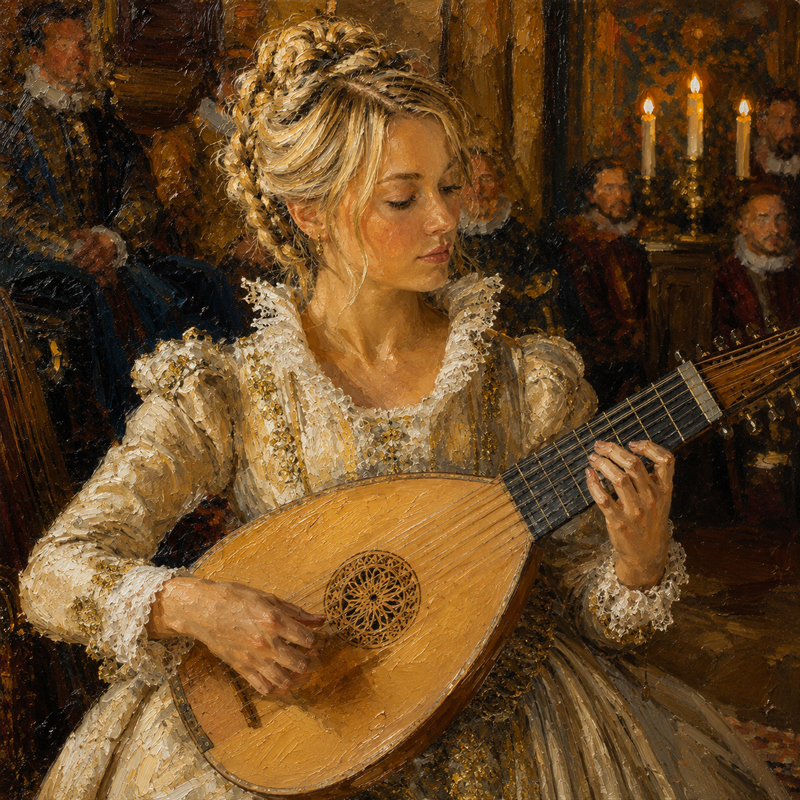
The European lute is best understood not as a single instrument but as a family of plucked chordophones whose history connects courtly art music, popular dance, craft economies, religious contact, migration, and colonial exchange. The word lute derives from the Spanish word laúd, which derives from the Arabic oud (ʿūd). In Spain, the laúd carries a particularly complex meaning. It may refer to the historical round-backed lute related to the Arabic oud (ʿūd), but it also names the modern Spanish laúd, a flat-backed plectrum instrument used by rondallas and orchestras of pulso y púa (pulse and plectrum).
The Arabic al-ʿūd entered current-day Spain through al-Andalus, and from there the instrument, its name, and related playing practices spread through European networks of courts, merchants, musicians, and artisans. By the late Middle Ages, European lutes had developed distinctive organological traits: a rounded bowl made from thin wooden ribs, a flat wooden soundboard, tied gut frets, paired strings known as courses, and a sharply angled pegbox. Medieval players commonly used a plectrum, while Renaissance performers increasingly plucked with the fingers, a technical change that encouraged polyphonic writing and made the lute a privileged vehicle for domestic, courtly, and professional music making.
In the sixteenth century, the lute became one of Europe’s fundamental secular instruments. It accompanied songs, rendered vocal polyphony in tablature, and circulated through printed materials in Italy, France, England, the German-speaking lands, and the Low Countries. Its repertory ranged from dances and fantasias to intabulations of chansons and madrigals. However, Spain followed a different path. Although the conventional lutes were known there, the vihuela became the dominant courtly plucked instrument of the Spanish Renaissance. This divergence should not be read as isolation. It indicates a broader Iberian pattern in which Christian, Arabic, Mediterranean, and transatlantic currents interacted with local taste, aristocratic identity, and the prestige of the Spanish guitar’s ancestors.
The making of a historical European lute required specialized craft. The bowl was assembled from narrow ribs, often maple, yew, fruitwood, or other resonant hardwoods. The soundboard was normally spruce, selected for lightness and responsiveness. A carved rose replaced the open sound hole of many other plucked instruments and served both acoustic and decorative purposes. The neck could be made from woods such as maple, beech, lime, oak, or similar materials, often veneered; fingerboards and decorative elements might use ebony or other dense woods. Early strings and frets were made from gut, while later bass strings typically incorporated metal winding.
As European music changed, the lute changed with it. Renaissance lutes typically had six or more courses. By the late sixteenth and early seventeenth centuries, larger instruments with extended bass ranges appeared. The archlute and theorbo answered the needs of basso continuo, opera, and chamber music by adding long unstopped bass strings. The baroque lute, especially in German-speaking regions, developed elaborate tunings and could reach thirteen courses.
The modern Spanish laúd belongs to a separate modern lineage. It is not the Renaissance lute under another name, but a plectrum instrument derived from the Baroque lute that evolved into something closely related to the bandurria. It generally has twelve metal strings in six double courses, a longer neck than the bandurria, a flat or shallow body, fixed metal frets, and a bright, articulate attack suited to ensemble performance. In Spanish rondallas, estudiantinas, tunas, and orchestras of pulso y púa, the laúd often occupies a tenor or inner melodic role between the bandurria and guitar. Its social world is therefore distinct from that of the Renaissance lute: it belongs to civic music making, student serenade traditions, regional dance, amateur associations, and organized plucked-string ensembles.
Beyond Spain, related names and instruments reveal further cultural crossings. The Cuban laúd, associated with rural musical genres and punto traditions, resembles the Spanish instrument but has its own tunings, body preferences, and performance idioms.
In the Philippines, the rondalla became a Spanish-influenced but locally transformed ensemble, with instruments such as bandurria, laúd, octavina, guitar, and bajo de uñas adapted to Philippine repertories, woods, pedagogy, and national cultural identity. These cases show how colonial transmission did not simply export Spanish music unchanged. Local musicians rebuilt the ensemble according to available materials, educational institutions, dance forms, and new ideas of heritage.
Other European lute traditions complicate the picture further. The Greek lauto, especially in Crete and Cyprus, is a long-necked, fretted, plectrum-played lute with four double courses, often used to accompany the violin or Cretan lyra. Its steel strings and rhythmic drive place it in a different sound world from the gut-strung Renaissance lute, yet it remains part of the broader lute family.
Swedish lute traditions, including the svenskluta, reveal how late eighteenth- and nineteenth-century musicians adapted lute-guitar hybrids to local song repertories.
Today, the European lute survives in several overlapping worlds. Historical performers commission replicas of Renaissance and baroque instruments for repertories by Francesco da Milano, John Dowland, Robert de Visée, and Silvius Leopold Weiss.

Author: Angel Romero
Angel Romero y Ruiz has dedicated his life to musical exploration. His efforts included the creation of two online portals, worldmusiccentral.org and musicasdelmundo.com. In addition, Angel is the co-founder of the Transglobal World Music Chart, a panel of world music DJs and writers that celebrates global sounds. Furthermore, he delved into the record business, producing world music studio albums and compilations. His works have appeared on Alula Records, Ellipsis Arts, Indígena Records and Music of the World.