
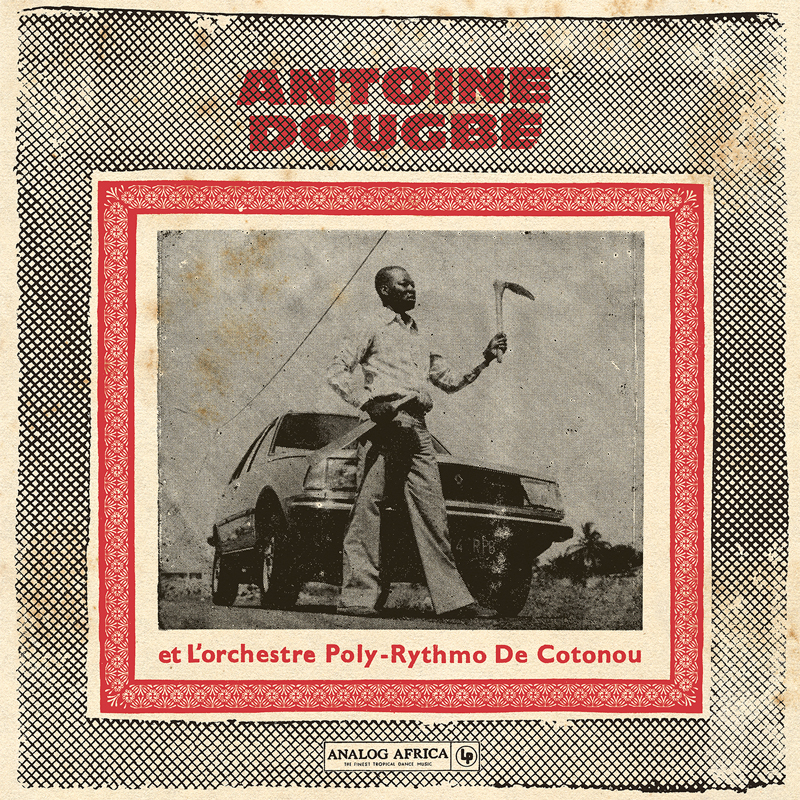
Antoine Dougbe et L‘Orchestre Poly-Rythmo De Cotonou — Antoine Dougbe et L‘Orchestre Poly-Rythmo De Cotonou (Analog Africa No. 44, 2026)
Analog Africa has turned to one of Benin’s most elusive artists for its latest archival release. That is Antoine Dougbé, a songwriter and Vodun initiate whose scarce late-1970s and early-1980s recordings remain largely absent from the reissue scene. The new anthology, Antoine Dougbe et L‘Orchestre Poly-Rythmo De Cotonou, collects some of Antoine Dougbe’s finest material.
Dougbé released only three LPs and several singles. Notably, musicians who knew him recalled a figure who inspired both respect and apprehension. In Cotonou’s active music scene, he developed a reputation as an inventive writer with a strong connection to Vodun (or vodu) practice. That identity led to the title he used for himself: “the Devil’s prime minister.”
He left Abomey for Cotonou as a young man, where he absorbed African and Latin music styles that circulated widely throughout West Africa at the time. Cuban son (son cubano) and rumba drew his attention, while Congolese rhythms also left a clear mark on his musical taste. However, his deepest musical interest lay in Benin’s traditional rhythmic systems, especially those linked to Vodún ceremonies. That focus set his work apart from more conventional regional trends.

His reputation complicated studio work early on. Accounts from fellow musicians describe a volatile bandleader who could threaten players when performances fell short of his expectations. As a result, he struggled to secure collaborators. Even so, Orchestre Poly-Rythmo de Cotonou agreed to work with him. According to band founder Mélomé Clément, Dougbé posed no issue for the group because drummer Yehouessi Leopold and bassist Bentho Gustave were also Vodún initiates, and Dougbé did not challenge them.

Dougbé also stood apart from most outside collaborators in another respect: he did not sing and did not handle the main instrumental parts on these sessions. Instead, he brought songs to Clément, who arranged them for the band. Vocals largely fell to Lohento Eskill and Amoussou William. Some accounts suggest that his ritual role in Vodún, where singing carries ceremonial weight, may have discouraged him from using his voice in popular music.
That partnership yielded some of Orchestre Poly-Rythmo’s most forceful performances. Whether the result came from artistic chemistry or from Dougbé’s formidable presence, the records capture the band at a notably high level.

His first LP came out in 1977 on Disques Tropiques. Although the early single “Nounignon Ma Kpon Midji” found moderate success, the rest of his catalog never reached a wide audience. By the early 1980s, he had disappeared from the music scene.
Illness altered the final years of his life. In 1992, he moved to Parakou in northern Benin, where he lived and worked for four more years. He died of cirrhosis of the liver on September 20, 1996, while on vacation in Cotonou.

Author: Tyler Bennet
