
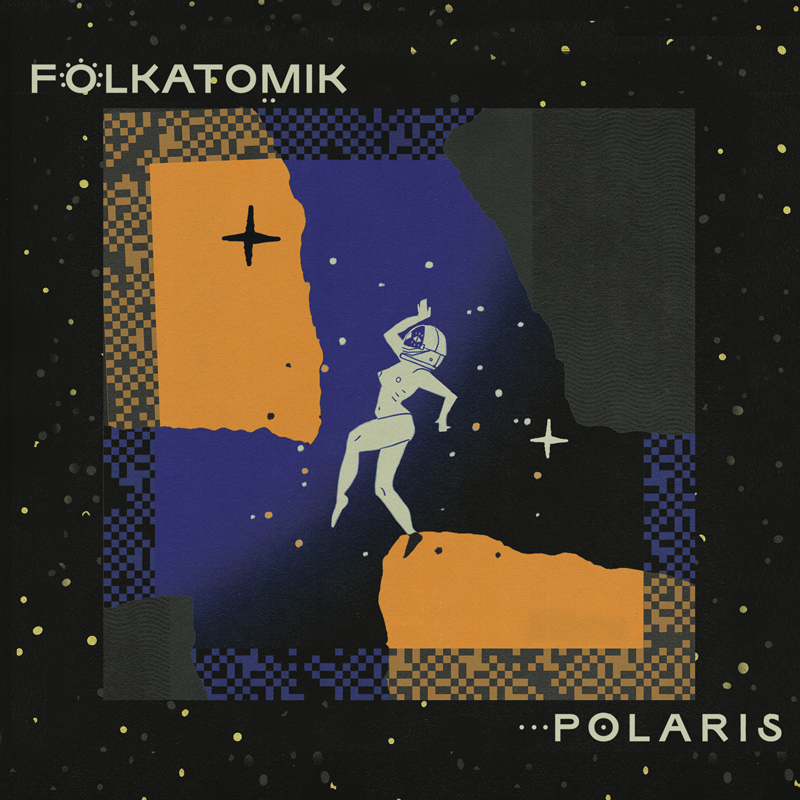
Folkatomik – Polaris (Italysona, 2022)
Folkatomik’s debut album, Polaris, is rooted in the traditional music of Southern Italy. At the same time, they weave in global and electronic influences. Formed in 2019 in Turin, this world music ensemble brings together the experience of Franco Montanaro, Oreste Forestieri, and Valeria Quarta, veterans of traditional Italian folk revival, with the electronic sensibilities of guitarist and producer Li Bassi. This collaboration results in a distinctive sound that bridges folk heritage and edgy, forward-thinking innovation.
The title track, “Polaris,” refers to the North Star, a fixed point for navigators, yet symbolic here of an evolving journey. In this context, the star becomes a metaphor for the band’s exploratory musical path, combining ancestral instruments with contemporary production.
The group’s sound is built on a foundation of traditional frame drums, Arabic, Latin, and African percussion, alongside stringed instruments such as the Portuguese guitar, tres cubano, bouzouki, mandolin, and charango. Wind instruments from Arab, Turkish, Andean, Irish, and Sicilian traditions also feature prominently. By mixing these acoustic textures with nuanced electronics, Folkatomik crafts a fresh and dynamic musical language.
Although the band’s starting point is the South of Italy, their musical reach extends across the broader Mediterranean and beyond. Their compositions draw inspiration from diverse cultures and histories, reflecting the multicultural fabric of Turin. The result is a hybrid sound that celebrates cultural diversity through dance-oriented, communal music.
The opening and title track, “Polaris,” serves as a thematic invocation. Set to the hypnotic rhythm of the pizzica pizzica, a fast-paced, triple-time dance, the piece features lyrics in an archaic Calabrian dialect. It tells the story of a castaway imploring the North Star for guidance, either to return home or venture into uncharted waters.
“Quant’ave” is a reimagined pizzica from the Terra d’Otranto region, presented with electro-latin flair.
Drawn from the town of Torchiarolo in Salento, this “Pizzica di Torchiarolo” version maintains its traditional form while introducing electronic nuances.
“Pizzica di San Vito” serves as a tribute to the renowned pizzica of San Vito dei Normanni, intertwining the two commonly performed variants, minor and major, into a single track that nods to the town’s mandolin heritage.
“Lu Tirullalleru” is a Calabrian tarantella popular in the Cosenza area. This song uses satirical dialogue between two unlucky friends who, despite mutual pleas for help, are unable to assist each other. The arrangement includes Greek bouzouki, evoking rebetiko and the emotional aftermath of the Asia Minor Catastrophe.
Set to a tango nuevo arrangement, this Calabrian ballad, “Tira la Pinna” is attributed to Domenico “Palma” Strafaci, a 19th-century brigand poet from Longobucco. Known as the “King of the Mountain,” Strafaci used verse to challenge the landowners and elites of his time.
“Tammurriata,” a Campanian carters’ song, begins with a fronna (a type of improvised solo) and builds into a pulsating electronic tammurriata.
Lastly, ‘Lu Traìnu” is a Sicilian carters’ song that incorporates Balkan-style arrangements. The track pays homage to the Romani communities of Southern Italy, long integrated into local cultures, while highlighting their enduring cultural identity.
Musicians:
Valeria Quarta – vocals, percussion.
Quarta began studying voice at a young age, with training in classical, jazz, and contemporary styles. She later specialized in traditional Southern Italian music and percussion. Her musical background spans genres from rock and reggae to South American styles. She currently leads her own project and performs with the trio Le Tre Sorelle, which focuses on women’s vocal traditions from Southern Italy.
Li Bassi – guitars, production.
A guitarist and producer, Li Bassi has shared the stage with artists such as Steve Winwood, Whitney Houston, Max Gazzè, and Bandabardò. As a composer, he has collaborated with EMI, Universal, and RAI. His solo album Il lato giusto won the Carisch “Stefano Rosso” award in 2015. He is also a regular contributor to theater productions and television through Banijay.
Franco Montanaro – vocals, tambourine, rattles.
A folk singer and percussionist, Montanaro specializes in tambourines from across the Mediterranean. He has performed at the Notte della Taranta and co-founded the Collettivo Musicale In.con.tra.da. His work has taken him across Europe and North Africa, and he has participated in numerous festivals and theatrical collaborations.
Oreste Forestieri – winds, plectrum instruments.
A multi-instrumentalist, Forestieri plays flutes, reed instruments, frame drums, and Mediterranean stringed instruments. He has performed with artists like Otello Profazio, Raiz, and Tonino Carotone. His global performance resume includes festivals in Europe, North Africa, and Latin America. In 2006, he released his debut album Taranta Muffin and has contributed to numerous recordings and theatrical productions.
Supported by the “Puglia Sounds Record 2022” initiative, Polaris was released on Italysona, a label known for promoting Italian identity-based world music with an eye toward innovation.
Buy Polaris.

Author: Iliana Cabrera
