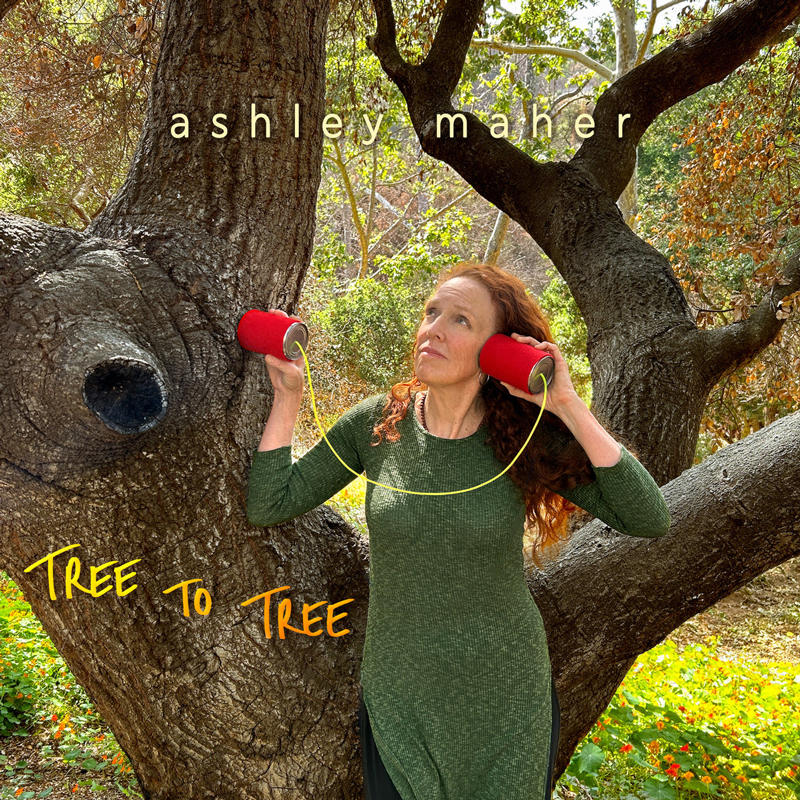
In the midst of stressful times, why not take a break, relax, sip some tea, and listen to Tree to Tree. This is Ashley Maher’s latest album, released on Spin Wild Records (October 2025). Her warm vocals invite us into this light and playful music. They run alongside a multi-genre mix that moves with ease from pop to folk to jazz to mbalax (more about that African genre later), and back again.
Ashley cuts a lithe figure with a flame of long, red hair. But she is more than a dramatic presence. She is a California-based lyricist, singer, and dancer, with a long-time love of Africa and its music. I spoke with her recently about her latest release, among other things.

I love your vocals on Tree to Tree. The tone is comforting and reminds me of hearing Joni Mitchell sing a good, compelling story. Perhaps you’ve heard that comparison before? … (we both chuckle).
I’ve heard that all of my life. People hear similarities in our vocal tone and phrasing. In Italy, years ago, when I was pursuing vocal training, some of the young singers were so focused on building their voices. I got to a point where I thought, “how can I sing in a more natural way?”
The music on this album feels just that – natural. Can you comment on that?
I went over to Senegal with just two weeks to work. That’s a short time to make an album. For the first few days, half of the musicians I normally work with were out on tour, so I only had one day to record with them. We did three songs together. In their initial absence, I recorded another five tracks with phenomenally gifted musicians from Benin, Gabon, Congo, and Côte d’Ivoire. This gave the album an international feel beyond pure mbalax.

Since there was no time to do multiple takes and piece them together, the whole album was recorded almost live. Sometimes when you squeeze something together, spontaneity is the absolute word, because there’s no time to overthink anything. It is terrifying, but I love the energy this brings to the music.
Are you an experienced improviser?
Many singers are given a song and told, “Sing your alto part correctly.”Unlike instrumentalists, they are not encouraged to improvise. So, someone like Ella Fitzgerald who could scat was incredible.
In the late ‘80s, Bobby McFerrin, who some readers may know, had a vocal group called Voicestra. They did vocal improvisation concerts. I studied with Rhiannon who sang with him. She has taught vocal improvisation worldwide for decades and has created a global network of improvisors.
Indeed, Ashley seems to thrive on fresh, unplanned sounds. On first traveling through Africa as a young dancer, she was mesmerized by mbalax, a genre found in Senegal and the Gambia. It’s a music that contains fiery polyrhythms and fast tempos. Mbalax often includes tightly cued moments, in which the drums play as one at rapid intensity.
The percussion is held together by a sabar that is played with one hand and a stick, a tama or talking drum that is shaped like an hourglass and changes pitch depending on arm pressure, and a nder that is a tall, lead drum that stands on the ground and is struck with a stick.
The Senegalese sabar dance that works alongside mbalax also drew her in. It allowed her to raise her arms and legs high alongside the rhythms. Since Ashley is tall, like some Senegalese, this dance felt liberating. After years of studying various dance forms from across Africa, sabar’s power, energy, and rhythmic complexity mysteriously fit.

Since 2007, Ashley has traveled to Senegal each year, eager to make new connections. While other Western musicians may jump in and out of the continent, she has worked hard at building and sustaining her musical partnerships there. On this, her eighth album, the strength of those collaborations is clear.
Your current album holds a more diverse musical language than previous ones I’ve heard. The vocals are richer, more multitracked. Is this album a departure for you?
My album before this was purely mbalax – with a team of the best Senegalese musicians. While some Senegalese music is rhythmically rich, it can be harmonically simple.
But when we made this album, there was an influx of very talented musicians from
other African countries into Senegal. They had stronger musical backgrounds in genres such as gospel and jazz. They bought a different approach to the music.
So yes, this record was a departure, but it felt good. It is more representative of my own musical vocabulary, because I grew up listening to the singer songwriters of the seventies, bands like Earth, Wind, and Fire, funk, Brazilian music, and a little jazz.
Did you prepare the songs ahead of time or do you create them on the spot?
Even while my musicality is all by ear, I arrived with all of the songs written, mapped out, and arranged. Working with Jean Mermose, who is a great pianist from Benin, was a dream come true. He was able to beautifully interpret and build from my demos. And he was excited by the arrangements. Willy Bousset is also a phenomenal bassist from Gabon, who brought an extra special level of fire to the mix.
What track can we hear Bousset shine on?
His bass solo at the end of the track “Music.”
Indeed, “Music” opens the album. It is a gentle and catchy, funk track. We hear a lower register female vocal that is at once intimate and direct. Alongside her, are soft, dancing keyboards, electric guitar, and bass that interweave with one another. The singer describes music’s healing power as, “here to free us.”
And this upbeat sensibility runs through several songs on the album. The second track, “Salt and Pepper,” is straightforward and playful. It describes a middle-aged person’s ambivalence about her hair going grey. And in the end, the singer praises the “salt and pepper warriors in my life.”
The third number draws us in even more with its mbalax percussive rumblings on an “American in Dakar.” It’s a fun, imaginative take on Sting’s pop song, “An Englishman in New York,” that he gave Ashley permission to record.
To me, the acoustic tracks are the most compelling on this album. “Nenam” is one of them. It is folk in feel. The pace is gentle and lulling. It’s a delicate, lullaby-like song that honors mothers. It contains acoustic guitar and three vocalists who are soothing to listen to …
Yes, that’s a collaboration that goes back to the height of Covid. This husband and wife team are called, “Leergui Acoustic.” Ken Ngom is a really talented Senegalese musician who often posts videos of himself in his apartment recording. He’s not trained in music theory, but his ear and his musicality are incredible. And his wife, Aminata Barro, has this earthy, unique voice.
In fact, ‘Leergui Acoustic,’ is just one point of inspiration for you. Do you take your musical inspiration from diverse sources?
Yes, well, a lot of people write about romance: “I miss you. I can’t stand you” but that theme becomes repetitive after a while. I am thinking, “What else can I write about?”
Music is my favorite of all the tracks. Its inspiration was drawn from seeing certain snapshots online of when Russia invaded Ukraine: a video of Yo-Yo Ma playing cello in front of the Russian embassy, footage of a young girl singing in a bomb shelter, and another picture that I thought was an angel on top of a column. The city was so afraid that their beloved statue would be bombed, they encircled it with a giant pyramid of sandbags up to the statues chin.
This song is saying that art, beauty, and music are always available to us. They belong to all of us. They are here as a vehicle of resistance. Hope and beauty are here for all of us.
And when listening to Tree to Tree we feel just that, a sense of hope and beauty. Ashley has matured as a musician, her voice is richer and this album encompasses more diverse musical genres. Her music will inspire to travel along with her.

Author: Dorothy Johnson-Laird
Dorothy Johnson-Laird comes from a long line of musicians, including a music teacher in the 1820s in England. As a child she trained in both classical and jazz piano. Dorothy has a Master’s Degree in Creative Writing from Sarah Lawrence College. At New School University, she was the Research Assistant for a course taught on gender issues and women in blues music. Dorothy’s passion is African music. She was formerly a regular contributor to worldmusic.about.com.