
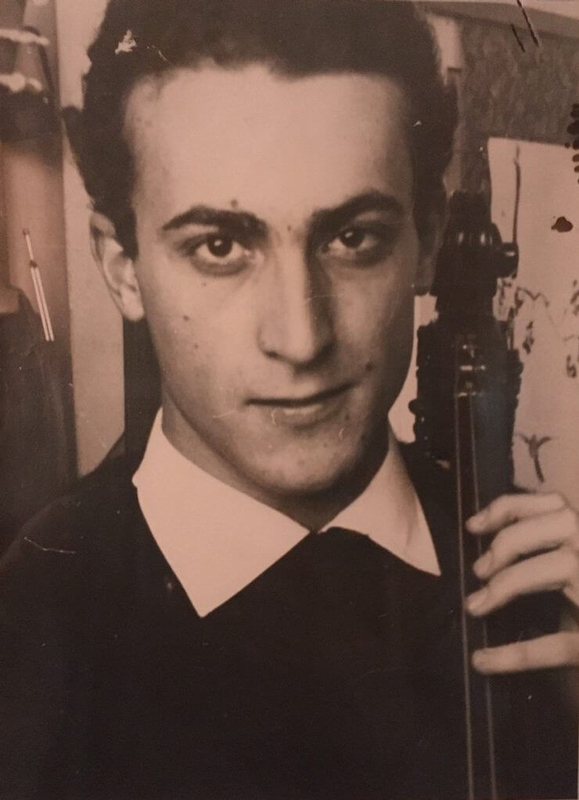
(headline image: Gregorio Paniagua – photo by Carlos Paniagua, 1961)
Gregorio Paniagua, Spanish early music director, composer, and founder of the Madrid ensemble Atrium Musicae, died on 10 January 2026 at the age of 81. He was widely known for his work in reviving medieval, Renaissance, and ancient repertoires and for rebuilding historical instruments from original sources.
He was born in Madrid on 2 February 1944. In his youth, he captained Real Madrid’s junior basketball team in 1960 and 1961 under coach Pedro Ferrándiz.
His formal studies ranged far beyond performance. He studied medicine at the Universidad Complutense and the Fundación Jiménez Díaz in Madrid. His artistic education included painting lessons with his maternal grandmother, María de Calderón, a pupil of Vicente López; cello studies at the Real Conservatorio with Ricardo Vivó; viola da gamba with August Wenzinger, director of the Schola Cantorum Basiliensis; and orchestral conducting with Sergiu Celibidache.
Paniagua dedicated his professional life to early music, focusing particularly on string instruments such as the vihuela, lute, hurdy-gurdy, and viola da gamba. He founded the early music ensemble Atrium Musicae de Madrid in 1964. His interest in musicological research led him to establish his own workshop, where he reconstructed many historical instruments. His reproductions were based on miniatures in manuscripts, paintings, low reliefs and polychrome ceramics, from classical Greek monuments to Romanesque, Gothic, and Renaissance art in Spain and across Europe.
Atrium Musicae gained international prominence for its ambitious recording projects and tours. The ensemble’s work included Las Cantigas De Santa María by Alfonso X, recorded in 1969 in the Gothic collegiate church of Covarrubias. That recording received a Gold Disc at the International Festival of Art in Tokyo in 1971. Another landmark project, Musique De La Grèce Antique, presented reconstructions of ancient Greek music and was issued in 1978 in an edition protected by UNESCO in support of the restoration of the Acropolis in Athens. The group also recorded Musique Arabo-Andalouse, and albums such as La Música En Cataluña Hasta El Siglo XIV, El Códice De Las Huelgas, Música Iucvnda, Las Indias De España, La Spagna, La Folia – De La Spagna, and Diego Ortiz / Recercadas.
His discography eventually reached around 25 releases on international labels and drew consistent critical acclaim. As director of Atrium Musicae he led numerous premieres of previously unrecorded early works and of his own compositions, presented in concert halls, churches, cathedrals, theaters, and museums across Europe, the Americas, Asia and Australia. He also collaborated with universities and specialized courses devoted to early music.
Atrium Musicae disbanded in the early 1980s, and several members, including his brother Eduardo Paniagua, went on to pursue successful solo careers. Gregorio Paniagua continued to record and experiment, contributing to projects such as Codex Gluteo, Batiscafo, Fandango and Canto Antiguo Español, and exploring both historical and early digital instruments.
Alongside his musical activities, he maintained a continuous but largely private career as a painter. He held exhibitions in his adolescence in Madrid, Mojácar and Almería, later presenting a private show with gallerist Juana Mordó. Much of this visual work remained reserved until recent years, when it began to appear publicly.

Author: World Music Central News Room
World music news from the editors at World Music Central