
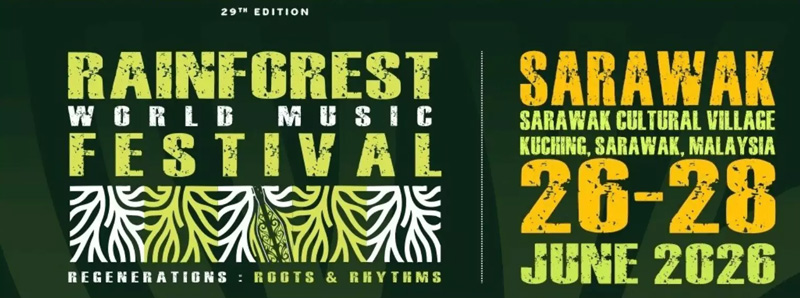
In its 29th year, the rainforest welcomed me back in my quest to hear age-old sounds new to my ear. From humble beginnings to global acclaim, RWMF has presented some of the most astonishing and captivating musical traditions imaginable. Instruments crafted from animal, vegetable, and mineral. From water on the village lake to a xylophone made of ice. The vocal wizardry of throat singers, an Inuit breathwork duo, polyphonic harmonies, and tribal chants. Stories of family, ceremony, migration, and heritage. The Celtic, Balkan, Islanders and desert-dwellers. Descendants of warriors, workers, and nomads. Convened by passionate ethnomusicologists of the highest order.
Under the resting gaze of Mount Santubong, the village site is ringed by longhouses re-creating the kampung atmosphere of the many and varied Sarawak ethnic groups. This year’s event showcased a range of acts from the region. From Sarawak: Ta’Dan, Suk Binie, The Thunder Beat of Nanyang Wushu Drums. Straw Lim from neighboring ‘sister’ state Sabah. Mindanao’s Drum Up from the Philippines. From Malaysia, [Dr.] DATO’ M. Nasir and the multicultural lineup of group AkashA.
The genesis of RWMF sprung from an idea to share and preserve the practice of local music and associated culture. The sapé – an indigenous version of a lute – was played by very few in 1998. The signature sound was in danger of being lost to time. RWMF can be credited with its revival over the past decades. On the two adjacent main stages and in workshops, young musicians have revived the sound back for a wider audience. While some play an electrified version with modern accompaniment and pop/rock rhythms, the greatest distinction of the sapé remains the acoustic lilt of ancient melodies.
Ta’Dan ‘rocked out’ in their evening concert, while their unplugged afternoon workshop provided an intimate sharing of featured solos, storytelling, and song. Salomon Gau, a renowned Kenyah dancer, craftsman, and musician, joined the young group. He demonstrated the ethereal, drone-like sound of the bamboo wind instrument, the kedire’, accompanied by sapé and percussion. To close the workshop, he led audience members in a graceful warrior dance.

Traditions from far and wide were represented. From Uzbekistan, folk and classical tunes were accompanied by jubilant dancers, radiant in traditional attire, by the Fergana Cultural Group.


Spain’s Basque Country group Korrontzi was led by Agus Barandiaran on the trikitixa (diatonic button accordion). He studied under teacher Rufino Arrola and showcased the instrument in fervent and lightning fashion.


Four-piece NAMGAR (Mongolia & Japan) was another distinctive highlight featuring a jaw harp, yatag (13-stringed zither), and captivating vocals of frontwoman Namgar Lhasaranova. Backing by her son and husband on guitars and chanza (a three-stringed plucked lute) with percussion by Japan’s Ayuko Ikeda was both intuitive and vibrant.

Benin International Musical (Benin/France) invoked a Voodoo spirit to their set with West African rhythms, honoring the region’s checkered history. They inspired a dancing crowd with bluesy polyrhythms that survived the scourge of displacement through slavery.

In a welcome return to RWMF, AkashA infused contemporary notes into their set while remaining a truly proficient ‘World Music’ ensemble. Sitar, tabla, guitars, and konnukol voice percussion made for a thrilling concert.

Thailand’s ASIA7 filled the Jungle Stage, combining modern instrumentation (guitars, brass) with saw-duang (fiddle), pin (flute), khaen (bamboo mouth organ), and female vocalist Aoy. Another member-rich group, SambaSunda (Indonesia), proved younger musicians are collaborating to preserve regional heritage sounds.

Headliners this year sat outside the World Music category.
The Commodores feat. Thomas McClary (USA), Dato’ M. Nasir (Malaysia), and Incognito (UK) received warm responses from the crowd. While there were no seated concerts held in the theater this time, it’s hoped ‘unplugged,’ acoustic, or intimate-styled performances may be enjoyed in its air-conditioned comfort once again next year. The acoustics are ideally suited to such acts.

It’s been great to see dedicated efforts of organizers to expand event sustainability. The Green Ruai pavilion on the festival grounds exhibited local measures adopted in the state. Even an electric sampan made its debut, sitting proudly on the village lake. Festival fans are now speculating on the 30th anniversary edition of RWMF in 2027. Will there be returning favorites? What form will workshops take? How will Kuching City celebrate? From a history of modest beginnings to its progression over the decades in hosting iconic world-renowned artists and local legends, innovative and unique cross-act workshop collaborations, and recognized world class sound and lighting. A venue and vibe like no other.
Chris was a guest of the Sarawak Tourism Board.

Author: Chris Lambie
