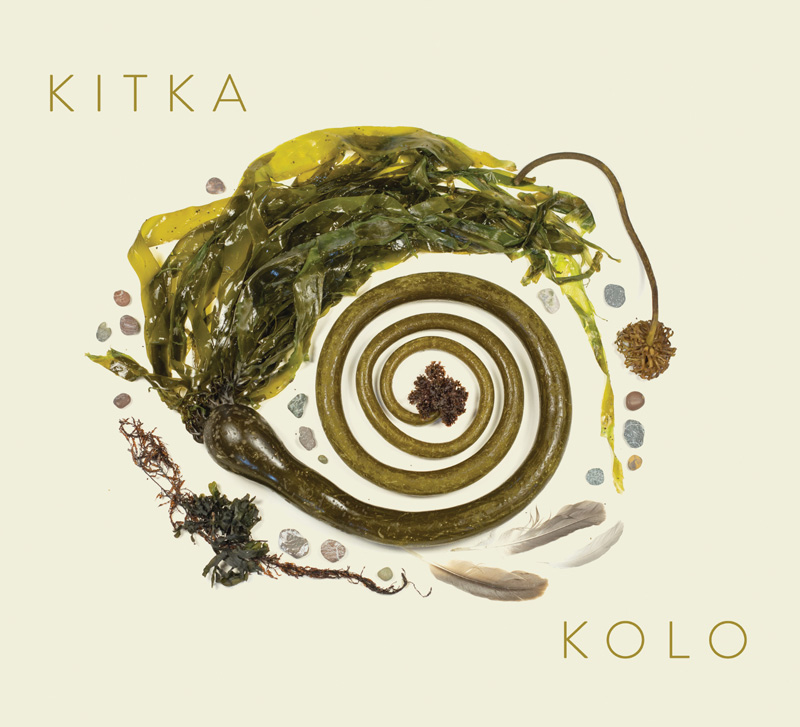
Kitka – Kolo (Six Degrees Records, 2026)
The legendary multigenerational women’s polyphonic vocal group, Kitka has a brand-new album titled Kolo. This lovely, exquisite and timeless recording coincides with their 45th anniversary.
A Proto-Balto-Slavic root word, Kolo means circle, wheel, and a spiraling communal line dance. It is the cosmic cycle of creation, growth, destruction, and renewal… the eternal turning of seasons, and the shared rhythms of lives woven together.
For Kitka, the Kolo also represents our always-evolving circle of voices, a close-knit creative community of women bound by the love of singing and friendship.
Kitka describes itself as a multigenerational American women’s vocal arts ensemble whose work is deeply grounded in traditional songs and vocal practices from Balkan, Baltic, Caucasian, and Slavic cultures. The group also develops new music for women’s voices from these traditions.
Throughout the album, recurring subjects include creation myths, seasonal transitions, fertility, courtship, marriage, healing, relationships between people and the natural world, and supernatural figures associated with folk belief.
The booklet lists ten members of Kitka: Kelly Atkins, Stacey Barnett, Kristine Barrett, Shira Cion, Charlotte Finegold, Erin Lashnits Herman, Janet Kutulas, Maclovia Quintana, Katya Schoenberg, and Talia Young-Skeen.
Kelly Atkins and Janet Kutulas are the album’s music directors and producers; Shira Cion is executive producer and annotator. The ensemble members also contribute arrangements, percussion, harmonium, and featured vocals. Guest instrumentalists include Joshua Horowitz on cimbalom, Cookie Segelstein on viola, and William Skeen on cello.
Song details:
“Loomine” — Estonia. An old Estonian creation song based on a Baltic cosmogonic tradition in which a bird lays eggs whose offspring become elements of the cosmos, including the moon, sun, world, stars, and rainbow. The title means “creation.”
“Līgo” — Latvia. A summer-solstice song connected with the Latvian goddess Māra and with fertility, land, domestic well-being, and seasonal renewal. Golden reeds and floral wreaths carry associations with vitality, fertility, protection, and Midsummer customs.
“Oj Ty Misjacju” — Ukraine. A courtship song from the Krolevets region of Sumy province. A young woman addresses her Cossack sweetheart through imagery of the moon, stars, an orchard, a horse, dew, and a flower wreath associated with unmarried womanhood. A dawn bird chorus recorded in Mendocino, California, accompanies the track.
“Ruotā, Ruotā” — Latvia. A composite arrangement of Latvian spring songs centered on blossoms, seasonal renewal, youth, nature, and courtship. Its component songs refer to flowers along the Daugava River and a shepherd seeking divine assistance. Field recordings include birds, a Slovak river, and loons.
“Lazarki” — Bulgaria. A collection of ritual tunes associated with the spring feast of St. Lazarus. The tradition involves adolescent girls wearing greenery and wreaths, traveling from house to house to sing and dance, and performing ritual leaps intended to encourage crop and livestock fertility.
“Došč, Došč” — Eastern Ukraine. A rain song that describes rainfall increasing from a light, sieve-like fall to a heavy downpour. The recording incorporates a rainstorm captured in Slovakia.
“Mtats’mindis Mtvare” — Georgia. A nostalgic song addressed to Tbilisi and Mtatsminda, the “holy mountain” overlooking the Georgian capital. The narrator expresses enduring attachment to the city despite travel and separation. Kitka learned the song while touring Georgia in 2024; the track includes sounds recorded at Mtatsminda Park.
“Veni Sancte Spiritus” — Corsica. A 13th-century introit traditionally performed before weddings and baptisms. Its Latin text invokes the Holy Spirit and divine light.
“O Onda” — Corsica / Ukraine. A composite arrangement centered on water. The Corsican song addresses the sea as a force carrying history, loss, memory, and possibility. It is paired with the Ukrainian “Vedu rusalku,” concerning a rusalka, a female supernatural being associated with water, forests, fields, and untimely death. Ocean recordings from Batumi, Georgia, are incorporated into the track.
“Gelino” — Shavsheti / Şavşat, Turkey. A wedding song sung by women of the groom’s family as they lead the bride through her new home. Its text welcomes the bride and presents marriage through images of mountains, water, moon, sun, earth, sky, wind, and stars.
“Bat’onebis Nanina” — Georgia. A ritual healing song associated with the bat’onebi, spirit-lords believed to cause disease. Georgian healing customs described in the notes involve flowers, red textiles, sweets, candles, and soothing songs intended to appease the spirits and remove illness from a child.
“Kakhuri Iavnana” — Georgia. A lullaby from Kakheti in eastern Georgia, sung to comfort and heal an ailing child. Its text addresses the child through affectionate maternal imagery and references to violets and roses.
“Zaklykannja Vesny” — Ukraine. A composite work built from Ukrainian vesnjanky, or spring-calling songs, and material associated with Rusalka Week. The songs invoke spring, birds, fertility, and rusalki, supernatural female figures who emerge from waters, forests, and fields. The sequence moves from welcoming spring to ritually returning the rusalki to their customary realms. The recording also incorporates Ukrainian and Slovak environmental sounds, including air-raid sirens recorded in Kyiv in 2022.
“Matica, Bitutė” — Balkan / Lithuanian. A composite arrangement connecting Balkan bee-calling traditions with the Lithuanian sutartinė “Bite, dabitėli, dabilio.” The Balkan texts call the queen bee back to the hive, while the Lithuanian material links bees and beekeeping with cooperation, diligence, family, community, and interlocking women’s ritual singing.
“Oj, Jak Že Bulo, Izpreždy Vika” — Ukraine. A Ukrainian winter-solstice song based on a pre-Christian Koliada creation narrative. Before the existence of sky or earth, three doves meet on a tree above the primordial sea and discuss the creation of earth, sky, stars, and plant life. The song closes the album by returning to the themes of creation and cyclical renewal introduced at its beginning.
Buy Kolo.

Author: Madison Quinn
