
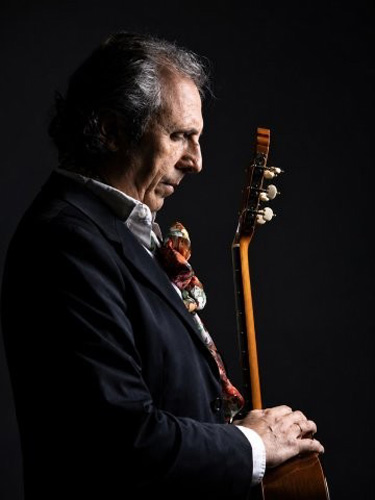
The late flamenco master’s disciple Juan Carlos Romero will lead a new international institute built around Sanlúcar’s musical and educational vision
Manolo Sanlúcar spent decades expanding the language of flamenco guitar. Now, four years after his death, a new institute in Seville aims to ensure that his ideas reach another generation of players.
The International Manolo Sanlúcar Flamenco Guitar Institute has been established to preserve and teach the guitarist and composer’s artistic, intellectual and pedagogical legacy. Juan Carlos Romero, Sanlúcar’s disciple and longtime collaborator, will serve as artistic and academic director.
The project turns a relationship between teacher and student into a formal educational program. Sanlúcar designated Romero as an heir to his artistic legacy, according to the institute, and Romero will now oversee a curriculum based on the principles that shaped his mentor’s work.
Sanlúcar, who died in 2022, was one of the major architects of contemporary flamenco guitar. As a guitarist, composer and researcher, he approached flamenco as a sophisticated musical language whose traditions could support experimentation without losing their identity.

Works such as Tauromagia, Medea, Soleá and Aljibe helped establish that vision. However, Sanlúcar’s influence extended beyond records and concerts. He spent years examining flamenco’s musical foundations and developed an approach to education that called for students to understand the music’s structure, history, and aesthetics rather than simply reproduce what previous guitarists had played. That philosophy will provide the foundation for the new institute.
Its program will combine guitar technique with the study of composition, flamenco history and musical structure, as well as the instrument’s relationship with cante (singing) and dance. The institute also intends to build an international community around that method, with Seville as its base.
Romero brings firsthand knowledge of Sanlúcar’s approach. The guitarist worked alongside his mentor at concerts, international tours and recordings and participated in projects connected to Tauromagia, Soleá and Medea.
He has since built an extensive career of his own. Romero has worked with Enrique Morente, Miguel Poveda, Carmen Linares, Arcángel, Estrella Morente, Rocío Molina, Eva Yerbabuena and El Pele. His performances have taken him from the Seville Flamenco Biennial to Carnegie Hall in New York.
His honors include several Giraldillo awards from the Seville Biennial, the National Critics Award, an Academy of Music Award, the Mario Maya Award and the Gold Medal of Huelva. He also received Grammy and Spanish Music Awards nominations for his contribution to Miguel Poveda’s Tierra de calma.
Romero’s work has also reached film and theater. His credits include Rafael Alberti’s La Gallarda and Carlos Saura productions such as Sevillanas, Flamenco, Fados and Flamenco, Flamenco.
The institute operates within the Manolo Sanlúcar Foundation, led by its president, José Martínez Talavera. The foundation develops educational, cultural and artistic projects designed to preserve Sanlúcar’s work and make his ideas accessible to future musicians and audiences.
Martínez Talavera is also president and CEO of Aura Seguros, where he has spent nearly four decades. He has brought that management experience to the foundation, with an emphasis on long-term cultural projects. Aura Seguros currently provides stable financial support for the foundation and its initiatives.
The organization calls the connection between Sanlúcar and Romero “La antorcha del Maestro” — “The Master’s Torch.” The idea reflects the institute’s central premise: Sanlúcar’s legacy will survive not only through his recordings and compositions, but through musicians who study his methods, understand their foundations and take the music somewhere new.
For Romero, that process began as Sanlúcar’s student. In Seville, it now enters its next chapter with a new generation of guitarists.

Author: World Music Central News Room
World music news from the editors at World Music Central