
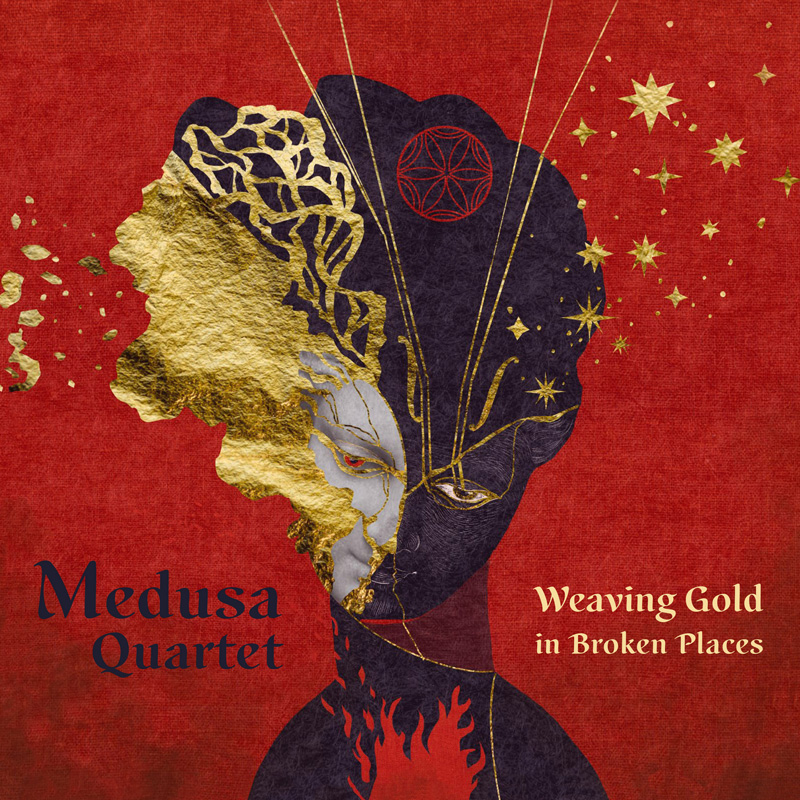
Medusa Quartet — Weaving Gold in Broken Places (self-released, 2026)
Weaving Gold in Broken Places is the first full-length album by Toronto chamber-folk ensemble Medusa Quartet. It is a project inspired by the fascinating Japanese art of kintsugi. Indeed, kintsugi repairs broken pottery with gold, preserving visible cracks rather than concealing them. The quartet applies that idea of turning fracture into strength with an album centered on rupture, recovery, and resilience.
Medusa Quartet first gained attention with its debut EP, which earned a Canadian Folk Music Award nomination for Instrumental Album of the Year. Since then, the group has also toured Canada, the United States, and the United Kingdom, with appearances at Calliope House, Calgary Folk Music Festival, and Hugh’s Room Live.
“With our first full-length album, we want to take people on a journey—both around the world and through the process of breaking and healing,” fiddler Geo Hathaway said. “Kintsugi doesn’t cover up the cracks; it uses them to build a stronger container. In Medusa, we don’t shy away from our cracks either. We see them as beautiful.”
Several pieces focus on historical figures, including a woman from an Ottoman harem, an African American who escaped slavery, and an Irish maid described by the group as the first person burned at the stake for witchcraft. Other tracks address community, family, and personal connection.
Individual Tracks
- “Tamzara” is a traditional Armenian tune and circle dance, often performed with parkapzuk (Armenian bagpipes) and drums. This arrangement retains its driving 9/8 rhythm while developing the melody with new material, including a cinematic interlude that builds into a final fanfare. Geo Hathaway learned the tune from Mike Anklewicz.
- Dancing Room Only / Chasing the Sun. This jig medley begins with three dissonant chords before moving into two contrasting original tunes. Saskia Tomkins wrote “Dancing Room Only” for her daughter Eile, whose name also inspired the tune’s key of E. Lea Kirstein’s “Chasing the Sun,” affected by their experience teaching teenage fiddlers, takes a more contemporary approach. The arrangement features Elise Boeur on Hardanger fiddle.
- Vulgar Bulgar. Saskia Tomkins draws on Bulgarian rhythmic traditions in a composition whose title also plays on the name of bulgur wheat. Alternating 7/8 and 7/4 meters create rhythmic tension beneath contrasting harmonies and melodic lines. The track features Persian percussionist Naghmeh Farahmand.
- Weaving Gold in Broken Places. Inspired by kintsugi, the Japanese practice of repairing broken pottery with lacquer and gold, this composition by Lea Kirstein considers repair and connection without concealing what has been broken. The tune also incorporates Kirstein’s experience dancing the schottische in the Balfolk community.
- Kujawiak / Oberek. This medley pairs two traditional Polish dances with contrasting characters: the slow, expressive Kujawiak and the faster, more vigorous Oberek. Both use triple meter and flexible rubato, with irregular subdivisions and accents added by the dancers’ steps. The resulting rhythmic movement resists a strictly metronomic pulse.
- Aaron’s Key / The Musical Priest. “Aaron’s Key” is a jig by Paul Roche, flutist with Stockton’s Wing, reportedly named after a teething ring used by his son Aaron. “An Sagart Ceolmhar” (“The Musical Priest”) is an Irish tune documented in the 19th century and later recorded by fiddler James Morrison in 1935.
- Air for Petronella. Saskia Tomkins composed this piece in 2024 in response to the story of Petronella de Meath, a servant in the household of Alice Kyteler in Kilkenny, Ireland. During the Kilkenny witch trials, Kyteler escaped prosecution, while Petronella was imprisoned, tortured, and executed on November 3, 1324. The composition traces a musical path through grief, pain, and release. Medusa Quartet premiered it on November 3, 2024, the 700th anniversary of Petronella’s execution and the date of her official exoneration.
- “Kerry Polska” incorporates a theme from Sibelius’s Fifth Symphony into a contemporary fiddle tune. Written by Rune Barslund, the piece uses the polska—a Scandinavian dance form with historical connections to Poland—to bring Swedish, Polish, folk, and classical traditions into direct conversation.
- A Heart’s Cry / Leyla’s Salon. The medley opens with a composition by Turkish composer, writer, and poet Leyla Saz (1850–1936), whose work includes Turkish classical vocal and instrumental music. The original song addresses unrequited love and longing. Saz studied music from an early age and later hosted gatherings of musicians, artists, and intellectuals. Geo Hathaway, influenced by her study of Turkish music, composed “Leyla’s Salon” in response to Saz’s life and work.
- Pompey Ran Away / Paddy’s Trip to Scotland / Elzic’s Farewell. This medley connects three traditional tunes associated with American, Irish, and Scottish musical histories. “Pompey Ran Away,” documented in James Aird’s 1782 collection, belongs to the early repertoire that contributed to Appalachian old-time music. It leads into the 19th-century Irish reel “Paddy’s Trip to Scotland,” reflecting longstanding musical exchange between Ireland and Scotland. The medley concludes with the Appalachian tune “Elzic’s Farewell,” traditionally associated with fiddler Harvey Elswick.
Medusa Quartet includes Georgia Hathaway on fiddle, viola, nyckelharpa; Lea Kirstein on cello, viola; Marta Sołek on suka, płock fiddle, lyra, cello; and Saskia Tomkins on nyckelharpa, fiddle.
Guests: Naghmeh Farahmand on hand percussion on track 3 and 9; Elise Boeur on hardanger fiddle on track 2; and Adam Iredale-Gray on foot percussion on tracks 2 & 10.
Produced by Adam Iredale-Gray and Medusa Quartet
Recorded and mixed by Adam Iredale-Gray at Metrolab Studio Toronto. Mastering by David Travers-Smith.
Artwork by Czarli Bajka.
Photo by Jen Squires.
Buy Weaving Gold in Broken Places.

Author: Tyler Bennet
