
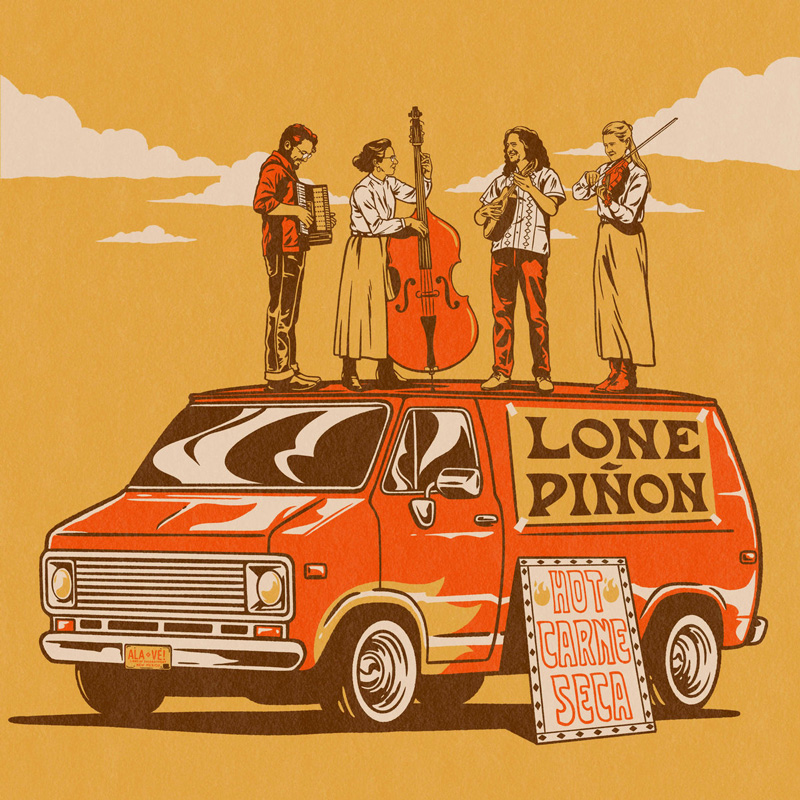
Lone Piñon – Hot Carne Seca (Jalopy Records, 2026)
New Mexico ensemble Lone Piñon celebrated its 10th anniversary with the release of a superb album titled Hot Carne Seca (spicy hot dried meat). The recordings were made in Eunice, Louisiana, with GRAMMY-winning producer Joel Savoy. The songs present the rich diversity of the musical traditions of the northern region of New Mexico.
Northern New Mexico’s musical heritage is the result of centuries of cultural exchange among Spanish, Mexican, Indigenous, European immigrant, Anglo-American, and African American communities. Lone Piñon explores that legacy through a delightful string band instrumentation that includes violin, upright bass, guitar, accordion, vihuela, and bilingual vocals. The instrumentation itself is another form of cultural fusion: guitars and vihuelas from the Spanish tradition, accordion from the German lands and the violin and bass rooted in western classical music and European folk music.
For Hot Carne Seca, the band traveled to Louisiana to work with Savoy, whose production credits include projects by Linda Ronstadt and Steve Earle, as well as contributions to television series such as the cult show Tremé. Savoy recorded the album on vintage equipment without overdubs or multitracking in an effort to capture the energy of the band’s live performances.
The collection features a broader emphasis on vocal material than previous releases. The finely-crafted, enthralling and evocative material is a mix of centuries-old repertoire and more recent musical traditions. Earlier this year, Jalopy Records introduced the album with the single “El Tecolote” (the owl), a song from a Northern New Mexican folk tradition known as tecolote, which focuses on references to the owl’s lament. The melody uses a 6/8 meter often compared to an Irish jig.
The New Mexico melting pot is evident in “Los Ojos de Pancha / La Felicita / Juana la Cubana,” (The Eyes of Pancha/La Felicita/Juana the Cuban), a joyful medley that combines polka ranchera and cumbia norteña styles. Here, the lively ranchera (ranch songs) honors the vaqueros, the first cowboys that arrived with Spanish settlers and continued under Mexican rule up to the modern New Mexican cowboys. Another component, the cumbia, traveled from Colombia in South America and became popular in Mexico and north of the border. Lastly, the polka was brought by German and other central European settlers.
Among the album’s other selections is “Polka Problemática,” a 20th-century piece learned from a home-recorded cassette made in the 1970s by fiddler and lumber camp worker Maximiliano Ortiz.
Meanwhile, “Juana la Cubana” traces its popularity to live performances by Tejana star Selena Quintanilla in the early 1990s. Another highlight, “El Preso Número 9” (prisoner number 9) presents a fast instrumental introduction composed by the band with a story about a condemned prisoner.
Elsewhere, the medley “No Eras Para Mi / Czardas / De Huetamo a Pachuca” (You Were Not for Me / Czardas / From Huetamo to Pachuca) transitions through several musical traditions, juxtaposing a Cuban-rooted bolero, an Italian composition inspired by Hungarian music that later gained popularity in central Mexico, and a pasodoble associated with Mexico’s Pacific Coast region of Michoacán and a popular Spanish two-step dance.
The group includes Tanya Nuñez on upright bass and vocals; Karina Wilson on violin, viola, and vocals; and Santiago Romero on guitar and vocals. Romero began his career as a mariachi musician and became the first official state representative of mariachi music in New Mexico through a gubernatorial appointment.
Multi-instrumentalist Noah Wax contributes violin, accordion, mandolin, guitar, and vocals. To deepen his understanding of huapango fiddle traditions, he spent six months in Mexico studying with Rolando “El Quecho” Hernández of Trio Chicontepec, Casimiro Granillo of Trio Chicamole, and musicians throughout the Huasteca region of San Luis Potosí.
Over the past decade, Lone Piñon has worked closely with tradition bearers, studied field recordings, and participated in traditional music and dance revitalization efforts throughout the United States and Mexico. As a result, the ensemble has helped reintroduce the New Mexico orquesta típica tradition to contemporary audiences and younger generations. Lone Piñon has performed at influential venues including the Kennedy Center, Lincoln Center, and Brooklyn Folk Fest.
Hot Carne Seca Track Listing
- Polka Problemática
- El Tecolote (Cuadrilla)
- Quiero Ver (Ranchera)
- Los Ojos de Pancha (Polka ranchera) / La Felicita / Juana la Cubana (Cumbia norteña)
- Cataclismo (Bolero)
- Viva Albuquerque (Polka)
- No Eras Para Mi (Bolero) / Czardas / De Huetamo a Pachuca (Pasodoble)
- El Preso Numero 9 (Huapango)
- Sunset Waltz
- Pecos Polka
- Nochesita
Buy Hot Carne Seca.

Author: Angel Romero
Angel Romero y Ruiz has dedicated his life to musical exploration. His efforts included the creation of two online portals, worldmusiccentral.org and musicasdelmundo.com. In addition, Angel is the co-founder of the Transglobal World Music Chart, a panel of world music DJs and writers that celebrates global sounds. Furthermore, he delved into the record business, producing world music studio albums and compilations. His works have appeared on Alula Records, Ellipsis Arts, Indígena Records and Music of the World.