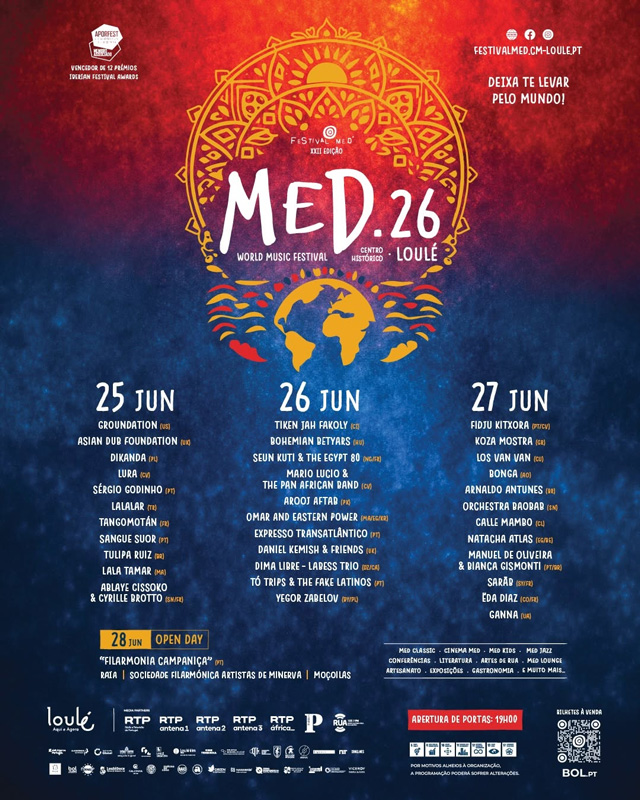
Set in Loulé, in the south of Portugal, from June 25 to June 28, Festival Med 2026 is shaping up to be an essential cultural moment where tradition, time, and global sound come together in unforgettable ways. Headlining this year’s edition are two giants of Lusophone music, Sérgio Godinho and Bonga.
Sérgio Godinho. Now 80, Sérgio is one of the defining voices of Portuguese music. His poetic, urban, and deeply human songwriting has shaped the country’s cultural imagination for more than five decades. Closely linked to the spirit of the Carnation Revolution, he brought literary intelligence, social awareness, and emotional depth into popular song, influencing generations of listeners and musicians.
Bonga, now 83, is equally essential. A major ambassador of Angolan music, he helped bring semba to the world while turning song into a form of memory, resistance, and identity during Angola’s struggle for independence. His rough, unmistakable voice carries both sorrow and strength, and his work remains tied to the history of exile, liberation, and cultural pride. Having both artists at Festival Med 2026 is a gift, and their presence alone makes this edition unmissable.
One of the most intriguing names on this year’s lineup is Omar and the Eastern Power, a project that combiners Middle Eastern sounds with modern rhythms. Led by Moroccan singer Omar Benassila, whose hypnotic voice gives the music much of its pull, the band comes from an unexpected place: South Korea.
From Poland, Dikanda, founded in Szczecin in 1997, draws on traditions from the Balkans, the Carpathians, the Middle East, Africa, and the Roma world. One of their most distinctive characteristics is their invented lyrical language, dikandish. On stage, Dikanda creates a powerful mix of voices, accordion, percussion, guitar, trumpet, and double bass.
Lala Tamar brings a rich mix of influences: Moroccan Jewish heritage, Brazilian rhythms, and a voice that moves easily between ancestral memory and contemporary fire.
Seun Kuti carries the legacy of his father, Fela Kuti. Seun brings Afrobeat in its most political and explosive form. His music is a call to action, a refusal to soften the message, and a reminder that rhythm can be a force for resistance.
Mário Lúcio, former Minister of Culture of Cape Verde and a writer, offers a reflective counterbalance, gentle, thoughtful, and deeply human. His work often explores migration, identity, and the emotional landscape of those who move between worlds.
Then there is Los Van Van, the Cuban superband whose songo style has kept people dancing for more than half a century. Their groove is irresistible. There is a deep irony in the fact that a country that has given the world so much musical brilliance has so frequently lived under hardship. Los Van Van embody that paradox: joy, invention, and resilience turned into rhythm.
Festival Med is about more than its lineup. It lives in the warm nights along the old streets of Loulé, in the aromas of food from around the world, and in the mingling of locals and travelers. The result is a four-day festival that celebrates world music, art, and Mediterranean culture featuring artists from around 30 countries.
More about the festival: festivalmed.cm-loule.pt/en/

Author: World Music Central News Room
World music news from the editors at World Music Central