
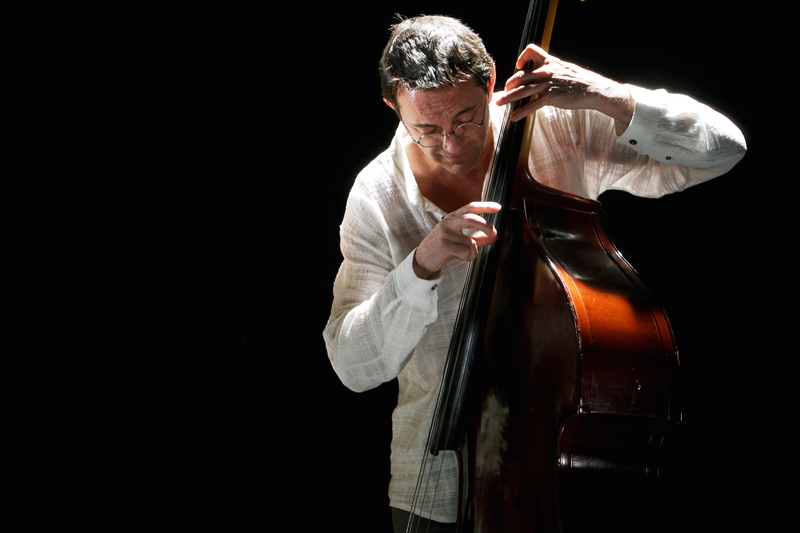
(headline image: Javier Colina – Photo by Igor Cortadellas)
Born in Pamplona, Spain, on December 2, 1960, Javier Colina ranks among Spain’s most widely respected jazz and flamenco bass players. Although his early piano studies shaped his ear, he eventually became a self-taught double bass player. By the early 1990s, he emerged in the vanguard of flamenco-jazz projects and became a first-call sideman. Work with drummer Guillermo McGill and pianist Chano Domínguez placed him on major festival stages and in Fernando Trueba’s iconic documentary Calle 54.
Colina’s command of flamenco and traditional music idiom earned invitations from leading figures across musical genres. In jazz, he has shared bandstands or studios with Tete Montoliu, Al Foster, Chucho Valdés, Jerry González, George Cables, Hank Jones, Brad Mehldau, Louis Bellson, Pat Metheny, and Michel Camilo. In flamenco, collaborations include Tomatito, Pepe Habichuela, Diego El Cigala, and Enrique Morente.
A Cuban chapter proved pivotal. Performances with Compay Segundo and Pancho Amat led to his role with Bebo Valdés on Lágrimas Negras (Calle 54 Records, 2003), followed by a week of New York dates and the live album Bebo Valdés & Javier Colina Live at the Village Vanguard (Calle 54 Records). His debut as leader, Si Te Contara (PLC S.L. Música), recorded in Cuba with Amat, featured Changuito, Santiago Auserón, Tata Güines, Julio Padrón, Duquende, and Perico Sambeat.
Partnerships have remained central. With Sílvia Pérez Cruz, he released En La Imaginación (Universal, 2016), reframing Cuban filin through his trio and her voice. With flamenco guitarist Josemi Carmona and percussionist Bandolero, he issued De Cerca (Universal Music Spain, 2016) and Vida (Universal Music Spain, 2022), touring widely.
His interest in world music extends to Gnawa traditions alongside Tanger’s Abdulah El Gourd and to Brazilian repertoire with Toquinho and pianist Albert Sanz on Sampa (Youkali Music, 2018), Sinhá (Youkali Music, 2021), and Rodizio Musical (Recoletos, 2023). The latter captured live at Madrid’s Recoletos Jazz Club with guests Antonio Serrano, Josemi Carmona, Israel “Piraña” Suárez, and Sílvia Pérez Cruz.
In February 2024 he appeared at the Paco de Lucía Legacy festival at Carnegie Hall and The Town Hall in New York, joining leading artists from today’s flamenco scene.
In 2025, Javier Colina toured with Cuban vocalist Haydée Milanés, daughter of Pablo Milanés, a leading figure in Cuban popular music. They presented the show ‘A Mi Manera’ (My Way), a unique journey through the memory and enduring relevance of Cuban song, approached through the expressive freedom of jazz. ‘A Mi Manera’ celebrates the freedom of improvisation, the dialogue between two worlds, and poetry from the depths of one’s being. Each concert is an unrepeatable experience, a journey where music becomes shared emotion.

The duo, accompanied by musicians Moisés Porro (percussion) and Luis Guerra (piano), played at the Chamber Hall of the National Music Auditorium in Madrid, to a full house in October 2025. The result was an intimate and exquisitely delicate concert, where bolero, trova, and the works of great Cuban composers intertwined with the freedom of jazz, offering a unique experience for lovers of both worlds.

Author: Angel Romero
Angel Romero y Ruiz has dedicated his life to musical exploration. His efforts included the creation of two online portals, worldmusiccentral.org and musicasdelmundo.com. In addition, Angel is the co-founder of the Transglobal World Music Chart, a panel of world music DJs and writers that celebrates global sounds. Furthermore, he delved into the record business, producing world music studio albums and compilations. His works have appeared on Alula Records, Ellipsis Arts, Indígena Records and Music of the World.