
British writer and musician John Phillpott looks at a form that still resonates with audiences in the folk music world and beyond… the transportation ballads.
IT’S said that you can take a boy out of the country… but you can’t take the country out of the boy.
And it’s true. For even though I’ve travelled quite a lot down the years, my heart somehow always returns to that small village nestling in Shakespeare’s English County of Warwickshire, the leafy land of my childhood.
Oh yes, I was a real country boy. Endlessly wandering the fields and woods, working on local farms during the school holidays, fishing the nearby river… and poaching.
From a young age I knew how to set a snare for rabbits, sneak up on hares lying up-wind in the grass, and had experienced the unmistakable shoulder ‘kick’ of a shotgun not long after my tender years had entered double figures.
One day, however, I was caught out by a local landowner, who mercifully let me go on my way after a stern admonishment. But had this been a couple of hundred years earlier then there would have been no mercy shown at all.
For poaching was once regarded as a heinous sin by the British landowning classes and the penalty for those convicted by the courts was harsh in the extreme.

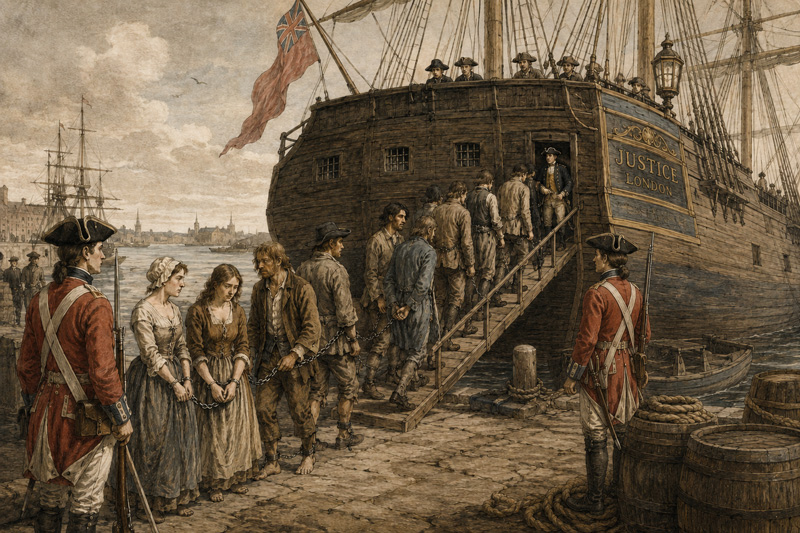
Transportation. Shackled in chains and loaded like cattle into the dank holds of sailing ships, the miscreant would find him – or herself – bound for penal servitude on the other side of the world in the then English colonies on the eastern seaboard of America. The destination later became Australia after the American declaration of independence in 1776.

There is a whole body of transportation ballads, many of which will be familiar to devotees of folk music right across the British Isles and beyond.
The songs were intended to serve as warnings of the hardships that came with conviction and thereby a deterrent against criminal behaviour. In the 18th and early 19th centuries transportation ballads were published as broadsides – song sheets sold cheaply in the streets, at markets and at fairs. And many have passed into the folk tradition.
Transportation ballads were almost exclusively related in the first person from the perspective of the convicted felon. They employed several frequent themes including…
A good upbringing, thereby implying that a life of crime was choice; a decision to take up with persons of low moral repute; incidental financial or emotional injury to the narrator’s family; harsh treatment of the narrator after conviction. Finally, a cautionary note of which the listener should take heed.
More rarely, transportation ballads served as a form of protest, particularly as a means of opposing the sentencing of those convicted of political crimes.
The first one I will deal with is of particular interest to me because of its setting.
Young Henry the Poacher is the story of six men tried at Warwickshire Assizes for poaching and transported to Van Dieman’s Land – Australia – for 14 years. This ballad may have been inspired by two big trials held in the county town of Warwick early in 1829. It circulated nationally, was frequently reprinted, and survived in oral tradition until the start of the last century.

This showed that the creation of new songs in traditional style survived until relatively recently. It also illustrates how the printed word and oral tradition might have complemented each other.
Almost certainly better known is “The Black Velvet Band.” This song deals with the dangers of petty crime which can lead to transportation. Although it is sometimes claimed as an Australian song, it probably originated in Britain.
The earliest known version was published in Manchester between 1837 and 1853, and sets the song in Barking, Essex. It has no chorus, but begins:
One day, being out on a ramble, alone by myself I did stray,
I met with a young gay deceiver, while cruising in Ratcliffe Highway;
Her eyes were as black as a raven, I thought her the pride of the land,
Her hair, that did hang o’er her shoulders, was tied with a black velvet band.
On this occasion, it was a young woman who seems to have got all the blame for what would eventually transpire. It is very popular in Ireland, where of course, it is claimed as an Irish song.
“The Black Velvet Band” has been recorded by many Irish groups, including The Dubliners, Dropkick Murphys and Dermot O’Reilly and Fergus O’Byrne.
Another well-known song is “Botany Bay.” It is not really an authentic Australian ballad as it was written in England by Henry Pottinger Stephens and William Yardley for the burlesque comedy, Little Jack Shephard (London, 1885; Melbourne, 1886).
It was first published in Australia in the Sydney Golden Songster in 1893. Since then it has become a standard part of the Australian folk tradition.
Meanwhile, “The Catalpa” is a song based on an incident that took place in April 1876, when six Fenians – Irish rebels – escaped from Fremantle Jail. The escape was funded by collections in Australia and the United States, including over three thousand pounds collected in Australia, some of which was placed in the hands of unscrupulous warders.
First published in Three Street Ballads in 1957, one version was collected by Russel Ward from Victor Courtney, a journalist on the Sunday Times, Perth, Western Australia.
It is said that the song became so popular that it was banned by the authorities of the day and anyone caught singing it was threatened with imprisonment.
Several tunes are associated with this song, including “Judges and Juries,” a tune very similar to “Botany Bay,” “The Dying Stockman” and “Rosin the Beau.”
Nearly 25,000 women were transported to Australia as convicts, half of them from Ireland. Convict Maid is one of the few songs about female convicts.
The tune is based on “The Croppy Boy,” an Irish song from the 1788 rebellion.
Another song, titled “Currency Lasses” dealt with the plight of women and girls who had been assigned to settlers as maids, kitchen hands and farm labourers or sent to workhouses where they worked as seamstresses.
Others were taken to the Parramatta female prison known as the Female Factory. Those who behaved sufficiently well were offered to lower-class settlers in search of a wife. Often these were prisoners who had served their time and were now termed ‘ticket-of-leave’ holders.
This song, from the early 1830s, is also known as “Currency Lads and Lasses,” and is sung to the tune of The Irish Washerwoman. The Mr Dunn referred to is Thomas Dunn, who had been Chief Constable at Sydney, but had retired to Parramatta to enjoy light duty and a pension.
The ladies, Mrs. O’Reardon and Mrs. Muldoon, were committee members of the Female Factory Institution. This information is from Warren Fahey’s excellent collection, Australian Folk Songs and Bush Ballads.
There can be few people who are not familiar with “Maggie May,” a ballad that originally hales from Liverpool. It was very popular among seamen all over the world, many of whom probably had similar experiences. It became widely circulated in a British ‘skiffle’ version from the late 1950s.
In this version, the setting is Lime Street, but earlier versions used several different street names. Folk music collector A L Lloyd recorded it in 1956 on the album English Drinking Songs, describing it in the liner notes as “last fling of sailor balladry. It is a song that has found its way into every ship but none of the songbooks.”
The Vipers skiffle group released a version in 1957, which became the best-known recording at the time, but it was banned by BBC Radio on its release because of the sexual content of the lyrics.
Stan Kelly also sang a version on his 1958 EP Liverpool Packet. Lionel Bart used the song in a musical in 1964, but with different lyrics which transformed Maggie into a heroine whose departure from the streets is lamented (“some rotten homeward bounder has got his grip around her”).
This version was often sung by Judy Garland and was recorded by her on the Maggie May EP in 1964. The song was also recorded by The Searchers, The Beatles and by Hughie Jones of The Spinners.
Shanty singer and writer Stan Hugill writes of an early reference to the song in the diary of Charles Picknell, a sailor on the female-convict ship Kains that sailed to Van Dieman’s Land in 1830.
The song’s relationship to the 1856 American slave song, “Darling Nellie Gray,” which uses the same tune is not clear.
“Moreton Bay” is another Australian song about transportation, originally known as The Convict’s Lament on the Death of Captain Logan.
Moreton Bay, in Queensland, was one of the worst penal colonies. Between 1825 and 1830 it was run by Captain Patrick Logan, notorious for his cruel and sadistic treatment of the prisoners.
Records kept by one of the prison clerks show that, from February to October in 1828, Logan ordered 200 floggings with over 11,000 lashes. He was killed by Aborigines in 1830 while he was surveying the upper Brisbane River.
When his body was brought back to Moreton Bay, it is reported that the convicts “manifested insane joy at the news of his murder, and sang and hoorayed all night, in defiance of the warders.”
The origins of the song are unknown, but it may well date back to the time of Logan’s death. Bushranger Ned Kelly quoted some of the lines in his “Jerilderie Letter” of 1879. Bushranger Jack Bradshaw, who wrote A True History of the Australian Bushrangers (1911) and Twenty Years of Prison Life in the Gaols of NSW attributed the song to Francis MacNamara (Frank the Poet), who spent years in various Australian penal settlements.
An image of penal servitude is created by Van Dieman’s Land, a song title known to many folk enthusiasts. Van Dieman’s Land is Tasmania, Australia’s island state, south of Victoria on the east coast.
It was originally named “Van Diemen’s Land” by Dutch explorer Abel Tasman, in 1642, after Anthony Van Diemen, the Governor of the Dutch East Indies, who had shown him hospitality.
Irish convicts being deported to Van Dieman’s Land would first be sent to Mountjoy jail in Dublin, which was the subject of Brendan Behan’s song “The Ould Triangle.”
They were then taken to Spike Island Prison in Cork before setting off on the long voyage to Australia (or New Holland, as it was then known). When transportation of convicts ended in 1853, the name was changed to Tasmania (after Abel Tasman) in an attempt to distance it from associations with the penal colony it had once been.


This song, though often considered an Australian folk song, probably originated as a broadside in England or Ireland in the 1800s, and is closely related to the previously mentioned Young Henry the Poacher or Henry’s Downfall, which has been recorded by British singer Ewan MacColl.
This first one featured on the classic LP Moreton Bay and Other Songs Mainly of Convict Origin (1963) which featured Australian folksingers Brian Mooney, Martyn Wyndham-Read and David Lumsden. It was produced by the record company Discurio, which specialised in folk recordings, headed by Peter Mann, who had a weekly radio programme of folk music.
But nearer the present, “The Fields of Athenry“ is an Irish folk ballad written in 1979 by Pete St John. Set during the Great Famine of the 1840s, the song’s lyrics feature a fictional man from near Athenry in County Galway, Ireland who has stolen food for his starving family and been sentenced to transportation to the Australian penal colony at Botany Bay. Somewhat ironically, it has become a popular anthem for Irish sports supporters.
Nevertheless, the song that will always resonate with this writer has to be “Young Henry the Poacher.” Because but for an accident of birth and the distance of the centuries, that Warwickshire boy who ended up shackled in chains on a prison ship bound for an uncertain future on the other side of the world might so well have been me.
(headline image: Representation of convicts loaded into sailing ship. 18th century, AI generated.)

Author: John Philpott
Author and journalist John Phillpott has written for many newspapers and magazines during a career that spans more than 50 years. His latest book Go and Make the Tea, Boy! is a memoir of his days as a young reporter.