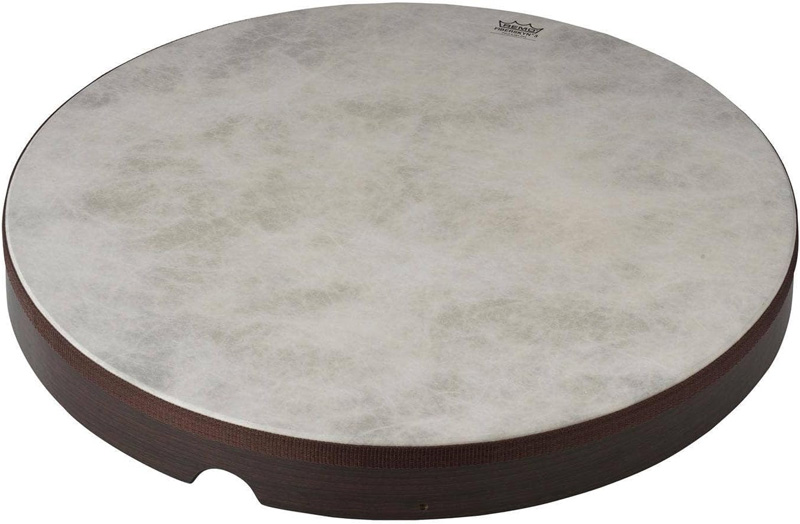
(headline image: Remo Fiberskyn 3 frame drum)
The frame drum is among the most widely distributed percussion instruments in human musical culture: a shallow frame, usually circular but sometimes square or polygonal, with a membrane stretched across one or both sides. Its simplicity is deceptive. Across the Middle East, North Africa, Central Asia, Europe, South Asia, Brazil, and the Caribbean, it has served ritual, courtly, folk, devotional, dance, and popular-music functions. A University of Central Asia study describes it as an ancient, portable instrument with varied sizes, names, patterns, techniques, and cultural uses, often made with animal skin and sometimes fitted with jingles or internal rings.
Frame drums are ancient Instruments. They appear across ancient Middle Eastern, Indian, Roman, Mediterranean, and later Islamic cultural routes. The University of Central Asia paper notes that names such as duff, daff, def, daireh, daira, tar, riq, tof, ghirbal, and bendir reflect long histories of circulation and localization. Smithsonian Folklife similarly places the daf within a family found worldwide, noting its links to Kurdish, Persian, Arabian, and Italian relatives such as the bendir and tamburello.

The instrument’s symbolic roles are as important as its musical ones. In Sufi, Central Asian, and shamanic contexts, frame drums have accompanied healing, trance, prayer, weddings, guest-welcoming, and public ceremony. In Badakhshan, Tajikistan, the daf is described as central to social life, performed by women, men, and children at weddings and other community events.
Traditional frame drums usually combine a wooden frame with an animal-skin head. In Central Asia, the daf or doira may use apricot or walnut wood, with calf, horse, goat, or snake skin stretched across the frame and metal rings inside the shell. The Persian-Kurdish daf often adds linked internal rings, which distinguish it from many plainer frame drums.
Other regions use different construction methods. The North African bendir commonly includes a gut snare across the head, producing a buzzing resonance. The Portuguese adufe and Spanish pandero cuadrado is square or rectangular, traditionally handmade with goat skin, pine, stitching, ribbons, and small seeds or stones inside. In Brazil, the pandeiro is a tunable single-headed frame drum with metal jingles, used in samba, choro, capoeira, and other Brazilian traditions.
Modern makers increasingly use synthetic heads, metal hardware, and mechanical tuning systems, but the core idea remains stable: a membrane, a frame, and a playing technique that turns a small object into a complete rhythmic vocabulary.
Regional Variations
In Iran, Kurdistan, Iraq, Turkey, Azerbaijan, Afghanistan, Pakistan, and Tajikistan, the daf and related doira/dayereh traditions connect music to Sufi ritual, weddings, and classical or folk performance. Smithsonian notes that Kurdish daf playing remains central at weddings, while Sufi contexts use the instrument in devotional dance and remembrance practices.
In the Arab world, the riq is a smaller, jingle-bearing frame drum central to classical and popular ensembles, while larger forms such as duff, mazhar, and bendir serve devotional, folk, and dance contexts. UNESCO documentation on Arab and regional intangible heritage frequently lists tambourines or frame drums among traditional ensemble instruments, including the small daff in Iraqi maqam-related practice.
In North Africa, the bendir is especially associated with Morocco, Algeria, and broader Amazigh and Sufi traditions. Its snare-bearing construction gives it a distinctive buzzing attack, while its vertical playing position is similar to wider Mediterranean and Middle Eastern frame-drum techniques.
In Europe, the Italian tamburello, Spanish pandero, Portuguese adufe, Irish bodhrán, and Balkan daire show how the frame drum is used in dance, procession, rural ritual, and theatrical music. The Portuguese adufe and the Spanish pandero cuadrado are especially notable because they are square and have historically been associated with women’s performance in Portuguese and Spanish religious and rural settings.
In South Asia, the kanjira of South Indian Carnatic music condenses the frame drum into a virtuosic concert instrument. Its small frame and lizard-skin or modern substitute head allow pitch bends, sharp strokes, and complex rhythmic dialogue with the mridangam.
In Brazil and the Caribbean, frame drums entered new social formations through Iberian, African, and Indigenous contact zones. The Brazilian pandeiro became a flexible emblem of samba, choro, capoeira, and popular music; academic work on Marcos Suzano describes it as a single-headed frame drum with embedded jingles whose modern amplified technique helped reposition it as a lead instrument in Brazilian popular music. Puerto Rico’s panderos de plena, inherited from Spanish settlers, use different sizes within plena ensembles, including requinto, punteador, and seguidor functions.
The frame drum’s importance lies in its adaptability. It can be used in a wedding procession, accompany a Sufi dhikr, support a samba groove, lead a folk dance, appear in jazz, world music and fusion bands, or sustain a shamanic rite. It is at once instrument, ritual object, gendered performance tool, craft tradition, and social marker.
Frame drums long predate many modern states. The frame drum is therefore best understood not as one instrument with many names, but as a family of related instruments through which communities have organized rhythm, memory, devotion, labor, celebration, and identity.
Influential frame drum specialists
Below is a curated list of musicians who are recognized by fellow percussionists, conservatories, festivals, and researchers as major exponents of a particular frame drum style.
Glen Velez (USA), bendir, tar, riq, bodhrán, ghaval.
Velez is widely credited with establishing modern concert frame drumming and creating a cross-cultural technique that influenced players worldwide. He is best known for his work with the Paul Winter Consort and his solo recordings.
Peyman Nasehpour (Iran), Persian daf, dayereh.
International authority on Persian frame drums and their history, with extensive educational publications.
Layne Redmond (USA), tar, bendir, ancient frame drums.
Redmond popularized historical and spiritual approaches to frame drums through performance and workshops.
David Kuckhermann (Germany), bendir, daf, riq, tar, pandero.
One of today’s leading educators, known for integrating Middle Eastern, Mediterranean, and Latin traditions into a coherent modern technique. He has been a member of Dead Can Dance since 2012.
Eliseo Parra (Spain), pandero cuadrado de Peñaparda.
Parra popularized the rare Peñaparda square drum of western Spain. He introduced it to modern folk bands and percussionists throughout Spain and beyond. It is now widely used by Spanish traditional, neofolk and world music ensembles.
John Joe Kelly (Ireland), bodhrán.
One of Ireland’s finest bodhrán soloists and a major influence on modern technique.
Zohar Fresco (Israel), frame drum, bendir, daf.
One of the most influential contemporary frame drummers in jazz and Middle Eastern music.
Murat Coşkun (Germany/Turkey), bendir, daf, riq.
Founder of the International Frame Drum Festival and a leading specialist in Turkish and Middle Eastern traditions.
Marla Leigh (USA), frame drums.
Influential professional musician and educator.
Carlo Rizzo (Italy), tamburello.
Revolutionized tamburello technique through finger control and tuning innovations. His influence extends well beyond Italy.
Alfio Antico (Italy), tamburo a cornice.
Sicily’s best-known traditional frame drum virtuoso. He’s a singer-songwriter, percussionist, and theatrical actor.
Alessandra Belloni (Italy), tamburello.
An influential disseminator of Italian traditions in North America.
Junior Davey (Ireland), bodhrán.
One of the pioneers of modern Irish bodhrán playing.
Marcos Suzano (Brazil), pandeiro.
Perhaps the most influential living Brazilian pandeiro player.
Bernardo Aguiar (Brazil), pandeiro.
Leading contemporary virtuoso and educator.
Xabier Díaz (Spain), pandeireta gallega.
Leading Galician tambourine player.
Aleix Tobias (Spain), pandero cuadrado, tambourine.
Celebrated jazz and world music percussionist.

Author: Angel Romero
Angel Romero y Ruiz has dedicated his life to musical exploration. His efforts included the creation of two online portals, worldmusiccentral.org and musicasdelmundo.com. In addition, Angel is the co-founder of the Transglobal World Music Chart, a panel of world music DJs and writers that celebrates global sounds. Furthermore, he delved into the record business, producing world music studio albums and compilations. His works have appeared on Alula Records, Ellipsis Arts, Indígena Records and Music of the World.