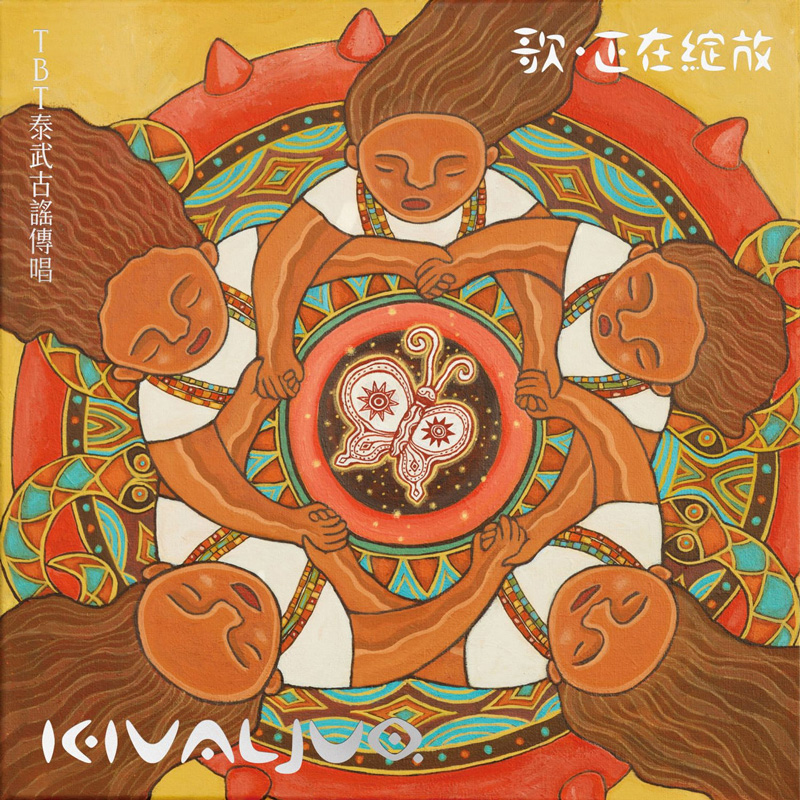
Taiwu Ballads Troupe (TBT)’s – Kivaljuq (Wind Music International Corporation, 2026)
Taiwu Ballads Troupe’s Kivaljuq introduces the listener to the traditional sounds of the Paiwan communities beneath Dawu Mountain in southern Taiwan. The album takes its title from the Paiwan word for “metamorphosis.” The five singers entrusted with ancestral songs now assume authority as custodians, teachers, and interpreters of that heritage.
Producer Wu Judy Chin-tai gives this transition an elegant structure. Ten pieces appear through contemporary world music arrangements and, in parallel, through unaccompanied performances with Puljetji Ancient Ballads Troupe. The two approaches illuminate each other: one reveals the music’s capacity for adaptation; the other exposes the formidable architecture of Paiwan polyphony, without instrumental embellishment.
“Sukai lja (The Words You Left Us)” is dedicated to the late TBT founder Camake Valaule. “Semulu (Tears of Longing)” introduces Sauniaw Tjuveljevelj’s rare Paiwan nose flute.
“Nalivan (A Treasured Token),” with Malaysian band Tuni Sundatang (Sabah, Borneo), extends the record beyond Paiwan territory toward a wider Austronesian conversation between the indigenous peoples of Taiwan and Borneo.

TBT (Taiwu Ballads Troupe): Hsieh En-Chi, Managing Director; Muni Maljangljang , alto / Team Leader & Operations Administrator; Zuljezulje Talimarav, lead vocalist, alto / Rehearsal & Performance Coordinator; Aruwai Vaviungan, lead vocalist, soprano & bass / Social Media Editor; Dresdres Vaviungan, lead vocalist, soprano / Social Media Editor; and Dresdres Vudjavure, lead vocalist, bass / Operations Administrator.
01. Sukai Lja (The Words You Left Us)
Lyrics: Adapted by Dremedreman Taljiyalep, Patagav Sadjiljapan, Camake Valaule, Idis Sadjiljapan
Music: Wu Judy Chin-tai
Written in memory of Camake Valaule, “Sukai Lja” draws its lyrics from words composed by Puljetji elders after his passing. Wu Judy Chin-tai builds the piece around ancient polyphony and a neutral third characteristic of traditional Paiwan music, where the pitch moves subtly between major and minor. The lyrics also reference the Paiwan ballad “Pu Aliu”: “My beloved, take your time; safe travels on your journey.”
Free-form chanting over the pulse of the bass drum suggests Camake’s ancestral presence accompanying his people, urging them to carry his teachings forward as they face an uncertain future.
02. Luljemai (Feat. Puljetji Ancient Ballads Troupe)
Lyrics & Music: Traditional Ritual Song from the Puljetji community (Paiwan)
A ceremonial song that belongs exclusively to Puljetji’s Curuvu clan, “Luljemai” uses song and dance to honor ancestral spirits and invite them to share in offerings prepared by their descendants.
Camake learned the ballad from community elders. Here, Hung Tzu-Lung gives it a more contemporary rhythmic flow, while the participation of Puljetji elders reinforces the bond between generations. Their voices suggest that TBT’s younger members continue forward with the encouragement of those who preserved their music, language, and culture before them.
03. Ljaleselem (Lament of a Lonely Suitor)
Lyrics & Music: Traditional Northern Paiwan Song
Field research traces this ballad to the Paridrayan community before it circulated among neighboring Paiwan groups. It appears to have originated as a male solo expressing loneliness and hardship while seeking a woman’s sympathy, although another interpretation views it as part of a courtship dialogue.
Hou Zhi-Jian arranged the piece in 2013 for seventh-grade singers Zuljezulje Talimarav and Dresdres Azangiljan, but the recording was never released. For this album, the adult troupe members sing alongside their younger recorded voices, linking two stages of their lives.
Camake’s harmonies remain the foundation, while the singers add new layers of their own. The result reflects the way traditional ballads continually evolve as successive generations bring new experiences and ideas to inherited songs.
04. Naluwan (A Lingering Presence)
Lyrics: Adapted by Camake Valaule
Music: Traditional Paiwan Song
Love songs occupy an important place within Paiwan ballad traditions, particularly the form known as “Naluwan,” which exists in dozens of variations. Passed through Paiwan and Rukai communities over generations, its melodies and words have developed into many distinct versions.
Here, the lyrics describe the moment when one person awakens another’s heart—an emotion that seems to have waited quietly until two kindred spirits finally meet.
05. Unanasi
Lyrics & Music: Traditional Song from the Puljetji community (Paiwan)
Counter-Melody: “u na si u lji” from the Masisi community
“Unanasi” is a celebratory Puljetji song associated with the joyful gathering that follows the harvest festival, when singing and laughter carry the festivities toward their peak.
Producer Wu Judy Chin-tai was especially drawn to its seven-tone scale and opening perfect fourth, both associated with traditional Paiwan ballads. She highlights these qualities through TBT’s ancient polyphonic singing, while Hung Tzu-Lung adds retro electronic elements and Alex Wu contributes cross-cultural percussion, bringing a contemporary energy to the traditional dance song.
06. Naluwan (So Near, Yet So Far)
Lyrics: Traditional Song from the Puljetji community (Paiwan) & TBT (Taiwu Ballads Troupe)
Music: Traditional Paiwan Song & Ling Nieh
“The slightest rustle of the grass makes me think it is you arriving. What appeared so distant turns out to be right before my eyes.”
Another example of the “Naluwan” love-song tradition, this version draws on two sections from an original cycle of twelve. Its lyrics move through shifting emotions and encounters, tracing a gathering whose memories eventually pass into legend.
07. Sipiyapiliq (Playful Banter) Feat. Alex Wu
Lyrics & Music: Traditional Northern Paiwan Song
“Sipiyapiliq” is a lively courtship song traditionally exchanged between young men and women in the family home. Improvised verses allow singers to tease and challenge one another, demanding quick thinking, attentive listening, and vocal skill. Ballad keeper Aruai Puljidam learned the song from her mother, who had encountered it in the Tukuvul community.
For this interpretation, award-winning percussionist Alex Wu created the rhythmic framework before Kan Ho-Shiang developed the arrangement around it. TBT’s interlocking voices interact closely with the varied rhythms, giving the traditional song fresh momentum.
08. Nalivan (A Treasured Token) Feat. Tuni Sundatang
Lyrics: Traditional Song from the Puljetji community (Paiwan) & Muni Maljangljang
Music: Traditional Song from the Puljetji community (Paiwan) & Wu Judy Chin-tai
“Nalivan” tells of a young Paiwan woman resisting the future chosen for her by family and tradition. Rather than accept the suitor selected by her mother, she dreams of discovering life beyond her village.
That desire for a wider world inspired a collaboration with Sabah-based Malaysian rock band Tuni Sundatang, known on the world music circuit for combining contemporary rock and experimental approaches with Dusun traditions. Band leader McFeddy Simon researches and makes the traditional sundatang lute, while the group incorporates several Dusun instruments in its effort to connect endangered traditions with contemporary expression.
09. Semulu (Tears of Longing) Feat. Sauniaw Tjuveljevelj
Lyrics & Music: Adapted by Camake Valaule, based on a Traditional Northern Paiwan Song
“Is there a longing as deep as the one you have carved into my heart?”
In Paiwan, the idea of love is often expressed through “saiv,” with tears embodying profound longing. The original ballad features a woman asking whether anyone could love a man as deeply as she does. This version transforms that sentiment into an elegy for TBT founder and teacher Camake Valaule.
The troupe honors his legacy through harmonies inspired by his distinctive approach, culminating in a Paiwan vocal cry of grief. Kui Tuljalang, one of Camake’s final students and only twelve when the recording was made, contributes to the piano arrangement, while nose flute master Sauniaw Tjuveljevelj adds another poignant voice to the song’s expression of loss.
10. Qaiyi (Shadows of Remembrance)
Lyrics & Music: Camake Valaule
Drawing on extensive fieldwork with village elders, Camake composed this love song around the paliljipilj grass, a Paiwan symbol of masculinity that becomes a metaphor for a man yearning for his beloved.
In TBT’s performance, the song acquires another dimension. Camake guided the troupe members as these traditional ballads became part of their lives and identities. Although their teacher is gone, the affection, gratitude, and longing he inspired remain.

Author: Tyler Bennet
