Every once in a while, when the international, national and local news aren’t quite enough to send me into a crazed frenzy, I wander over to the good folks at FreeMuse.org to get a dose of the outrages of music censorship around the world. I know that there I’ll get the lowdown on the latest skirmishes between country music stations and the Dixie Chicks or updates on the American piano tuner Paul Larudee cooling his heels in a jail cell in Israel’s Ben-Gurion airport for his outrageous notion of tuning Palestinian pianos in Ramallah and Jenin.
Another story caught my eye detailing the Muslim extremists in Serbia ransacking the stage, equipment and instruments before the Balkanika Orchestra could perform, exhorting audience members with, “Brothers, go home, they are working against Islam here. This is Satan’s work.” An orchestra part of Satan’s work? Then there was the article on Osman Arabi of Lebanon, a composer and producer of Dark Ambient music, being forced to sign papers ensuring government officials that he would no longer send or receive music considered “dark,” “harsh,” or “weird,” music seen as “satanic” and “offensive to people’s morals.”
Pushing the whole theme over the top was the report on local Taliban leaders in North Waziristan, Pakistan issuing a ban on all “un-Islamic” activities like listening to music. The kicker to this story was that the tribal leaders thought this was just the thing to smooth over infighting in the tribal agency. And these guys were serious, announcing that, “Any person committing these atrocities from Monday ( June 12, 2006) will be punished accordingly if spared by the government.” Happy thought, no?
I began to wonder about these attacks on music. When exactly did music become considered as an atrocity? When did it become so evil as to call out the moral police and officials to be publicly excoriated and be vilified as a perfidious force? Amongst many on the world scene today music has become something to fight and die over. There have always been, over course of history, those politically, religiously and socially motivated to squelch opposition by targeting the arts and music deemed unfit, evil or morally corrupting, but when did music become an atrocity? Mass murder, rape, ethnic cleansing and torture are all recognized by the United Nations as the instruments of atrocity, but how did a bunch of fanatics hook onto the idea that music in itself was an atrocity with so many other horrors laid in the hands of man?
Then I began to wonder if music was an essential part of man, a necessity and a human right. Can music be considered an imperative and does the banning of an imperative constitute an atrocity of its own? Some wouldn’t think music on the same scale as they would water, food and shelter, but is music not a human imperative too, so intertwined and intrinsic to our existence as to be on level with air? If we take a stand against genocide, rape, ethnic cleansing and torture, mustn’t we also take a stand against the banning of music? Is the censorship of music a sign of a culture’s deeper sickness and a symbol of other atrocities? How much of an imperative is music to a people?
When I was a kid, I had a girlfriend who belonged to a small, severely strict fundamentalist sect in which there was no singing, no dancing and no music, especially in the church’s service. Followers met in a tiny house where the preacher and his wife lived. I just assumed that the parishioners, being mostly from relatively poor families, wasn’t able to afford a piano or organ, therefore decided to forgo musical praises to God. The group was so staunchly severe as to prohibit any music or dance at all times and required all the women and girls to wear dresses and never cut their hair.
I considered what services at my church during Christmas and Easter would be like without the music or even what a regular Sunday would be without those familiar droning hymns and cringed. I’m sure I turned to my friend and said something, “No, really? You must sing something, perhaps hum a little.” She, very straight and certain, turned to me and said, “Singing and dancing are a part of the Devil’s work.” That took care of that conversation, and any personal ones that didn’t have to do with schoolwork.
I’ve always considered music an essential part of life on this planet. Music is used to lull babies to sleep, comfort children during a thunderstorm, drown out the prattling of disapproving parents, blot out the neighbor’s leaf blower, set the mood for the occasional intimate evening, entertain us as we sit in traffic while we sip our decaf lattes and mellow us out after a long day.
Music can be a collective rant, a come on, a protest or a solo in front of the mirror with a hairbrush. The way unwanted pop tunes heard over the sound systems in grocery or convenience stores get hard wired into the brain and torment us throughout the day must surely be a sign that music must have its own elemental properties and effects on the human brain. So what’s music’s worth? What does listening and
playing music really do to us?
To gauge music’s worth I hopped on the Internet and did a little research. I discovered that music is a health benefit. Recent studies have shown that music can reduce the human stress hormone cortisol, alleviating the stress in heart attack victims, serious injury patients and the every day folks suffering from overloaded circuits. Music therapy is currently being used in everything from lowing blood pressure to aiding in the anxiety of cancer treatment patients.
Studying music makes our children smarter, resulting in higher test scores, reducing behavior problems and the development of math and science skills. The National Education Longitudinal Study in 1988 found that students participating in music programs “received more academic honors and awards than non-music students, and that the percentage of music participants receiving As, As/Bs, and Bs was higher than the percentage of non- participants receiving those grades.”
Another study by physician and biologist Lewis Thomas discovered that 66% of music students applying to medical school were admitted, far and beyond any other group of applicants.
The American Music Therapy Association has been working with a wide variety patients and illnesses, even getting involved in geriatric studies as more and more emphasis has been placed on reaching out to dementia and Alzheimer’s patients. Imagine being an elderly man or woman in a care facility, unable to remember your family members or how to tie your shoe, but someone puts on a cut of Cab Calloway’s “Minnie the Moocher” and then suddenly you can remember the tune and lyrics.
Doctors and researchers are now promoting the learning to play an instrument, citing that the play and practice can keep the mind active and help stave off such illnesses. Music is starting to look more and more like a health imperative.
So, for all the religious bleaters and blatherers out there and the dictatorial thugs wanting to squash a musical rebellion how hard is it to erase the music? Well, let’s put it this way archaeologists in the Swabian Mountains of southern Germany recently discovered a 30,000 year-old flute carved from a mammoth’s tusk. The three-finger holed flute is considered one of the oldest musical instruments found to date. The flute is bound for an exhibit on Ice Age music. Thirty-thousand years is a mighty long legacy to try and wipe out in an afternoon or two.
The recent book The Singing Neanderthals: The Origins of Music, Language, Mind and Body by Steven Mithen, put out by Harvard University Press in March 2006, might just push the evolution of music back to early hominids who possibly “may have initiated the greatest musical revolution in human history.” Blending musicology with neurology, anatomy and archeology, Mithen sets up his arguments about the evolution of man sure to turn any creationist or Taliban cleric inside out with rage.
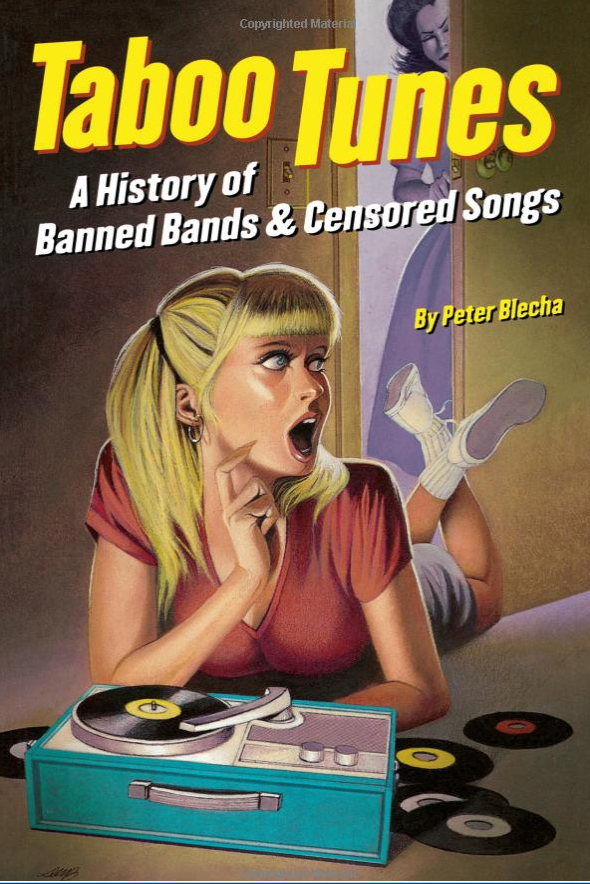
So, what’s the basis in all this religious ferocity to music censorship? In the US, the early years of jazz saw politicians, moralists and preachers jump on the censorship wagons at the risqué wildness brought on by the intoxicating new genre. Later, the Big Bopper, Chuck Berry and Elvis, as well as every other rock ‘n roll act, were thought to be the usurpers of good character and sound living by just about everyone over the age of thirty. (As a side note, there is a site called Tabootunes.com, based on the book Taboo Tunes – A History of Banned Bands and Censored Songs, by Peter Blecha out on Backbeat Books that offers a gallery of posters and information on music censorship throughout history.)
Then there were the good old days of parents sitting hushed and tense around the record player listening to Beatles tunes backwards, trying to catch the outright pronouncements of devil worshiping. Heavy metal bands didn’t do themselves any favors with the occult images splashed across their album covers, but I couldn’t find a single reference to music being evil or considered an atrocity in any of the religious books and sites I searched. Several moderate Muslim sites noted that the prophet Muhammad makes no mention of the banning of music; that only later books, the Hadith and Sunna, both written 200 years after the death of the prophet, have been employed to censor music by current Islamic religious leaders.
Don’t get me wrong, I did find more than one site suggesting that rock music was the work of the Satan and would eventually lead to emotional instability, self-expression, sex and the abandonment of the sanctity of marriage. Even the Seventh-day Adventists came out with a philosophy of music, where they stated that, “Music that does not directly praise and adore God – so called “secular” music – has a legitimate place in the life of the Christian.” Hey, at least there’s one group out there saying it’s okay.
So is music an imperative? I’d like to think so. Music has soothed and saturated our collective history from the time we were able to walk upright. Music is good for us, makes our children smarter and has the ability with a good pair of headsets make the fool down the street with the jackhammer a faint memory.
Without music, at least half of our cultural, religious and historical heritage would be reduced to rotting papers and dull as dirt. Music is what we drown our sorrows in, collectively cheer for our favorite team with, express love and devotion with, rail against injustice with and soothe the savage beast in all of us. It is an imperative. But what of the fringe fanatics calling it an atrocity?
We might tell ourselves it’s just a few kooks out there calling music an evil, but if music is a human imperative are we not called to stand up against such, dare I say, atrocities? Unfortunately, there are more than just one or two fanatics out there willing to step on your music imperative for their own power trip in the name of whatever political position or religion they follow.
The question remains – do we stand by and watch another person’s music die? Is not the end of one person’s music a threat to the whole music imperative?

Author: TJ Nelson
TJ Nelson is a regular CD reviewer and editor at World Music Central. She is also a fiction writer. Check out her latest book, Chasing Athena’s Shadow.
Set in Pineboro, North Carolina, Chasing Athena’s Shadow follows the adventures of Grace, an adult literacy teacher, as she seeks to solve a long forgotten family mystery. Her charmingly dysfunctional family is of little help in her quest. Along with her best friends, an attractive Mexican teacher and an amiable gay chef, Grace must find the one fading memory that holds the key to why Grace’s great-grandmother, Athena, shot her husband on the courthouse steps in 1931.
Traversing the line between the Old South and New South, Grace will have to dig into the past to uncover Athena’s true crime.
